
1.The despots of Vidin
The last ruling house of medieval Bulgaria came from the north-west. In the early 1280s the lord of Vidin was Shishman, an influential boyar of Cuman origin with the title of despot. The Serbian biographer Danilo says that he lived in the city called Bdin and ruled the country around it and many Bulgarian lands, and the Synodikon of Boril remembers him among the tsars, between George Terter I and Theodore Svetoslav. Around 1300 his domain was the largest of the semi-independent principalities into which the tsardom had broken, and to some outsiders it looked like a kingdom in its own right. A Dominican report of 1308 describes Bulgaria as a great empire whose capital is Vidin and whose emperors "are all called Shishman".
The despot leaned on Khan Nogai. In 1292, with Tatar troops, he invaded Serbia as far as the district of Peć, was routed, and fled across the Danube when King Milutin took Vidin. Nogai forced the Serbs to give it back. Shishman swore loyalty to the king and married the daughter of the Serbian grand župan Dragoš, and Milutin married his own daughter Anna-Neda to Shishman's eldest son, Michael. When Nogai's grandson Karakishek fled from Tokhta in 1303, he took refuge in Vidin with three thousand horsemen, and the Tatar troop stayed in Shishman's service. By 1313 a Venetian list names the new lord: "Michael, despot of Bulgaria, lord of Vidin, son-in-law of King Uroš".
2.Michael III Shishman Asen (1323–1330)
When George Terter II died without an heir in the spring of 1323, the boyars of Tarnovo sent for the despot of Vidin. John Kantakouzenos, who records the choice in one sentence, calls Michael a man of Mysian and Cuman descent. Michael himself chose a different name. He reigned as Michael Asen, and the Byzantine chancery addressed him so: "the most high emperor of the Bulgarians and beloved son of my majesty, lord Michael Asen". For the historian of his reign the election meant not a new dynasty but the return of the old one; Michael was the senior descendant of the Asens and for that reason the strongest candidate.
He started by repairing the losses of the interregnum. Byzantium had taken the towns between Mesembria and Sliven, and Smilets's brother Voysil had seized the old family lands in Sredna Gora and styled himself "despot of Mysia"; within about a year Michael had recovered the towns and driven Voysil out. In 1324 he raided deep into Thrace. Andronikos III, short of troops, challenged him to single combat; Michael laughed and answered that only a foolish smith picks up hot iron with his bare hands when he has tongs. He then made a sharper move. He sent away his Serbian wife Anna-Neda and married Theodora Palaiologina, the widow of Theodore Svetoslav and sister of Andronikos III, and so became the brother-in-law of one side in the Byzantine civil war.
For five years he played that war with great energy and little result. He allied with the young Andronikos at Chernomen in May 1327, switched to the old emperor early in 1328, and sent a detachment under Ivan Rusina towards Constantinople, which Gregoras says was meant to make Michael master of a state "from Byzantium to the Ister". The soldiers saw the walls of the city only from the outside. When Andronikos III won the war, Michael claimed part of the empire as his wife's inheritance and was offered vassalage instead. A century after Ivan Asen II, a Bulgarian tsar had again set his sights on Constantinople, and again failed.
3.Velbazhd and the crisis of 1330–1331
He turned west instead. The Serbs had been taking Macedonia for half a century, and in 1329 they took Prosek and attacked Ohrid. Michael secured Andronikos III as an ally, recruited Wallachians, Moldavians and Tatars, and in July 1330 marched by way of Sofia and the Struma valley to Velbazhd (Kyustendil), with perhaps fifteen thousand men. On 28 July, somewhere between Velbazhd and Zemen, the Serbian army of Stefan Uroš III Dečanski and his son Stefan Dušan caught the Bulgarians off their guard and broke them. Michael was wounded and taken to the Serbian camp, where he died of his wounds or was killed on Dušan's orders; he was buried in the church of St George at Staro Nagoričane.
The Serbian king did not march on Tarnovo. He settled for a change of ruler, and the throne went to his own nephew, Michael's son by Anna-Neda, Ivan Stefan. The reign lasted seven or eight months. Andronikos III used the moment to take Anchialos, Mesembria and the towns of the south-east. In the spring of 1331 the protovestiarios Raksin and the logothete Philip led the boyars against the pro-Serbian court; Anna-Neda and her son fled to Serbia, and the nobles elected the despot Ivan Alexander. Kantakouzenos gives him a passive part, but the historian of the reign suspects he organised the coup himself and kept to the shadows.
4.Ivan Alexander: the long reign (1331–1371)
Ivan Alexander was Michael's nephew, the son of the despot Sratsimir of Kran and of Keratsa Petritsa, Michael's sister. He ruled for forty years, the longest reign of the Second Empire. He opened it by taking back what Andronikos III had seized and in 1332 defeated the emperor himself at Rusokastro, near Aytos; he did not press into imperial territory, and the peace that followed provided for the marriage of his eldest son Michael Asen to Andronikos's daughter Maria-Irene, celebrated in 1338–1339. To the west he made peace with Serbia by giving his sister Elena to Stefan Dušan, who would crown himself emperor in 1346 with Elena beside him as empress.
His family was large and his court full of co-rulers. His first wife, Theodora, was the daughter of the Wallachian voivode Basarab; their sons Michael Asen, Ivan Sratsimir and Ivan Asen were crowned or styled young tsars in turn. Later he set her aside and married a converted Jewish woman who took the name Theodora, and the sons of that marriage, Ivan Shishman and a younger Ivan Asen, displaced their elder half-brothers. Ivan Sratsimir, styled young tsar from about 1352, went to Vidin and ruled there in his own right; Ivan Asen IV fell fighting the Ottomans in 1349, Michael Asen IV died in 1355. In the same year a synodal act of the Constantinople patriarchate recorded the betrothal of his daughter Keratsa-Maria to the future Andronikos IV, and called the Bulgarian tsar by his full name, Ioannes Alexander Asen.
The last fifteen years were hard. In 1365 King Louis of Hungary occupied Vidin and carried Ivan Sratsimir off to Croatia; in 1366 the crusade of Amadeus of Savoy took Anchialos and Mesembria; in the north-east the despot Dobrotitsa built a principality of his own. Ivan Alexander recovered Vidin in 1369 at the price of a large payment to the Wallachian voivode. He died on 17 February 1371, a few months before the Ottomans destroyed the Serbian lords at Chernomen on the Maritsa.
5.A court of books and painters
Ivan Alexander's reign was also the high point of medieval Bulgarian culture. The Tarnovo court commissioned the illustrated Bulgarian translation of the chronicle of Constantine Manasses, now in the Vatican, with its added notes on Bulgarian history; the Gospels of 1355–1356, now in the British Library, which show the tsar with Theodora and their children; a psalter and other luxury manuscripts. The rock churches of Ivanovo were painted with his portrait as founder. Monks of the hesychast movement, Theodosius of Tarnovo and his pupils, made the capital a centre of Orthodox learning; from 1375 the patriarch Euthymius reformed the written language and the lives of the saints. The Rila charter of Ivan Shishman (1378) and the Vitosha charter belong to the same world.
6.Why Božilov calls them Asens
The name "Shishmanids" for the house is a convention. Historians took it from the plain fact that Ivan Alexander was a nephew of Michael III Shishman and a grandson of Shishman of Vidin. Božilov argues that the family was a younger branch of the Asens, and that the sources say so repeatedly.
The Bulgarian additions to the Manasses chronicle call Ivan Alexander a shoot "from the root of the most excellent Ivan Asen". A letter of the Egyptian sultan, preserved by Kantakouzenos, addresses the emperor with a borrowed title, "basileus of the Bulgarians, of the Asens", which only makes sense if the Bulgarian royal family was known as the Asens. In his charter for Zograf (1342) Ivan Alexander speaks of the monastery's benefactors as his royal "grandfathers and great-grandfathers"; in the Rila charter of 1378 Ivan Shishman names them: the tsars Asen and Kaliman. A charter for the monastery of St Nicholas at Mesembria calls Ivan Asen the tsar's grandfather and one "Sevina" his grandmother, which Božilov reads as a copyist's garbling of Irene, that is, Irene Komnene. Ivan Alexander was called Asen in patriarchal acts, in the inscription of his founder's portrait at Ivanovo and in other inscriptions. A Byzantine Alexius Asen, a descendant of Ivan Asen III, calls himself a cousin of Ivan Alexander's sister Elena.
The decisive document is a painting. In 1356, newly widowed, the empress Elena had her family tree painted in the church of Matejče in Macedonia. Read with the other sources, it shows her and her brother descending from Ivan Asen II and Irene Komnene through their youngest daughter Anna-Theodora and the sebastokrator Peter, and, through Irene, from Trojan, a son of Ivan Vladislav, one of the last tsars of the First Empire. A scribe of the time could therefore write that Ivan Alexander came "from a royal line on both sides". The same reasoning makes Michael III Shishman and his sister Keratsa grandchildren of Anna-Theodora, and second cousins of George Terter I's daughter Anna, who descended from Anna-Theodora's sister Maria and Mitso. In Božilov's reading the last three generations of Bulgarian tsars were Asens by the female line, and knew it.
7.Two tsardoms and the fall (1371–1422)
After 1371 there were in effect two Bulgarian tsardoms. Ivan Shishman ruled at Tarnovo and Ivan Sratsimir at Vidin; the half-brothers were rivals, and Sratsimir even placed the church of Vidin under the patriarchate of Constantinople. Both became Ottoman vassals. Ivan Shishman sent his sister Keraca-Tamara to the harem of Sultan Murad I, lost Sofia in 1382 and tried in 1388 to break free, which brought an Ottoman army down on Shumen and Nikopol.
On 17 July 1393, after a siege of three months, Tarnovo fell to Bayezid I's army; the patriarch Euthymius was sent into exile. Ivan Shishman held on at Nikopol on the Danube. After the Ottoman victory over the Wallachian voivode Mircea in May 1395 the sultan decided to finish with his unreliable vassal, and the Bulgarian tsar was put to death that year; a Bulgarian chronicle gives 3 June. His elder son Alexander took Islam and served the Ottomans as a governor in Anatolia; the younger, Fruzhin, escaped to Hungary.
Ivan Sratsimir joined the crusade of King Sigismund in 1396, and after the crusaders' defeat at Nicopolis on 25 September Vidin was taken and he was carried off to Bursa, where he ended his life. His son Constantine and his cousin Fruzhin kept the cause alive from exile and in a rising of 1408, and Constantine, the last to call himself tsar of the Bulgarians, died in 1422.
Rulers
Shishman dynasty
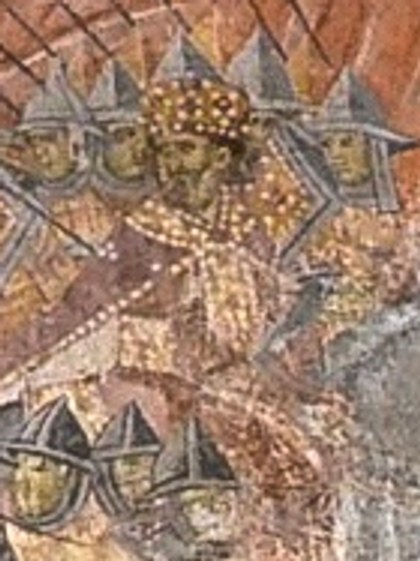
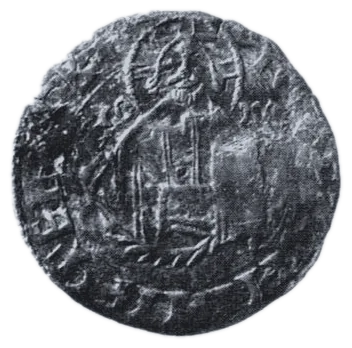
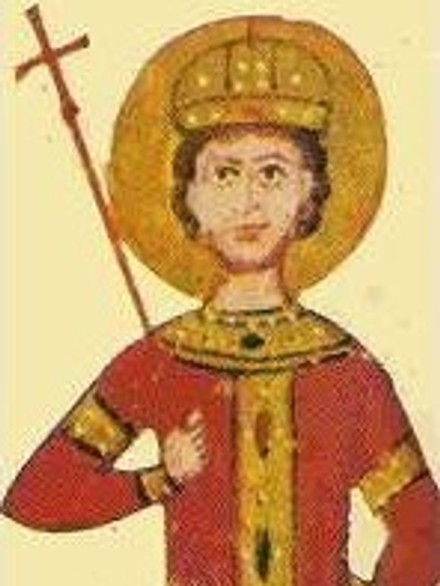
- Michael III Shishman Asen1323–1330Despot of Vidin, son of Shishman of Vidin and an Asen princess; elected tsar in 1323 after the Terter line died out, founding the Shishman dynasty. Killed at the Battle of Velbazhd against the Serbs in 1330.
- Ivan Stefan1330–1331Son of Michael III Shishman and the Serbian princess Anna-Neda. Took the throne after Velbazhd but was deposed in 1331 by the boyar elite in favour of his cousin Ivan Alexander.
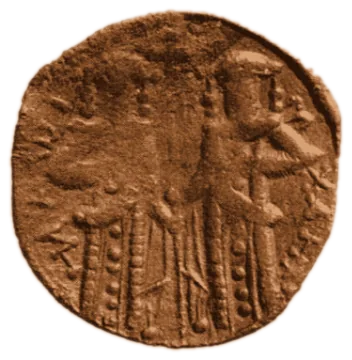
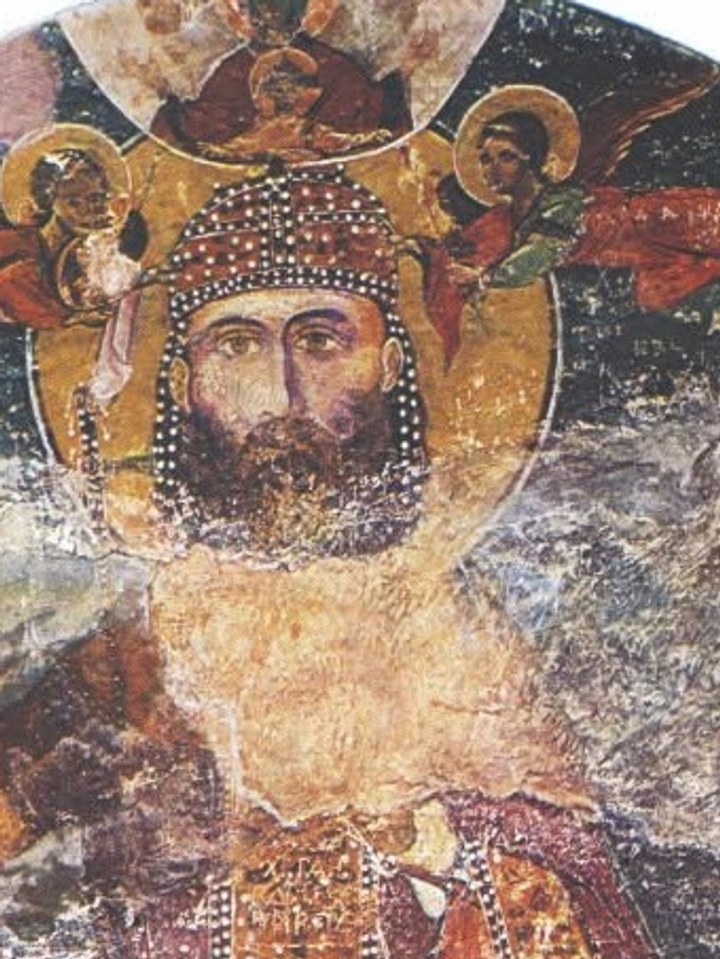
- Ivan Alexander1331–1371Nephew of Michael III Shishman, son of despot Sratsimir and Petritsa (Michael's sister). A long, culturally brilliant reign; but he ultimately divided the realm between his sons, weakening it before the Ottoman threat.
- Michael Asen IV1332–1355Eldest son of Ivan Alexander by his first marriage, proclaimed co-tsar and designated heir. Killed fighting the Ottomans around 1355, predeceasing his father.
- Ivan Asen IV1337–1349Son of Ivan Alexander by Theodora Basarab, raised to co-tsar. Killed in battle against the Ottomans in 1349.
- Ivan Sratsimir1356–1396Son of Ivan Alexander by his first marriage; received the Tsardom of Vidin as a separate appanage around 1356. Ruled Vidin until the Ottoman conquest in 1396; died in captivity.
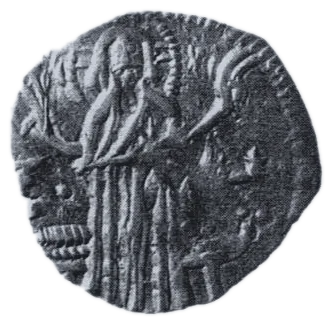
- Ivan Shishman1371–1395Son of Ivan Alexander by his second marriage to Sara-Theodora. Last tsar of the Tarnovo realm; ruled a shrunken, besieged state that fell to the Ottomans in 1393–1395.
Members who did not reign
- Shishman of VidinDespot
- Despot SratsimirDespot
- PetritsaPrincess
- Elena of BulgariaPrincess · ?–1376
- BelaurDespot
- ShishmanPrince
- MichaelDespot
- LouisPrince
- Yoan Komnin AsenDespot · ?–1363
- Michael AsenPrince
- DragushinPrince · ?–1340
- TheodoraPrincess
- Kera TamaraPrincess · ~1340–?
- Keratsa MariaPrincess · ~1348–1402
- Ivan AsenCo-Tsar
- DesislavaPrincess
- VasilisaPrincess
- Alexander Komnin AsenPrince
- ShishmanPrince
- ConstantinePrince · ?–1422
- DorotheaPrincess
- AlexanderPrince
- FruzhinPrince
- KeratsaPrincess
Married into the house
- Anna-NedaTsaritsa
- Theodora PalaiologinaTsaritsa
- Theodora BasarabTsaritsa
- Sarah-TheodoraTsaritsa