
1.Political Narrative
Out of that turmoil emerged Theodore Svetoslav, whose reign opened in 1300 with a violent and decisive reordering of power at Tarnovo. The Tatar prince Caka, who had installed himself in the capital, was seized by Theodore’s supporters, imprisoned, and strangled; the Patriarch Joachim was likewise put to death, accused of treachery. Theodore’s accession was therefore not the product of a smooth succession but of a carefully prepared palace coup, and it marked the return to the throne of a legitimate member of the Terterid line after years in which the crown had been manipulated by boyar factions, foreign protectors, and rival claimants. Once in power, he set about restoring the authority of the center. The first years of his rule were still shadowed by disorder: Byzantine diplomacy tried to exploit anti-Theodore circles in Bulgaria, and in 1301 an imperial expedition even brought the “purple-born” Michael into Bulgarian territory as a claimant to the throne. Yet this intervention achieved nothing lasting. Michael found no real support, wandered outside Tarnovo, and quickly became politically irrelevant, while Theodore steadily gathered the stronger men of the realm around himself and began to reassemble the kingdom.
The internal consolidation was matched by a deliberate recovery of lost ground. Theodore came to terms with his uncle, the despot Eltimir, and brought the Krn region under Tarnovo’s supremacy, strengthening the southern frontier at a moment when Byzantine pressure remained real. In the meantime the struggle around the lower Danube and the Black Sea took a new turn. After the collapse of Caka’s following, the sons of his house, driven by events and by the rise of Toktu, withdrew in 1303 with several thousand horsemen into the Vidin territory of the Shishman family. That arrival greatly increased the military weight of Vidin and tied the western border more closely to the broader Bulgarian political world. Theodore then turned against Byzantium at precisely the moment when the empire was preoccupied elsewhere. In March 1304 he launched a campaign against the neighboring fortresses of the Hemus zone, and the fighting culminated in the Bulgarian victory at Skafida. This success was more than a battlefield triumph: it restored Bulgarian confidence, enabled the recovery of the southern Black Sea line, and signaled that the kingdom was no longer merely defending what remained, but pressing to regain what had been lost.
The victory at Skafida also opened the way to a longer period of stabilization. In the years that followed, Theodore’s position improved enough for him to govern with a freer hand and to reduce the influence of the rival magnates who had dominated the previous generation. The outcome was not immediate peace in every direction, but the kingdom no longer lived under the same pressure of continuous crisis. Relations with Byzantium moved gradually toward a durable settlement, and by 1307 a stable peace had been concluded. That peace did not mean passivity. Rather, it allowed Theodore to rebuild the kingdom’s internal structure and to press the interests of Tarnovo in zones where the borders had been blurred by the upheavals of the 1290s. At the same time, the autonomous and semi-autonomous lords of the country — above all the rulers of Vidin and the men of the Middle Gora — increasingly acted within a political field that was again centered on the Tsar’s authority. The Shishmans of Vidin were especially important in this process. Shishman, whose seat at Vidin was large and wealthy, remained tied to the larger Bulgarian state even when outsiders sometimes treated his domain as if it were almost a separate kingdom. In 1313 he was already described in Venetian records as a ruler of Bulgaria and lord of Vidin, and his son Michael, married to Anna-Neda, daughter of the Serbian king Milutin, inherited a position that linked the western frontier of Bulgaria to Serbian politics while still belonging to the political orbit of Tarnovo.
The last years of Theodore Svetoslav’s reign preserved this restored order, and when he died in 1322 the kingdom did not immediately collapse back into the old anarchy. His son George II Terter succeeded him, but only briefly. George’s reign was too short to establish a durable line; in the opening months of it the Byzantine frontier remained active, and soon after Theodore’s death the southern borderlands again became vulnerable to pressure from Constantinople. Some cities and fortresses in the south and southeast passed over voluntarily to the Byzantines when the balance of power shifted, and the empire regained influence in the strip between Sliven and Mesembria. Even so, the response of the Bulgarian magnates showed how much the kingdom had changed since the days of total disarray. Faced with a rulerless or uncertain future after George II’s death in 1323, they turned not to another adventurer but to the strongest available aristocratic figure of the realm, Michael Shishman of Vidin. His election reunited the separated parts of Bulgaria and brought to the throne a man who combined Asenid descent, western power, and a network of dynastic connections. With him the state entered a new phase, no longer the exhausted kingdom of the late thirteenth century but a more coherent monarchy with a ruler drawn from one of its greatest provincial houses.
Michael III Shishman’s reign, which ran from 1323 to 1330, continued the recovery but also shifted the center of gravity of Bulgarian politics. He married Theodora, sister of Andronikos III, and used that dynastic tie to position himself within the rivalries of the Byzantine civil war. In 1324 he began to press southward, exploiting imperial distraction to recover towns and fortresses in the Black Sea and inland Thrace; soon after, he seized the opportunity to reassert Bulgarian influence in the borderlands around Plovdiv and the surrounding districts. His policy, however, was never static. In 1327 he met Andronikos III at the frontier and concluded a formal alliance, binding Bulgaria and the young emperor together against their common enemies. Yet the rapid course of Byzantine politics immediately complicated this arrangement. When Andronikos III gained the upper hand, Michael altered his position and, for a time, turned toward an alliance with Andronikos II in a renewed bid to influence Constantinople itself. By 1328, however, the Byzantine civil war had effectively ended, and peace between Bulgaria and Byzantium was restored. What remained was the more dangerous problem of Serbia. The kingdom had spent nearly a decade using the breathing space gained under Theodore Svetoslav and then under Michael Shishman to recover its strength, but the new balance in the western Balkans made confrontation almost inevitable. In 1330 war broke out, and at Velbuzhd on 28 July the Bulgarian army was crushed by Stephen Decanski. Michael Shishman was fatally wounded, his wife Theodora was expelled, and the political settlement that followed opened the way to another dynastic change in Tarnovo, closing the brief but important age of partial recovery that Theodore Svetoslav had begun.
2.Wars and Warfare
When Theodore Svetoslav came to power in 1300, Bulgarian warfare was still shaped by the collapse of the previous decade: the country had been weakened by Tatar pressure, divided by powerful local lords, and exposed to Byzantine attempts to manipulate the succession. Theodore’s first military task was not a grand external conquest but the restoration of the state’s fighting capacity. He turned against the seceded and semi-independent regions that had broken away from Tărnovo’s control and sought to bring them back into a working political and military system. In this he acted less like a crusading conqueror than like a ruler reassembling a shattered frontier kingdom. The Byzantines, for their part, tried to exploit the instability by backing pretenders and dissatisfied magnates, sending a candidate of their own with troops at the beginning of 1301, but that effort failed to gain real support. Bulgarian resistance to these designs rested on Theodore’s ability to reassert authority over the kingdom’s internal military resources and to bind together, at least temporarily, the men who had previously acted as local warlords.
Once this internal consolidation was underway, Theodore turned decisively to the Byzantine frontier. The war of 1304 opened with a carefully chosen offensive, launched while Byzantium was absorbed by the struggle against the Seljuk Turks in Anatolia and further distracted by wider turmoil in the Aegean and by the Catalan presence. Bulgarian troops struck the forts and towns south of the Hemus, with the Black Sea littoral as the main theatre of operations. The crucial encounter came near the river Skafida, where the Byzantine army under Michael IX Palaiologos, aided by Vojsil and other local forces, suffered a severe defeat. The battle was not merely a field victory: it broke the immediate Byzantine attempt to restore control over the coast and gave Theodore the initiative. After Skafida the Bulgarians advanced toward Adrianople and ravaged the surrounding district, showing that the kingdom had moved from defensive endurance to offensive campaigning. The action around the southern Black Sea did more than punish the enemy; it signaled that the Bulgarian state again possessed the operational reach to strike beyond its immediate core.
The campaigns of 1304–1305 reveal the character of Theodore’s warfare. He did not rely on a single set-piece advance alone, but combined battlefield action with rapid territorial recovery and pressure on exposed borderlands. The seizure of coastal strongpoints appears to have followed the defeat at Skafida, and the recovery of Mesembria and Anchialos restored Bulgaria’s hold on the Black Sea line. Theodore also pressed inland, striking the region around Jambol and taking back territory that had recently fallen under Byzantine influence. When Eltimir, the semi-independent lord whose appanage lay in the same zone, shifted sides, Theodore responded by overrunning both the reclaimed district and Eltimir’s original holding, demonstrating that his military policy aimed at restoring coherence along the southeastern marches. The use of local intermediaries and captives also mattered: the former patriarch John XII was kept as a useful figure in negotiations, showing that warfare and diplomacy were already tightly intertwined. Theodore’s conquests were therefore not isolated raids but a systematic attempt to redraw the border from the Tundzha to the sea and to make the old frontier of fragmentation yield to a more defensible line.
Byzantine resistance after Skafida was serious, but it was constrained by the empire’s wider military burdens. Michael IX had to face pressure in more than one direction, with the emperor forced to juggle the Bulgarian front, the struggle in Anatolia, and the arrival of the Catalans. The dispatch of Roger de Flor and his men across to the Balkan side showed how grave the situation had become for Constantinople. Yet the prolonged conflict also exhausted both powers, and by 1307 a durable peace was concluded that recognized Theodore’s gains on the Black Sea coast and the hinterland westward to the Tundzha. The treaty did not end the strategic rivalry, but it marked a major turning point: Bulgaria had not only retained what it had recovered in war, but had forced Byzantium to accept the new territorial reality. The marriage that followed, linking Theodore to the imperial family, expressed the same military settlement in dynastic form. War had established the border; diplomacy now sealed it. For the next years, the kingdom could fight less for survival than from a position of partial recovery.
That recovery did not mean the disappearance of warfare, but it did change its scale and setting. In the 1320s, while Byzantine civil war destabilized the southern frontier, Theodore’s successor George II Terter was able to exploit the moment and recover Plovdiv and a number of forts in northern Thrace. The Bulgarian army that entered the region in 1322 included both cavalry and heavily armed infantry, and the city’s garrison was sufficiently strong to require a mixed force under a competent commander. The Bulgarians then pushed on toward the surroundings of Adrianople, laying waste to parts of eastern Thrace, though a night attack on their withdrawing troops later reversed that success. After George II’s death, the balance again shifted, and several southern towns voluntarily submitted to the Byzantines, showing how closely local warfare remained tied to the fortunes of the field armies. Even so, the long period of conflict with Byzantium had established a durable military rhythm: strikes at frontier towns, rapid occupation of exposed districts, and constant competition for the allegiance of local elites.
The final great clash of this era came not against Byzantium but against Serbia in 1330, when the struggle for Balkan primacy exposed the limits of the recovery Theodore had achieved. The Bulgarian army was destroyed at Velbăžd, and Michael III Shishman was fatally wounded. Byzantium took advantage of the aftermath to occupy some frontier fortresses and seize Mesembria and Anchialos, but those gains were temporary and did not alter the broader military balance for long. The battle of Velbăžd thus closed the cycle that Theodore Svetoslav had opened three decades earlier: Bulgaria had shaken off Tatar domination, beaten back Byzantine pressure, and restored its coastal line, yet the kingdom still depended on the personal energy of its rulers and on the shifting alignment of its neighbors. In warfare, as in politics, Theodore’s legacy was not one of unbroken expansion, but of a hard-won and fragile stabilization that made later campaigns possible.
3.State and Institutions
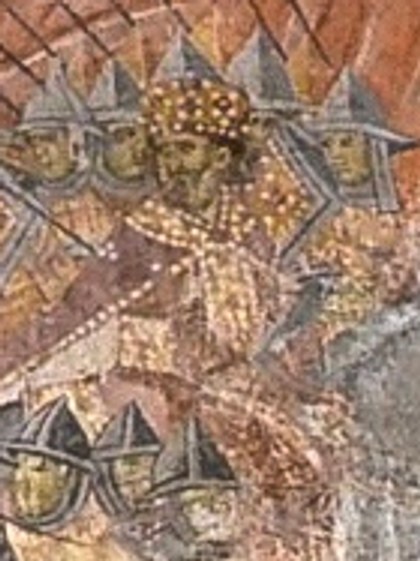
The machinery of power under Theodore Svetoslav was built first of all on restoration: after years of instability, foreign tutelage, and repeated dynastic collapses, the crown again sought to speak in its own name. Theodore’s return from captivity among the Tatars gave him legitimacy as the lawful heir, but not immediate authority. At the start of his reign he had to overcome the suspicion that he was, in effect, a Tatar-backed pretender and prove that the throne in Tărnovo could again command obedience on its own terms. That meant re-centering the state on the monarchy, drawing the major magnates back into a recognisable hierarchy, and reasserting the sovereign’s right to decide war, peace, rank, and loyalty. The years after 1300 were therefore not simply a military recovery; they were the reconstitution of a political order that had to function once more without the constant pressure of the Horde and without the fragmentation that had marked the preceding crisis.
One of the clearest signs of this recovery was the reactivation of the court hierarchy. Theodore Svetoslav did not rule through a bare personal household, but through a court that once again displayed the full spectrum of high dignities: despots, great sevastokrators, domestics, protovestiarii, and the rest of the royal order. The very act of naming and distributing such offices mattered, because title was one of the principal tools by which the king translated power into hierarchy. In Bulgaria these dignities did not yet operate with the rigid dynastic logic familiar from Constantinople, where certain ranks were more closely tied to imperial sons and a carefully managed family order. In Tărnovo they remained more flexible, more political, and more susceptible to immediate needs. They expressed proximity to the throne, but they also helped the throne bind great men to itself. The overlap between court and leading capital families was therefore more than ceremonial: it was the social form through which monarchy could recover its working elite.
At the same time, the kingdom was far from uniformly administered from the capital. It remained a landscape of powerful regional centers, and Theodore’s achievement lay in bringing at least some of them back into a relation of recognized suzerainty. His accommodation with his uncle Aldemir and the subordination of the Krn principality to Tărnovo show how the crown worked with local rulers rather than simply abolishing them. In the north-west, Vidin continued to function as the largest autonomous domain in Bulgaria, ruled by the Shishman family, yet politically tied to the capital and increasingly drawn back toward the royal center. Such lordships were not anomalies outside the state; they were part of the state’s own structure. The king’s power extended through them by negotiation, kinship, marriage alliances, and the granting or recognition of titles, not through a fully developed provincial bureaucracy. The monarchy was strongest where it could turn local dynasties into obedient partners without destroying their usefulness.
The boyar class sat at the heart of this system, but it was a divided and unstable stratum. Some magnates resisted Theodore outright and treated him as an intruder; others sought advantage by attaching themselves to the new balance of power. In practice, a boyar could be regional ruler, court dignitary, military supporter, or all three at once. The crown therefore had to govern aristocratic society as much as territory. Its methods were dynastic and judicial as well as military. The exchange of prisoners with Byzantium after the fighting in 1302, the submission of captured archons to Tărnovo, and the return of the former king George I Terter from exile all show a royal authority that still spoke the language of personal sovereignty: the king could pardon, exchange, imprison, restore, and reassign. Even punitive acts such as blinding an enemy commander belonged to this political world, because justice was inseparable from the enforcement of hierarchy. Royal law was less a written code visible to us than a practice of deciding who belonged within the order of obedience and who stood outside it.
Taxation and revenue, too, were shaped by this restored but still layered state. Theodore’s recovery of Zagore, the southern Black Sea towns, and the approaches to the great routes toward Constantinople mattered not only strategically but economically. These were the zones where customs, market dues, and the commercial movement of grain, salt, wine, and imported goods could again feed the royal center. The peace achieved after 1307 gave the state a more stable fiscal horizon, because warfare, tribute, and external interference no longer consumed the whole political field. Yet the kingdom did not become a centralized taxing machine in a modern sense. Its revenues depended on the obedience of towns, the cooperation of local lords, the control of passes and ports, and the king’s ability to keep strategic regions from drifting into the hands of rivals. Theodore Svetoslav’s reign therefore marks less the creation of a new administrative order than the reassembly of an older one: a monarchy with a restored court, a renewed hierarchy of office, a negotiating relationship with magnates, and a stronger grasp on the territories and revenues that made Bulgarian kingship possible.
4.Church and Letters
In Theodore Svetoslav’s reign, the church stood not simply as a devotional institution but as one of the principal bearers of political continuity after the years of crisis. The end of Tatar domination and the gradual stabilization of royal power made room for a more orderly ecclesiastical life, in which legitimacy was articulated through sacred language as much as through arms. The memory of rulers was preserved within the church’s own ritual framework, and that framework could place a contested figure such as Shishman in an ordered sequence of lawful rulers, remembered with the title of king and commended to eternal memory between George I Terter and Theodore Svetoslav. In such a world the patriarchate was more than an ecclesiastical office: it was a guardian of dynastic memory, a witness to continuity, and a necessary partner of the throne in the task of making recovery appear not accidental but rightful.
The capital at Tărnovo remained the natural centre of this spiritual and literary order. It was there that political restoration, royal memory, and church hierarchy met most visibly, and there that the authority of the ruler was most effectively framed in Orthodox terms. The years around 1300 were marked by dynastic uncertainty and the spectacle of rival claimants, some of them resident far away in Byzantine lands, but the church’s language of commemoration and titulature helped distinguish legitimate sovereignty from mere pretension. In that respect the ecclesiastical world offered a counterweight to the instability of politics. Even when diplomacy and warfare occupied the foreground, the church preserved the deeper grammar by which a Bulgarian ruler could be understood: as an anointed Orthodox sovereign whose power belonged inside a sacred historical order rather than above it.
The monastic world, too, benefited from the restoration of a measure of peace. Theodore Svetoslav’s reign did not produce in the surviving narrative an elaborate account of doctrinal conflict, and that silence itself is suggestive: the age was less one of spectacular heretical agitation than of the consolidation of inherited Orthodox structures after a time of fracture. Monasteries remained among the chief repositories of memory, prayer, and legitimacy, and the rulers’ relationship to them was part of the broader process of recovery. The spiritual landscape of the kingdom was therefore one of continuity rather than rupture: churches and monasteries did not stand apart from politics, but helped absorb political change into forms of remembrance, intercession, and lawful order. In this sense, orthodoxy was asserted less by polemic than by repetition — in titles, commemorations, prayers, and the careful placement of rulers within the sacred sequence of the past.
Written culture reflected the same stabilizing impulse. The age belonged to a Balkan world in which diplomacy, tribute, hostages, marriages, and exchanges of prisoners were all accompanied by documents, reports, and formulae, and where the written word was indispensable to both rule and negotiation. Theodore Svetoslav’s reign unfolded amid intensive dealings with Byzantium and with neighbouring powers, and those dealings presupposed a developed chancery culture capable of translating political reality into formal record. The church was part of that written environment, for the remembrance of rulers and the regulation of ecclesiastical life depended on texts that could preserve names, rank, and obligation. The result was not a literary blossoming in the sense of a single dramatic school, but a durable culture of writing in which royal authority, sacred memory, and legal order were inseparable.
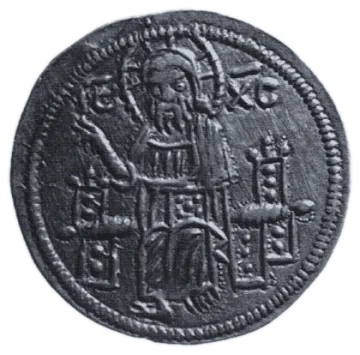
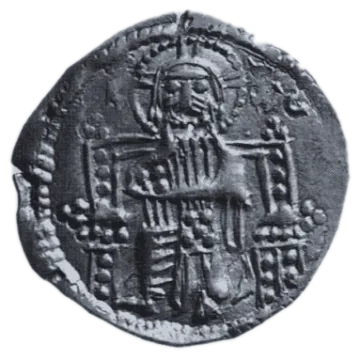
The visual arts likewise expressed this fusion of the sacred and the political. The ruler’s public image was not confined to ceremony; it appeared in coinage and in other forms of court representation, where kingship was made visible through signs that linked authority with Christian symbolism. Under Theodore Svetoslav, as under the rulers before and after him, the image of power could be mounted, armoured, and sacral at once, while the reverse or accompanying sign reinforced the same message through the cross and the language of legitimacy. Such art was not decorative only: it taught viewers how to read sovereignty. In the years of partial recovery, therefore, church, letters, and image all worked toward the same end — to show that Bulgaria had emerged from disorder into a realm once again held together by Orthodox memory, written authority, and the visible signs of lawful kingship.
5.Economy and Charters
Theodore Svetoslav’s reign opened with a hard-earned restoration of normal life after years in which the state had been battered by Tatar pressure and internal instability. The recovery was not spectacular in the sense of dramatic institutional reform; it was more fundamental than that. The kingdom was given time. After the victory at Skafida and the settlement with Byzantium in 1307, the sources present Theodore’s years as markedly peaceful, with only one war against Byzantium and a minor clash with Genoese interests standing out from an otherwise calmer political horizon. That breathing space mattered most in the countryside, where agriculture depended on continuity: fields had to be sown, harvests brought in, routes kept open, and the channels between village, town, and court made secure again. Peace did not eliminate tension, but it allowed the productive life of the kingdom to resume after a generation in which war, migration, and tribute had repeatedly disrupted it.
The most vivid image of economic strength in this period comes from the northwestern lands, especially the region around Vidin. A Dominican observer in 1308 described Bulgaria as a land of great size and richness, with a capital at Vidin, many navigable rivers, forests and oak woods, and an abundance of bread, meat, fish, silver, gold, wax, silk, and many other goods; he also emphasized the presence of silver mines and the gold-bearing sands of the rivers. Even allowing for the exaggeration of a foreign eye, the testimony points to a mixed and diversified economy. The land supported grain production and stockbreeding, while the rivers and wooded uplands yielded fish, game, timber, and pasture, and the mining districts added metallic wealth to the agrarian base. This was not an economy of a single crop or one export commodity, but of overlapping resources tied together by river transport, local markets, and regional exchange.
The towns benefited directly from this recovery. Urban life in Theodore Svetoslav’s Bulgaria was sustained by a combination of trade, craft production, and the processing of the surrounding countryside’s surplus. The coastal cities and the southern Black Sea corridor were of special importance because of the expanding commercial links with Genoa and Venice, which made these places valuable not only strategically but also economically. The towns were the points where agricultural produce, imported goods, and artisanal products met: markets, shops, and workshops drew together merchants, craftsmen, peasants who sold their surplus, and in many cases men who also worked adjacent lands. The economic profile of the medieval Bulgarian city was therefore mixed rather than narrowly commercial. Trade mattered, but so did production; the town was both market and workshop, and often also a local center of land use, administration, and ecclesiastical life.
Coinage reflects this same recovery of authority. Theodore Svetoslav’s monetary issues belong to a political world in which the ruler’s image again stood for order, sovereignty, and legitimate control. The mounted royal figure with the cross, rather than the symbols of dependence that had appeared under earlier subordination, expressed a restored monarchy that no longer advertised foreign overlordship. In a kingdom where stability had recently been precarious, the appearance and circulation of coin were more than an economic convenience. They signaled that the king could assert himself in the realm of exchange as well as war, and that his authority reached into the everyday transactions of towns, markets, and estates. The very fact that contemporary and near-contemporary testimony preserves notice of Theodore’s personal wealth and prestige, gained even before his accession through his marriage into a wealthy Venetian merchant milieu, only reinforces the point that political recovery and economic resources were closely intertwined.
The royal charters of the period reveal how the crown managed this economic world. They show a monarchy that ruled not simply by command, but through grants, confirmations, exemptions, and carefully phrased rights over land and revenue. Estates could be confirmed as secure and inalienable; monastic holdings were protected; and villages, fields, pastures, and other sources of income were attached to specific holders under royal authority. The same documents make clear that the fiscal landscape was made up of multiple dues and obligations—payments tied to grain, grazing, construction, tolls, and other forms of production or movement—and that the king could protect selected holders from interference in these revenues. Such charters do more than record generosity. They show a state in which landholding, taxation, and privilege were tightly linked, and in which the crown used exemptions to stabilize loyalty, reward service, and anchor authority in places of economic value. In Theodore Svetoslav’s Bulgaria, the charter was therefore both a legal instrument and an economic map: it defined who held what, who could collect what, and which incomes the king was willing to leave untouched in the interest of peace and recovery.
6.Foreign Relations
Theodore Svetoslav came to power in 1300 with the external world already reshaped by the collapse of Tatar interference and by the long pressure of the great neighbours on Bulgaria’s frontiers. His accession followed the elimination of Chaka and the settling of the question of the Golden Horde’s hold over Tărnovo; the new ruler himself had been formed by that world, having spent years as a hostage at Nogai’s court and returned to Bulgaria through a marriage alliance that had given him both wealth and standing. The steppe danger did not vanish at once, but it was transformed. When the followers of Chaka’s son Kara Kishek sought refuge in 1303 in the Vidin lordship of Shishman, bringing with them a substantial mounted force, they no longer appeared as masters of the Bulgarian political scene, but as a military resource available to a regional ruler. That influx strengthened Vidin and made it more capable of resisting Serbian and Hungarian pressure, while also underlining how far the balance had shifted away from direct Tatar domination.
From the beginning of Theodore Svetoslav’s reign, the central axis of Bulgarian foreign policy became Byzantium. The emperor Andronikos II tried to exploit anti-Tudor sentiment among the Bulgarian nobility by sending the purple-born Michael at the head of troops in 1301, but the venture found little support and collapsed in embarrassment. Theodore’s own counter-moves were more effective. He reached an understanding with his uncle Aldimir, drew the Krăn area under Tărnovo’s supremacy, and in 1302 strengthened the southern frontier further by exchanging prisoners with the exiled former tsar George I Terter. The decisive turn came in 1304, when Bulgaria, taking advantage of Byzantine preoccupation in Anatolia and the wider disorder in the empire, went over to the offensive. The campaign culminated in the victory at Skafida, a turning point that restored confidence after the long years of retreat and allowed Theodore to impose himself along the line of the Hemus and the southern Black Sea region.
The wars of 1304–1307 were not merely border clashes; they reshaped the geography of power in eastern Bulgaria and the coast. Theodore’s troops struck the strongholds nearest the Balkan range and pushed along the Black Sea littoral, while the Byzantines, weakened by their own troubles and by the rise of the Catalans, were unable to sustain their earlier gains. Theodore also recovered the territory around Yambol and attacked the appanage of Eltimir when that ruler shifted away from him. The peace concluded in 1307 was therefore no ordinary truce. Byzantium recognized Bulgaria’s reconquests on the Black Sea, and the boundary was pushed back from the Tundzha to the coast itself, restoring the hinterland west of the river to Bulgarian control. The settlement was sealed by marriage diplomacy: Theodore married Theodora, granddaughter of Andronikos II, binding the two dynasties even as they had only recently been at war. The regained ports also reopened and enlarged Bulgaria’s foreign trade, especially with Venetian and Genoese shipping, so that diplomacy and commerce began to reinforce one another.
To the west and north-west the picture was more fragmented, but no less important. The rise of Serbia continued to constrain Bulgarian policy, especially through the autonomous lordship of Vidin, where Shishman occupied a place of unusual prominence. His position was strengthened not only by the Tatar horsemen who had followed Kara Kishek into his lands, but also by his dynastic ties to the Serbian crown. He married the daughter of the great župan Dragosh, and his son Michael was in turn married by King Milutin to Anna-Neda, Milutin’s own daughter, in an attempt to secure Serbian influence over Vidin. Yet the arrangement did not detach the Danubian lordship from the Bulgarian political sphere: it remained a part of the wider Bulgarian state, even when it seemed to some contemporaries to behave almost as an independent kingdom. The same could be said of Hungary, whose expansion remained a constant northern concern, though in these years Bulgaria’s answer to that pressure came less through open war than through the strengthening of frontier magnates and the use of mobile steppe cavalry in their service.
The broader Mediterranean and ecclesiastical world mattered as well, though more indirectly. The papacy continued to pursue its active policy of Catholic expansion and union in the East, while the Italian maritime republics increasingly linked commercial interests with political influence along the Black Sea. For Bulgaria this was not a matter of conversion or formal submission, but of opportunity. The recovery of the coastal towns brought the kingdom into closer contact with Venetian and Genoese trade, and that trade in turn gave the ruler an additional diplomatic lever in dealing with Byzantium. The strengthening of Bulgarian power therefore took place in a milieu where spiritual diplomacy, commercial expansion, and dynastic marriage all overlapped. Bulgaria was no longer isolated on the defensive; it was a state whose rulers could be courted, watched, or enlisted by powers much larger than themselves.
After Theodore Svetoslav’s death in 1322, and after the brief reign of George II Terter, the same external pressures returned in a new form. Byzantium seized the opportunity provided by the interregnum and recovered part of the southern coastal belt by voluntary submission, while Philippopolis came under attack. The boyars then turned to Michael Shishman, the powerful Vidin ruler and son-in-law of Milutin, whose election in 1323 restored the line of the Asenids in the eyes of many contemporaries. Michael’s own diplomacy was more flexible and more dangerous than Theodore’s had been. He married Theodora, sister of Andronikos III, and for much of the Byzantine civil war supported the younger claimant, even meeting him on the frontier in May 1327 and concluding an alliance against both Andronikos II and Serbia. But the rapid shifting of the civil war soon drew him into a different course: in early 1328 he turned against his former partner and sought help from Andronikos II for an attack on Constantinople, only for the tide to reverse again when Andronikos III prevailed. Peace between Bulgaria and Byzantium was then restored and held until 1330, when Michael’s war against Serbia ended in catastrophe at Velbuzhd. The decade closed as it had begun in a field of unstable alliances, but by then Bulgaria had already moved far from the helplessness of the years before Theodore’s accession.
1.Political Story
Theodore Svetoslav came to power in 1300 during a time of chaos. He quickly took control in Tarnovo by force. The Tatar prince Chaka, who had taken over the capital, was captured by Theodore’s supporters, locked up, and strangled. The Patriarch Joachim was also executed, accused of betrayal. Theodore did not become ruler through a peaceful succession but by a planned palace coup. His rise marked the return of a rightful member of the Terterid family to the throne after years of boyar factions, foreign powers, and rival claimants controlling the crown. Once in charge, Theodore worked to restore the central authority. The early years of his rule were still unstable. The Byzantine Empire tried to use anti-Theodore groups in Bulgaria, and in 1301, they sent Michael, a royal claimant, into Bulgarian lands. However, this attempt failed. Michael found little support, wandered outside Tarnovo, and soon lost political importance. Meanwhile, Theodore gathered the kingdom’s strongest men and began rebuilding the state.
Theodore’s internal consolidation went hand in hand with reclaiming lost lands. He made peace with his uncle, the despot Eltimir, and brought the Krn region under Tarnovo’s control, strengthening the southern border at a time when Byzantine pressure was still a threat. Meanwhile, the struggle around the lower Danube and the Black Sea changed. After Chaka’s followers collapsed, his sons, pushed by events and the rise of Toktu, retreated in 1303 with thousands of horsemen to the Vidin region, ruled by the Shishman family. Their arrival increased Vidin’s military strength and tied the western border more closely to Bulgaria’s political world. Theodore then attacked Byzantium just as the empire was distracted by other problems. In March 1304, he launched a campaign against fortresses near the Hemus Mountains, leading to a Bulgarian victory at Skafida. This win was more than a battle success: it boosted Bulgarian confidence, allowed them to recover the southern Black Sea coast, and showed that the kingdom was no longer just defending but actively trying to regain lost territory.
The victory at Skafida led to a longer period of stability. Over the following years, Theodore’s position grew stronger, allowing him to rule more freely and reduce the power of rival nobles who had dominated before. This did not bring immediate peace everywhere, but the kingdom no longer faced constant crisis. Relations with Byzantium slowly moved toward a lasting peace, which was finalized by 1307. This peace did not mean inactivity. Instead, it let Theodore rebuild the kingdom’s internal structure and push Tarnovo’s interests in border areas unsettled by the 1290s’ turmoil. At the same time, local and semi-independent rulers—especially those in Vidin and the Middle Gora region—began to act more within the political sphere centered on the Tsar’s authority. The Shishman family of Vidin was particularly important. Though Vidin was large and wealthy, it stayed connected to Bulgaria even when outsiders treated it almost like a separate kingdom. By 1313, Venetian records called Shishman a ruler of Bulgaria and lord of Vidin. His son Michael, married to Anna-Neda, daughter of Serbian King Milutin, inherited a position linking Bulgaria’s western border with Serbian politics while still belonging to Tarnovo’s political orbit.
The last years of Theodore Svetoslav’s reign kept this restored order. When he died in 1322, the kingdom did not immediately fall back into chaos. His son George II Terter took over but ruled only briefly. George’s short reign was too brief to establish a lasting dynasty. Early in his rule, the Byzantine border remained active, and after Theodore’s death, the southern borderlands became vulnerable again to Byzantine pressure. Some southern and southeastern cities and fortresses voluntarily switched to Byzantine control when the balance of power shifted, and the empire regained influence between Sliven and Mesembria. Still, the reaction of the Bulgarian nobles showed how much the kingdom had changed since earlier times of disorder. When George II died in 1323, leaving no clear ruler, the nobles chose Michael Shishman of Vidin, the strongest aristocrat available. His election reunited Bulgaria’s divided parts and brought to the throne a man with Asenid ancestry, western power, and many family connections. Under Michael Shishman, Bulgaria entered a new phase—not the exhausted kingdom of the late 1200s but a more united monarchy led by a ruler from one of its most powerful provincial families.
Michael III Shishman ruled from 1323 to 1330, continuing the kingdom’s recovery but also shifting the focus of Bulgarian politics. He married Theodora, sister of the Byzantine emperor Andronikos III, using this family tie to involve himself in the Byzantine civil war. In 1324, he pushed southward, taking advantage of the empire’s distractions to reclaim towns and fortresses along the Black Sea and in inland Thrace. Soon after, he reasserted Bulgarian influence around Plovdiv and nearby areas. His policies changed with the political winds. In 1327, he met Andronikos III at the border and formed an alliance against their common enemies. But as Byzantine politics shifted, Michael switched sides, briefly allying with Andronikos II to try to influence Constantinople. By 1328, the civil war ended, and peace between Bulgaria and Byzantium was restored. However, Serbia became a more serious problem. Bulgaria had spent nearly a decade rebuilding under Theodore Svetoslav and Michael Shishman, but the new balance in the western Balkans made conflict almost unavoidable. In 1330, war broke out, and on July 28 at Velbuzhd, the Bulgarian army was defeated by Serbian King Stephen Decanski. Michael Shishman was fatally wounded, his wife Theodora was expelled, and the political settlement that followed led to another change in Bulgaria’s ruling dynasty, ending the brief but important period of recovery that Theodore Svetoslav had started.
2.Wars and Fighting
When Theodore Svetoslav became ruler in 1300, Bulgaria’s military was still weakened by the previous decade’s collapse. The country had suffered from Tatar pressure, was divided by powerful local lords, and was vulnerable to Byzantine interference in its leadership. Theodore’s first military goal was not to conquer new lands but to restore the state’s ability to fight. He focused on bringing back under Tarnovo’s control the regions that had broken away and reuniting the kingdom’s political and military forces. He acted less like a conquering hero and more like a leader rebuilding a broken frontier kingdom. The Byzantines tried to take advantage of Bulgaria’s instability by supporting rival claimants and discontented nobles, sending a candidate with troops in early 1301. But this effort failed because Theodore reasserted control over the kingdom’s military resources and united the local warlords, at least temporarily.
Once he had strengthened internal control, Theodore turned his attention to the Byzantine border. In 1304, he launched a well-timed attack while Byzantium was busy fighting the Seljuk Turks in Anatolia and dealing with troubles in the Aegean Sea and the Catalan presence. Bulgarian forces struck forts and towns south of the Hemus Mountains, focusing on the Black Sea coast. The key battle took place near the Skafida River, where the Byzantine army, led by Michael IX Palaiologos and supported by local forces, suffered a heavy defeat. This victory was more than just a battlefield win; it ended the Byzantine attempt to regain control of the coast and gave Theodore the upper hand. After Skafida, the Bulgarians advanced toward Adrianople, devastating the surrounding lands. This showed that Bulgaria had moved from defending itself to launching offensive campaigns. The fighting along the southern Black Sea coast was not just punishment for the enemy; it showed that Bulgaria had regained the ability to strike beyond its core territory.
The campaigns of 1304–1305 show Theodore’s style of warfare. He did not rely on a single big attack but combined battles with quick territorial recovery and pressure on vulnerable border areas. After the victory at Skafida, Bulgarian forces captured coastal strongholds, regaining Mesembria and Anchialos and restoring control over the Black Sea coast. Theodore also pushed inland, retaking areas around Jambol that had recently fallen under Byzantine influence. When Eltimir, a semi-independent lord in the same region, switched sides, Theodore responded by conquering both the reclaimed district and Eltimir’s lands. This showed that his military goal was to restore unity along the southeastern border. Theodore also used local figures and prisoners in diplomacy; for example, the former patriarch John XII was kept as a useful negotiator, showing that warfare and diplomacy were closely linked. Theodore’s conquests were not random raids but a planned effort to redraw the border from the Tundzha River to the sea, replacing a fragmented frontier with a more defensible line.
Byzantine resistance after Skafida was serious but limited by the empire’s other military problems. Michael IX had to deal with threats on multiple fronts, including the Bulgarian border, the fight in Anatolia, and the arrival of the Catalans. The empire sent Roger de Flor and his troops to the Balkans, showing how serious the situation was for Constantinople. Still, the long conflict exhausted both sides, and by 1307 they agreed on a lasting peace that recognized Theodore’s gains on the Black Sea coast and the area west to the Tundzha River. This treaty did not end the rivalry but marked a turning point: Bulgaria kept the lands it had won and forced Byzantium to accept the new borders. The marriage that followed, linking Theodore to the Byzantine imperial family, confirmed this military settlement through family ties. War had set the border; diplomacy made it official. For the next years, Bulgaria could fight less for survival and more from a position of strength.
This recovery did not mean the end of war but changed its scale and focus. In the 1320s, while Byzantine civil war unsettled the southern border, Theodore’s successor George II Terter took advantage of the situation to regain Plovdiv and several forts in northern Thrace. The Bulgarian army that entered the region in 1322 included both cavalry and heavily armed infantry, and the city’s defenders were strong enough to require a mixed force led by a skilled commander. The Bulgarians then moved toward Adrianople, damaging parts of eastern Thrace, although a surprise night attack later reversed some of their gains. After George II’s death, the balance shifted again, and several southern towns voluntarily submitted to Byzantium, showing how local warfare depended on the movements of field armies. Still, the long conflict with Byzantium had created a pattern of warfare: attacks on frontier towns, quick occupation of vulnerable areas, and constant competition for the loyalty of local leaders.
The last major battle of this period was not against Byzantium but Serbia in 1330. The fight for dominance in the Balkans showed the limits of the recovery Theodore had started. The Bulgarian army was destroyed at Velbuzhd, and Michael III Shishman was fatally wounded. Byzantium took advantage of the situation to occupy some border fortresses and retake Mesembria and Anchialos, but these gains were temporary and did not change the overall military balance for long. The battle of Velbuzhd closed the cycle that Theodore Svetoslav had begun thirty years earlier: Bulgaria had freed itself from Tatar control, pushed back Byzantine pressure, and restored its coastal line. Yet the kingdom still depended on the energy of its rulers and shifting alliances with neighbors. In both war and politics, Theodore’s legacy was not continuous expansion but a hard-won, fragile stability that made future campaigns possible.
3.Government and Institutions
The power structure under Theodore Svetoslav was built mainly on restoration. After years of instability, foreign control, and repeated dynastic failures, the crown aimed to rule on its own terms again. Theodore’s return from captivity among the Tatars gave him the right to rule but not immediate authority. At the start, many suspected he was a Tatar-backed pretender. He had to prove that the throne in Tarnovo could command loyalty independently. This meant refocusing the state on the monarchy, bringing the major nobles back into a clear hierarchy, and reasserting the king’s right to decide on war, peace, ranks, and loyalty. The years after 1300 were not just about military recovery; they were about rebuilding a political order that could function without constant pressure from the Horde and without the fragmentation of the previous crisis.
One clear sign of this recovery was the revival of the court system. Theodore Svetoslav did not rule through a small personal household but through a court with a full range of high-ranking officials: despots, sevastokrators (senior nobles), domestics (military commanders), protovestiarii (treasurers), and others. Naming and assigning these offices mattered because titles were a key way the king turned power into a hierarchy. In Bulgaria, these ranks were more flexible and political than in Constantinople, where certain titles were tied closely to imperial family members. In Tarnovo, titles showed closeness to the throne but also helped the king keep powerful men loyal. The overlap between court officials and leading families was more than ceremonial; it was how the monarchy rebuilt its working elite.
At the same time, the kingdom was not ruled entirely from the capital. Powerful regional centers remained, and Theodore’s success was in bringing some of them back under recognized royal control. His agreement with his uncle Aldemir and the submission of the Krn principality to Tarnovo show how the crown worked with local rulers instead of simply abolishing them. In the northwest, Vidin remained the largest autonomous domain, ruled by the Shishman family but politically tied to the capital and increasingly connected to the royal center. These lordships were not outside the state; they were part of its structure. The king’s power reached through them by negotiation, family ties, marriage alliances, and granting or recognizing titles, not through a full provincial bureaucracy. The monarchy was strongest when it could make local dynasties loyal partners without destroying their usefulness.
The boyar class—the noble landowners—was central to this system but divided and unstable. Some nobles resisted Theodore and saw him as an outsider; others tried to gain by supporting the new order. A boyar could be a regional ruler, court official, military supporter, or all three. The crown had to govern the aristocracy as much as the land. It used family ties and legal actions as well as military force. The exchange of prisoners with Byzantium in 1302, the submission of captured local leaders to Tarnovo, and the return of former king George I Terter from exile all show a royal authority that still worked through personal power: the king could pardon, exchange, imprison, restore, and reassign. Even harsh punishments like blinding an enemy commander were part of this political world because justice was tied to enforcing hierarchy. Royal law was less a written code than a practice of deciding who belonged within the order of loyalty and who was outside it.
Taxation and revenue were also shaped by this restored but layered state. Theodore’s recovery of Zagore, the southern Black Sea towns, and the routes toward Constantinople mattered not only strategically but economically. These areas were where customs duties, market fees, and trade in grain, salt, wine, and imported goods could again support the royal center. The peace after 1307 gave the state a more stable financial outlook because war, tribute, and foreign interference no longer dominated politics. Still, the kingdom did not become a centralized tax system like modern states. Its income depended on the loyalty of towns, cooperation of local lords, control of passes and ports, and the king’s ability to keep key regions from slipping away. Theodore Svetoslav’s reign marks less the creation of a new administration than the rebuilding of an older one: a monarchy with a restored court, renewed hierarchy, negotiated relations with nobles, and stronger control over lands and revenues that made kingship possible.
4.Church and Culture
During Theodore Svetoslav’s reign, the church was not just a religious institution but a key part of political continuity after years of crisis. The end of Tatar rule and the gradual strengthening of royal power allowed for a more orderly church life, where legitimacy was expressed through sacred language as much as through force. The church preserved the memory of rulers through its rituals, placing contested figures like Shishman in a recognized sequence of lawful kings, remembered and honored between George I Terter and Theodore Svetoslav. In this way, the patriarchate was more than a religious office; it was a guardian of dynastic memory, a witness to continuity, and an essential partner of the throne in making recovery seem rightful and natural.
Tarnovo, the capital, remained the center of this spiritual and literary world. It was where political restoration, royal memory, and church hierarchy came together most clearly, and where the ruler’s authority was framed in Orthodox Christian terms. Around 1300, the kingdom faced dynastic uncertainty and rival claimants, some living far away in Byzantine lands. But the church’s language of commemoration and titles helped distinguish true sovereignty from mere claims. In this way, the church offered a counterbalance to political instability. Even when diplomacy and war were most visible, the church preserved the deeper understanding of a Bulgarian ruler as an anointed Orthodox sovereign whose power belonged within a sacred historical order, not above it.
Monasteries also benefited from the return of peace. Theodore Svetoslav’s reign does not show signs of major religious conflicts in surviving records. This silence suggests the time was less about religious disputes and more about strengthening existing Orthodox structures after a period of disruption. Monasteries remained key places of memory, prayer, and legitimacy, and rulers’ relationships with them were part of the recovery process. The kingdom’s spiritual life was one of continuity rather than break: churches and monasteries did not stand apart from politics but helped absorb political changes into forms of remembrance, prayer, and lawful order. Orthodoxy was maintained less by argument and more by repetition—in titles, prayers, commemorations, and placing rulers within the sacred history.
Written culture reflected this stabilizing trend. The period belonged to a Balkan world where diplomacy, tribute, hostages, marriages, and prisoner exchanges all involved documents, reports, and formal language. Writing was essential to both ruling and negotiating. Theodore Svetoslav’s reign involved intense dealings with Byzantium and neighbors, requiring a developed chancery (official writing office) capable of turning political reality into formal records. The church was part of this written world, as remembering rulers and managing church life depended on texts preserving names, ranks, and obligations. This did not produce a literary golden age but a lasting culture of writing where royal authority, sacred memory, and legal order were closely linked.
Visual arts also showed this mix of sacred and political power. The ruler’s public image appeared not just in ceremonies but on coins and other court symbols, where kingship was shown through Christian signs. Under Theodore Svetoslav, as before and after him, the image of power was both armed and sacred, while the reverse side of coins or other symbols reinforced the message with crosses and words of legitimacy. This art was not just decoration; it taught people how to understand sovereignty. During this time of partial recovery, church, writing, and images all worked together to show that Bulgaria had emerged from disorder into a realm held together by Orthodox memory, written authority, and visible signs of lawful kingship.
5.Economy and Documents
Theodore Svetoslav’s reign began with a hard-won return to normal life after years of Tatar pressure and internal chaos. The recovery was not dramatic institutional reform but something more basic: the kingdom was given time. After the victory at Skafida and the peace with Byzantium in 1307, sources describe Theodore’s years as mostly peaceful, with only one war against Byzantium and a minor conflict with Genoese interests standing out. This breathing space was most important in the countryside, where farming depended on stability: fields had to be planted, harvests gathered, roads kept open, and connections between villages, towns, and the court secured again. Peace did not end all problems but allowed the kingdom’s productive life to resume after a generation of war, migration, and tribute disruption.
The strongest economic image of this period comes from the northwest, especially around Vidin. A Dominican observer in 1308 described Bulgaria as a large and rich land with a capital at Vidin, many navigable rivers, forests, and oak woods, and plenty of bread, meat, fish, silver, gold, wax, silk, and other goods. He also noted silver mines and gold-bearing river sands. Even if this foreign account exaggerated somewhat, it points to a mixed and diverse economy. The land supported grain farming and animal husbandry, while rivers and forests provided fish, game, timber, and pasture. Mining added metal wealth to the agricultural base. This was not an economy focused on one crop or export but a combination of resources connected by river transport, local markets, and regional trade.
Towns benefited directly from this recovery. Urban life in Theodore Svetoslav’s Bulgaria was supported by trade, crafts, and processing the countryside’s surplus. Coastal cities and the southern Black Sea corridor were especially important because of growing commercial links with Genoa and Venice, making these places valuable strategically and economically. Towns were where farm products, imported goods, and crafts came together: markets, shops, and workshops brought together merchants, craftsmen, peasants selling surplus, and often people working nearby lands. Medieval Bulgarian cities had a mixed economic profile, not just trade but also production; they were markets, workshops, and centers of land use, administration, and church life.
Coinage also shows this recovery of authority. Theodore Svetoslav’s coins belonged to a political world where the ruler’s image stood for order, sovereignty, and control. The image of the king on horseback with a cross, instead of symbols of subordination seen under earlier foreign rule, showed a restored monarchy no longer under foreign overlords. In a kingdom recently unstable, the appearance and use of coins were more than economic convenience. They showed the king’s power extended into everyday town, market, and estate transactions. Contemporary and near-contemporary accounts also mention Theodore’s personal wealth and prestige, gained even before he became ruler through marriage into a wealthy Venetian merchant family. This shows how political recovery and economic resources were closely linked.
Royal charters from this time reveal how the crown managed the economy. They show a monarchy ruling not just by command but through grants, confirmations, exemptions, and carefully worded rights over land and income. Estates could be confirmed as secure and unchangeable; monastic lands were protected; villages, fields, pastures, and other income sources were assigned to holders under royal authority. These documents also show that the fiscal system involved many different dues and obligations—payments tied to grain, grazing, building, tolls, and other production or trade—and that the king could protect certain holders from interference in their revenues. These charters were more than records of generosity. They show a state where landholding, taxation, and privilege were closely connected, and where the crown used exemptions to secure loyalty, reward service, and anchor authority in economically valuable places. In Theodore Svetoslav’s Bulgaria, charters were both legal tools and economic maps: defining who held what, who could collect what, and which incomes the king would leave untouched to maintain peace and recovery.
6.Foreign Relations
When Theodore Svetoslav took power in 1300, the outside world had already changed because of the end of Tatar control and the ongoing pressure from powerful neighbors on Bulgaria’s borders. His rise followed the removal of Chaka and the settling of the Golden Horde’s hold over Tarnovo. Theodore himself had been shaped by this world, spending years as a hostage at Nogai’s court and returning to Bulgaria through a marriage alliance that gave him wealth and status. The steppe threat did not disappear immediately but changed. When Chaka’s son Kara Kishek’s followers fled in 1303 to the Vidin lordship of Shishman, bringing a large cavalry force, they no longer ruled Bulgaria but became a military resource for a regional lord. This strengthened Vidin and helped it resist Serbian and Hungarian pressure, showing how much the balance had shifted away from direct Tatar control.
From the start of Theodore Svetoslav’s reign, Byzantium was the main focus of Bulgarian foreign policy. Emperor Andronikos II tried to use anti-Theodore feelings among Bulgarian nobles by sending Michael with troops in 1301, but this failed due to lack of support. Theodore’s own moves were more effective. He made peace with his uncle Aldimir, brought the Krn area under Tarnovo’s control, and in 1302 strengthened the southern border by exchanging prisoners with the exiled former tsar George I Terter. The turning point came in 1304, when Bulgaria, taking advantage of Byzantine distractions in Anatolia and internal disorder, went on the offensive. The campaign ended with the victory at Skafida, a moment that restored confidence after years of retreat and allowed Theodore to assert control along the Hemus Mountains and the southern Black Sea coast.
The wars from 1304 to 1307 were more than border fights; they changed the power map in eastern Bulgaria and along the coast. Theodore’s forces attacked strongholds near the Balkan Mountains and pushed along the Black Sea coast, while Byzantium, weakened by its own troubles and the rise of the Catalans, could not hold its earlier gains. Theodore also recovered territory around Yambol and attacked Eltimir’s lands when that ruler turned against him. The peace treaty in 1307 was not just a truce. Byzantium recognized Bulgaria’s reconquests on the Black Sea, and the border moved back from the Tundzha River to the coast, restoring the hinterland west of the river to Bulgarian control. This agreement was sealed by marriage diplomacy: Theodore married Theodora, granddaughter of Andronikos II, linking the two dynasties even as they had recently been at war. The regained ports reopened and expanded Bulgaria’s foreign trade, especially with Venetian and Genoese ships, so diplomacy and commerce supported each other.
To the west and northwest, the situation was more complex but equally important. Serbia’s rise continued to limit Bulgarian policy, especially through the autonomous lordship of Vidin, where Shishman held a key role. His position was strengthened not only by the Tatar horsemen who followed Kara Kishek into his lands but also by family ties to the Serbian crown. He married the daughter of the powerful Serbian noble Dragosh, and his son Michael was married by King Milutin to Anna-Neda, Milutin’s daughter, to secure Serbian influence over Vidin. Still, this arrangement did not separate Vidin from Bulgaria; it remained part of the larger Bulgarian state, even if some outsiders saw it as almost independent. The same was true of Hungary, whose expansion was a constant northern threat. Bulgaria’s response was less open war and more strengthening of frontier nobles and using mobile steppe cavalry under their command.
The wider Mediterranean and church world also mattered, though more indirectly. The papacy continued efforts to expand Catholic influence and church union in the East, while Italian maritime republics grew their commercial and political influence along the Black Sea. For Bulgaria, this was not about conversion or submission but opportunity. Regaining coastal towns brought Bulgaria closer to Venetian and Genoese trade, which gave the ruler extra diplomatic leverage with Byzantium. Bulgaria’s growing power took place in a setting where religious diplomacy, commercial expansion, and dynastic marriage overlapped. Bulgaria was no longer isolated and defensive; it was a state whose rulers could be courted, watched, or involved by much larger powers.
After Theodore Svetoslav died in 1322, and after the brief rule of George II Terter, these external pressures returned in new forms. Byzantium took advantage of the leadership gap to regain part of the southern coast through voluntary submission, and Philippopolis came under attack. The nobles then turned to Michael Shishman, the powerful Vidin ruler and son-in-law of Milutin, whose election in 1323 restored the Asenid dynasty in many eyes. Michael’s diplomacy was more flexible and riskier than Theodore’s. He married Theodora, sister of Andronikos III, and during the Byzantine civil war supported the younger claimant, even meeting him at the border in May 1327 and forming an alliance against Andronikos II and Serbia. But as the civil war shifted, Michael changed course: in early 1328, he turned against his former ally and sought help from Andronikos II for an attack on Constantinople, only to see the tide turn again when Andronikos III won. Peace between Bulgaria and Byzantium was restored and lasted until 1330, when Michael’s war against Serbia ended in disaster at Velbuzhd. The decade closed as it began, with unstable alliances, but by then Bulgaria had moved far from the helplessness of the years before Theodore’s rule.
In 1300, Theodore Svetoslav became ruler of Bulgaria after a violent palace coup. He removed foreign and rival powers and worked to restore the kingdom’s strength. Early in his reign, he fought the Byzantines and won a key battle at Skafida in 1304, which helped Bulgaria regain lost lands along the Black Sea coast. By 1307, a peace treaty with Byzantium confirmed these gains and allowed Bulgaria to rebuild.
Theodore ruled with a strong court system and worked with local lords to keep the kingdom united. He restored royal authority and managed taxes and land through charters, helping the economy recover. The church played an important role in supporting the king’s legitimacy and preserving royal memory.
After Theodore died in 1322, his son ruled briefly before the nobles chose Michael Shishman, a powerful lord from Vidin, as the new tsar. Michael continued to strengthen Bulgaria and made alliances through marriage and war, especially during Byzantine civil conflicts. However, in 1330, Bulgaria was defeated by Serbia at the battle of Velbuzhd, ending this period of recovery.
Overall, Theodore Svetoslav’s reign marked the end of chaos and the start of a more stable Bulgarian kingdom that regained territory, rebuilt its government, and renewed its economy and foreign ties.
Key Events
- 11300 — Theodore Svetoslav’s supporters seize Caka in Tarnovo, imprison and strangle him, and execute Patriarch Joachim; Theodore takes the throne in a palace coup.
- 21301 — Byzantium sends the purple-born Michael into Bulgaria as a claimant, but he gains no real support and soon becomes irrelevant.
- 31302 — Theodore reaches an accommodation with his uncle Eltimir, bringing the Krn region under Tarnovo, and exchanges prisoners with the exiled George I Terter.
- 41303 — The sons of Caka, with several thousand horsemen, withdraw into the Vidin territory of Shishman.
- 51304 — Theodore opens a campaign against the Hemus fortresses and wins the battle of Skafida against Byzantium.
- 61304 — After Skafida, Bulgarian troops advance toward Adrianople and ravage the district.
- 71305 — Theodore recovers Mesembria and Anchialos and reasserts Bulgarian control along the southern Black Sea line.
- 81305 — He also retakes the Jambol region and overruns Eltimir’s holding after Eltimir shifts sides.
- 91307 — Theodore and Byzantium conclude a durable peace, sealed by Theodore’s marriage to Theodora, granddaughter of Andronikos II.
- 101313 — Venetian records describe Shishman as ruler of Bulgaria and lord of Vidin, and his son Michael is married to Anna-Neda, daughter of King Milutin.
- 111322 — George II Terter succeeds Theodore Svetoslav, while Byzantine pressure again destabilizes the southern frontier and some towns and fortresses drift to Constantinople.
- 121323 — After George II’s death, the Bulgarian magnates elect Michael Shishman, uniting the separated parts of Bulgaria.
- 131324 — Michael Shishman launches a southern offensive, recovering towns and fortresses in the Black Sea region and inland Thrace.
- 141327 — Michael Shishman meets Andronikos III on the frontier and concludes a formal alliance.
- 151328 — As Andronikos III prevails, Michael turns toward Andronikos II; peace between Bulgaria and Byzantium is then restored.
- 161330 — At Velbuzhd on 28 July, Stephen Decanski crushes the Bulgarian army, fatally wounds Michael Shishman, and expels Theodora.
Key People
Sources
Ivan Bozhilov, Vasil Gyuzelev, History of Medieval Bulgaria, 7th–14th Century. Sofia: Anubis, 1999.
Show the 6 quoted passages
„Видинското деспотство било най-голямото по територия и население самостоятелно владение в България“
Read p. 782 in the book„позициите на деспотството се стабилизирали и то отново преминало под политическото влияние на Търновското царство“
Read p. 784 in the book„българовизантийските отношения станали доминанта“
Read p. 800 in the book„поставил под върховенството на Търново Крънското княжество“
Read p. 801 in the book„след близо полувековна дефанзивна политика спрямо Византия“
Read p. 802 in the book„Културният живот в столицата Търново достигнал своя връх“
Read p. 973 in the bookIvan Bozhilov, The Asen Family (1186–1460): Genealogy and Prosopography. Sofia: Marin Drinov Academic Publishing House, 1994.
Show the quoted passage
„сключил съюз с царя на българите“
Read p. 123 in the book