
1.Political Narrative
Out of the ruin at Velbuzhd emerged a new ruler, Ivan Alexander, who in the spring of 1331 took the throne in Tarnovo and began to rebuild royal authority from the wreckage left by the Serbian-backed regime of Ivan Stefan. The transfer of power was swift, but it was not simple. In the view of later narrative traditions, the change was brought about by a group of leading boyars headed by the protovestiary Raksin and the logothete Philip, while Ivan Alexander, then lord of Lovech and already one of the most prominent princes of the Asenid line, remained in the shadow of the conspiracy and stepped forward only when the moment was ripe. However it is reconstructed, the outcome was decisive: the widow Anna and the young Ivan Stefan were driven out, first taking refuge in Serbia and then, after the new Serbian ruler Stephen Dusan had established himself, moving on to Dubrovnik in 1332, where their political importance steadily faded. The accession of Ivan Alexander thus marked not merely a dynastic replacement, but the restoration of a native Asenid king after a brief and humiliating interlude of Serbian tutelage.
The new reign was tested at once from within. Belaur, the brother of the slain Michael Shishman and the dominant figure in the Vidin appanage, refused to accept the change in Tarnovo and rose in revolt. His uprising was serious enough for contemporaries to treat it almost as a civil war, for it detached the northwestern lands from the king's immediate grasp and threatened to make Vidin into a rival center of power. Ivan Alexander answered with force and with hired Tatar horsemen, an early sign that he was prepared to use whatever means were necessary to secure the crown. Belaur was defeated, forced into flight, and eventually died in exile. Yet the rebellion mattered even in defeat, because it revealed how brittle the kingdom still was in 1331: the king had won the throne, but he had not yet won the obedience of the realm. In the years that followed, Vidin would remain a sensitive and partly separate political space, one that the Tarnovo court could not treat simply as an ordinary province.
Almost at the same time, Ivan Alexander faced an external challenge on the southeastern frontier. After the catastrophe at Velbuzhd, Andronikos III had occupied several Bulgarian fortresses and seized Mesembria and Anchialos on the Black Sea coast under the pretext of avenging his sister Theodora, the wife of Michael Shishman. The Byzantine gains, however, were short-lived. Ivan Alexander moved against the emperor and on 18 July 1331 won a major victory at Rusokastro. That battle became the opening demonstration of his reign: the first great proof that the new king could not only survive a dynastic crisis but also impose himself in war. It restored Bulgarian confidence after the humiliation of 1330, checked Byzantine advances on the coast, and gave Ivan Alexander the authority to present himself not as a compromise candidate but as a victorious ruler. The political meaning of Rusokastro was as important as its military one, for it announced that Tarnovo still possessed the will and the capacity to defend its claims.
The broader Balkan balance was changing at the same moment. In Serbia, Stephen Dusan rose to power in 1331 after the overthrow and murder of Stephen Decanski, and the new Serbian king would soon become the dominant figure in the western Balkans. Yet the immediate result of his accession was not a fresh clash with Bulgaria; rather, relations settled into a more complex and less openly hostile form. Serbia no longer sheltered the fallen Ivan Stefan as a viable claimant, while Ivan Alexander concentrated on securing his own frontiers and on suppressing domestic opposition. The kingdom, in other words, emerged from the crisis of 1330-1331 with a restored center and with neighboring powers that were strong, but for the moment absorbed in their own rearrangements. The long-standing rivalry with Serbia did not disappear, but it was temporarily displaced by the king's need to consolidate his own realm.
The middle years of Ivan Alexander's reign brought a different kind of challenge: not a single dramatic war, but the gradual loosening of the political fabric around Tarnovo. When Byzantium fell into civil war in 1341, Bulgarian policy became entangled in the struggle, and the frontier zones of the empire were once more opened to opportunistic local lords and shifting alliances. In the Rhodopes, Momchil emerged between 1343 and 1345 as an independent ruler, a vivid sign that central authority could no longer fully command the mountain marches. In the northeast, the boyar Balik, based at Karvuna, broke away in the middle of the 1340s; his successor Dobrotica would give the Dobruja its political identity. Even where the Tarnovo court retained nominal sovereignty, the kingdom was becoming more fragmented in practice, its outlying regions increasingly governed by local dynasts, military leaders, and family appanages. By the 1350s this process had also reached Vidin, which was being shaped as a distinct holding for Ivan Alexander's son Ivan Sratsimir. The realm was not yet broken, but its structure was changing, and the king's authority had to be exercised through a growing number of semi-autonomous centers.
By 1352 a still more dangerous frontier had opened. The Turks had crossed onto the Balkan Peninsula, and the old strategic world in which Tarnovo had balanced Serbia, Byzantium, and local Bulgarian magnates was being altered by a new and far more persistent enemy. Ivan Alexander still ruled from Tarnovo, but the pressures on his kingdom were no longer only dynastic or regional; they were now systemic. In the north-west, Vidin was developing its own political weight, in the north-east Dobruja was slipping toward a separate lordship, and in the south the Ottoman foothold gave a new urgency to every dispute over roads, fortresses, and alliances. By 1355 the outlines of the later crisis were already visible. Ivan Alexander remained the central figure of Bulgarian politics, and his reign still had years ahead, but the first cracks were no longer hidden. The victories of 1331 had secured his crown; they had not prevented the slow emergence of a more divided and more vulnerable Bulgaria.

2.Wars and Warfare
Ivan Alexander came to the throne out of a military disaster, and the first months of his rule were shaped by the need to turn defeat into authority. The death of Michael III Shishman at Velbuzhd had shattered the prestige of the crown, left the kingdom exposed to Serbian pressure, and made it clear that the new ruler could not rely on ceremony alone. Ivan Alexander, who had been governing Lovec before the change of regime, emerged as the man most capable of restoring cohesion after the collapse of the previous order. His earliest military task was not a grand offensive but the reassertion of control over the kingdom’s own peripheries, especially the north-west, where Belaur resisted the new regime. That struggle was important because it shows the character of Ivan Alexander’s power at the outset: he did not command a monolithic national host, but a coalition of royal troops, boyar followings, and hired warriors. Belaur was defeated by a force of Tatar mercenaries in Ivan Alexander’s service, a reminder that the crown’s reach could be extended by mobile auxiliaries whose loyalty was bought and whose value lay in speed, shock, and intimidation. The north-west was thereby brought back under central pressure, while Vidin, though not yet fully settled into its later appanage status, ceased to be a free-standing challenge to the new order.
The great early test of Ivan Alexander’s reign came against Byzantium. In 1331, as the empire was distracted by internal conflict, he moved against Andronikos III and won the victory at Rusokastro. That success mattered not merely because it was a battlefield triumph, but because it demonstrated that the Bulgarian crown could still exploit the fluid politics of the southern frontier. The war was fought in a world of fortresses, passes, and shifting local allegiances: control of strongpoints in the Rhodopes and along the Trakian border could decide whether a campaign would advance or stall, and military success depended as much on timing and positioning as on numbers alone. Ivan Alexander’s victory did not produce an era of uninterrupted expansion, but it did restore a measure of strategic confidence after Velbuzhd. It also helped to stabilize relations with Byzantium through dynastic settlement, for the peace was sealed by marriage ties between the two courts. Yet the deeper significance of Rusokastro lay in the fact that Ivan Alexander had shown he could still lead a war of movement and frontier pressure, not simply defend inherited ground.
The armies of the period were mixed, flexible, and deeply personal in their organization. The royal host rested on the service of boyars and their retainers, but it was strengthened when need arose by hired horsemen and irregular auxiliaries from the steppe. The record of the early 1330s shows how important such forces were: Tatar mercenaries could be used in the suppression of internal opposition, while the larger Balkan powers all depended on a similar combination of noble contingents, household troops, and outside help. Even the enemy armies reflect this pattern. Serbia at Velbuzhd fielded not only its own forces but also heavily armed foreign horsemen; Byzantium relied on ad hoc alliances, local garrisons, and the services of ambitious defectors; and in the wider eastern Mediterranean the same age saw leagues and coalitions assembled around maritime power, mercenaries, and short-lived agreements. Warfare was therefore less a matter of standing armies than of assembling the right combination of mounted elites, frontier warriors, and opportunistic allies. Siegecraft remained crucial, but sieges were often decided by betrayal, blockade, starvation, or the collapse of morale rather than by frontal assault. In that respect Ivan Alexander’s wars were typical of the Balkans in the mid-fourteenth century: armies marched quickly, sought decisive encounters when possible, and otherwise fought for fortresses, crossings, and the loyalty of local magnates.
The civil wars of Byzantium after 1341 widened these tendencies. They created a battlefield in which neighboring rulers could intervene indirectly, using frontier lords as proxies or relying on the military ambitions of men who were not always easy to control. In the north-east of Bulgaria, Balik’s defection signaled how far regional power could drift from the center. His family’s domain around Karvona became an armed local lordship, and one of the clearest signs of this decentralization was the dispatch of a thousand troops under Balik’s brothers Dobrotica and Theodore to support Anna of Savoy in the war against John Kantakouzenos. This was a Bulgarian military presence, but not one shaped directly by the will of the Tarnovo court. It shows how the kingdom’s resources could be drawn into the broader Byzantine struggle while also revealing the growing autonomy of the Dobrujan magnates. For Ivan Alexander, the problem was not only external war but the gradual multiplication of military centres within the Bulgarian lands themselves. The old model of a single royal host gave way, at the edges, to a patchwork of armed principalities, each able to bargain, defect, or intervene in larger conflicts on its own behalf.
By the middle of the 1340s and into the 1350s, the military horizon had altered again. The new danger was no longer only Serbia or Byzantium, but the arrival of the Ottomans in Europe and the beginning of a long period of Balkan insecurity. The wider eastern Mediterranean was already experiencing the first phase of Turkish maritime and raiding power, and by 1352 the Ottomans had crossed onto the Balkan peninsula. For Ivan Alexander’s kingdom this did not yet mean the full-scale catastrophe that would follow later, but it did mean that warfare increasingly had to be viewed through the lens of frontier fragility. The balance of the reign up to 1355 was still dominated by dynastic diplomacy, opportunistic campaigns, and local military interventions, yet the direction of events was unmistakable. The early triumph at Rusokastro belonged to a more confident moment; the later decades were already haunted by the fragmentation of lordship in Dobruja and Vidin, and by the sense that the real struggle of the future would be fought not merely against traditional Christian rivals, but against a new and far more relentless enemy on the eastern approaches of the Balkans.
3.State and Institutions
Ivan Alexander came to the throne in a moment when the machinery of power still looked unmistakably Asenid, yet had become even more dependent on the balance among the great men of the realm. After the catastrophe at Velbuzhd and the brief and fragile enthronement of Ivan Stefan, the shift of 1331 was not simply a dynastic replacement but a political rearrangement inside the ruling elite. The new ruler was himself an Asenid descendant through the maternal line, and his standing as dēspot of Lovech had already given him a princely base of power before he wore the crown. Yet the accession was mediated through the high aristocracy: the pro-Serbian elements were pushed aside, and men bearing prestigious court ranks, above all the protovestiarios Raksin and the logothete Philip, are presented as leading the movement that brought Ivan Alexander forward. However the precise sequence is reconstructed, the essential fact is clear enough: the throne was legitimate only when dynastic right, boyar support, and control of the capital came together.
The central government at Tarnovo operated in a political world shaped by Byzantine forms, not merely imitated in vocabulary but adopted as a way of ruling. The court was more than a ceremonial backdrop. It was the place where major decisions were made, where offices ranked men into a visible hierarchy, and where personal proximity to the sovereign mattered almost as much as formal competence. The very prominence of titles such as protovestiarios and logothete shows that the state was organized through a courtly language of rank, while the ruler’s household and entourage formed the nerve center of power. At the same time, the sources make it plain that command and title were not always identical. A military leader might head a campaign without any explicit military office being named, while a court dignity could signify status rather than operational command. In practice, this gave the state a flexible but deeply personal character: power radiated from the monarch, yet was exercised through a dense web of office-holders, counselors, and magnates clustered around the throne.
At the local level the kingdom was structured through inherited provincial units that continued the older imperial pattern rather than replacing it. The common language of administration still spoke of chorai, lands, regions, and countries, terms that reveal a state thinking in territorial blocs rather than in rigid modern districts. In the northwestern and Danubian zones, old centers such as Vidin retained major administrative importance, and the same was true for other established urban nodes and frontier strongholds. The evidence suggests not a uniform provincial map but a layered one, in which some centers acted as nodal points for wider areas while others retained a more restricted local function. Tarnovo itself occupied a special position, not simply as another district but as the royal center with an exceptional mode of government. The capital’s distinctiveness sharpened the contrast between court and province, yet the state remained cohesive because both were linked through the same administrative culture and through the personnel who moved between them.
The boyar class stood at the heart of that system. Ivan Alexander’s rise itself showed that the throne depended on aristocratic consent, and his reign began with a political settlement among those who could mobilize men, office, and local loyalty. The great nobles were not passive recipients of royal commands; they were partners, rivals, and sometimes kingmakers. In a kingdom that had suffered succession crises and foreign intervention, the ruler had to bind the leading dynasts to himself while also curbing the centrifugal pull of regional power. Court ranks were one means of doing this, for they translated aristocratic standing into a place within the royal hierarchy. Dignity and service thus became intertwined. The highest nobles could appear as guardians of legitimacy, yet they also embodied the danger of fragmentation, for a strong provincial lord could become the nucleus of an alternative power center. Ivan Alexander’s early reign was therefore governed by a continual act of balancing: rewarding loyalty, preserving dynastic continuity, and preventing the court from becoming hostage to any single faction.
Law and taxation are less visible in direct detail for these years, but the surviving picture still reveals a state that governed through written order, privilege, and administrative routine. The very fact that the monarchy could issue charters and confirm the rights of monasteries shows a legal culture in which landholding, immunity, and obligation were all matters of formal state action. Such acts did not merely favor the Church; they also defined the relationship between crown, local holders, and fiscal rights. They presupposed a machinery capable of identifying property, recognizing jurisdiction, and protecting exemptions. Taxation, too, must be understood in this context: not as an abstract centralized system known to us in full detail, but as a web of claims mediated by provincial officials and the court. The persistence of Byzantine-style administration meant that taxation and justice belonged to the same political language. The state ruled by naming offices, defining territories, granting privileges, and drawing leading men into its hierarchy. Under Ivan Alexander, that machinery remained intact and in some respects became more refined, even as the political compact on which it rested grew more fragile.
4.Church and Letters
With Ivan Alexander’s accession in 1331, the spiritual life of the kingdom acquired a new political weight. The capital Tarnovo, already consecrated by earlier Asenid rulers, was increasingly imagined not simply as the seat of government but as a sacred center, a renewed Constantinople, a city that “grows, strengthens, and grows young again.” In that atmosphere the church was not a passive ornament of power: it was one of the chief languages through which power was made legitimate. The ruler’s authority was expressed in the idiom of Orthodoxy, dynastic continuity, and public piety, and the monastery and the palace became closely intertwined spheres. Ivan Alexander’s reign thus opened with a visible turn toward the cultivation of sacred prestige, a turn that helped bind the fractured political world of the 1330s to a larger vision of Christian order.
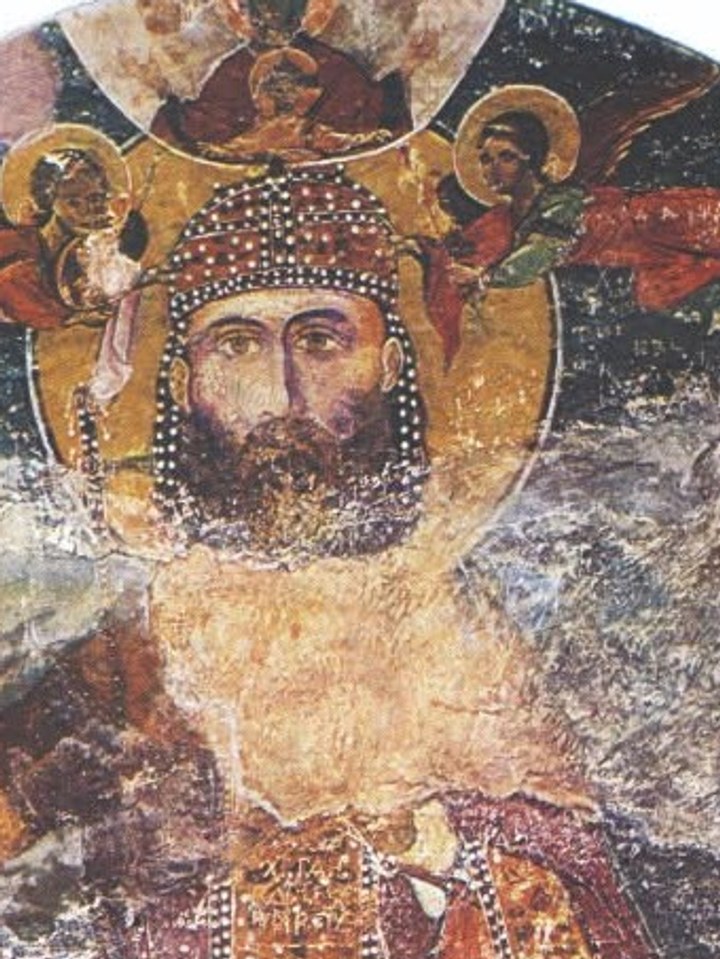
This piety was not abstract. The sources consistently present Ivan Alexander as a ruler with a real reverence for books and a refined eye for artistic form. He emerges as a connoisseur of beautiful manuscripts, a patron who valued not only the sacred text but also the visual splendor through which the text was revealed. No fewer than three of the most celebrated books of the age were commissioned by his order: the illustrated copy of Constantine Manasses’s chronicle in Bulgarian translation, the richly illuminated Four Gospels of the mid-1350s, and the Tomić Psalter. They differ in genre, purpose, and artistic effect, yet together they define the high point of courtly book production in mid-fourteenth-century Bulgaria. In them the written word, the decorative frame, the miniature, the chromatic balance, and the rhythm of the page work together to create a new literary-artistic prestige for the dynasty. The ruler’s name, appearing repeatedly in manuscript inscriptions and dedicatory notes, became part of the books’ own authority: the manuscript was not merely read, but presented as a gift of rule.
The cultural energy of the period rested on older traditions, but it was not content to repeat them. The literary life that took shape around Tarnovo needed new impulses in order to move beyond the heritage of the thirteenth century. Those impulses came from several directions at once: from hesychast spirituality, from the renewed movement of translation from Greek, from the search for new genre models closer to Byzantine literary forms, and from a desire to regularize language and spelling so that book culture might answer the realities of speech without losing its solemnity. These were not isolated experiments but part of a broader intellectual refashioning that began in the middle of the reign and only later bore its fullest fruit. Around the capital and in the monastic world connected to it, the work of copying, translating, revising, and illuminating texts gave the Bulgarian written language a new dignity. The literary blossoming of Ivan Alexander’s time was therefore not merely a court fashion; it was a disciplined and sustained effort to rebuild the prestige of Orthodox learning.
Monasteries stood at the center of this world. The capital was ringed with houses of prayer and learning, and the network stretched beyond the city to the wider Orthodox ecumene. Ivan Alexander’s patronage reached even Mount Athos, where he followed the example of earlier Asenids in supporting the Bulgarian monastery of Saint George, Zograph, through the mediation of the Byzantine emperor. Such acts were more than expressions of devotion. They linked the Bulgarian ruler to a transregional spiritual geography, in which the monastery served as a bridge between court, empire, and sanctified landscape. At the same time, monastic centers inside Bulgaria helped shape the intellectual climate of the age, above all the circles associated with Theodosius of Tarnovo. Theodosius appears as the driving force behind a more austere and intellectually ambitious religious culture, one that sought to purify doctrine and refine practice. The court’s relationship with such figures reveals a strong alliance between royal authority and monastic reform.
That alliance became especially visible in the response to religious dissent. By the first half of the 1350s, various heterodox currents had gained real strength, and the kingdom faced not only political strain but spiritual fragmentation. Ivan Alexander, acting with the active involvement of Theodosius, convened an anti-heretical church council in 1350. Bogomils, varlaamites, adamites, and Jews were condemned in that gathering, which shows how broad the perceived challenge to orthodox order had become. The council was not an isolated act of repression; it was the public face of a wider effort to defend doctrinal unity and social discipline. Heresy was understood not simply as a theological error but as a threat to the moral and institutional coherence of the realm. In this sense the synodal action of 1350 belonged to the same program as the patronage of books and monasteries: all were instruments for restoring and strengthening the kingdom’s Christian identity.
Seen together, church politics, monastic reform, and literary patronage reveal the deepest paradox of Ivan Alexander’s reign in these years. Even as the kingdom was beginning to feel the first pressures of political division and the growing shadow of the Ottoman advance, its spiritual and artistic culture entered one of the most brilliant phases in its history. The court in Tarnovo fostered a style of Orthodox kingship that was at once defensive and ambitious, rooted in dynastic memory yet eager for renewed cultural brilliance. The result was a true flowering: a capital celebrated as sacred, a monarchy sustained by ecclesiastical symbolism, and a literary milieu in which books were not only copied and read but made into works of art. In the years between 1331 and 1355, Bulgarian church and letters did not merely survive political uncertainty; they transformed it into the occasion for one of the great cultural revivals of medieval Southeastern Europe.
5.Economy and Charters
The economic life of Ivan Alexander’s Bulgaria rested first of all on the countryside. Despite the dynastic crisis that brought him to the throne in 1331, the long stretch of relative internal stability that followed gave agriculture room to recover and remain the backbone of the kingdom. The state was still overwhelmingly agrarian: villages, fields, vineyards, orchards, pastureland, and stockbreeding sustained both local subsistence and the fiscal needs of the crown. Grain, animals, and produce from the lower valleys and uplands fed the towns and the monastic estates, while the great river corridors and the routes through the passes linked these rural zones to markets and administrative centers. Under Ivan Alexander, the countryside was not transformed, but it was held together more securely than in the troubled decades before him, and that stability mattered enormously for every other branch of economic life.
The towns gave this agrarian world its commercial and artisanal face. Tărnovo remained the principal center, not only of government and culture but of exchange, craft production, and redistributive power. Its markets and workshops drew on the labor of builders, metalworkers, potters, leatherworkers, and textile producers, while the needs of the court, the church, and the urban elite sustained a dense web of specialized work. Other towns, especially on the Danubian and Black Sea routes and in the interior crossings, formed a secondary but vital network of exchange. Vidin was emerging as an important urban and political center in its own right, and the great towns of the kingdom stood as nodes where rural produce, imported goods, local craft output, and fiscal extraction met. Urban prosperity was inseparable from fortification work, church building, and the consumption habits of the court and aristocracy, all of which helped keep artisans busy and gave the towns a sharper profile than their rural surroundings.
Trade depended on movement, and movement depended on security and legal protection. The kingdom’s charters and fiscal language show a world in which merchants, roads, river crossings, fords, bridges, and market places were all closely watched by the authorities. Customs dues, tolls, and fines belonged to the ordinary machinery of rule, but the very existence of immunities and exemptions tells us how important trade was to the crown as both a source of revenue and a field requiring regulation. The circulation of goods was not confined to local exchange: the kingdom stood between the Danubian world, the Black Sea ports, the interior Balkan routes, and the great southern roads. Even where royal charters granted freedom from interference, that freedom itself presupposed a traffic dense enough to make privilege worth recording. The crown therefore appears not as a passive spectator but as a power that sought to order commerce, protect favored institutions, and extract dues where privilege did not intervene.
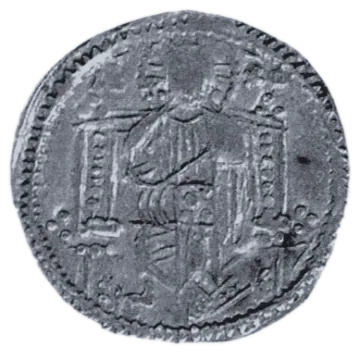
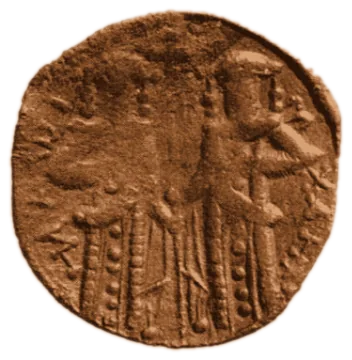
The most visible expression of this economic order was coinage. Under Ivan Alexander Bulgarian minting reached a high point, and the coinage of his reign stands out for both its volume and its symbolism. Silver and copper were issued in several series, and the ruler’s image sometimes appears alongside that of his son and co-ruler Michael Asen, or beside his second wife Theodora. Such images were not mere decoration. They proclaimed dynastic continuity, displayed the ruler’s authority, and anchored political legitimacy in the everyday use of money. The appearance of the fortress gate and the name of Tărnovo on the reverse of certain copper issues points clearly to the capital as a minting center and to the city’s role as the heart of the kingdom’s monetary life. In a society where barter, dues in kind, and fiscal obligations still mattered greatly, the spread of coined money signaled both the confidence of the regime and the growing complexity of exchange.
The charters of Ivan Alexander reveal how landholding and taxation were organized beneath that larger framework. They show a world of layered rights: royal, monastic, and aristocratic. Land was not simply territory; it was a bundle of holdings, revenues, labor services, and jurisdiction over dependent people. When the ruler confirmed a monastery’s possessions, he was not merely blessing piety. He was fixing ownership, protecting income, and often transferring villages, people, and rights into a legally defended sphere. The solemn formulas of perpetual possession, pure freedom, and inalienable holding express a political economy in which the crown could stabilize allies by granting immunity, while at the same time marking the boundaries of lawful interference. The fiscal vocabulary of the age, with its tolls, dues, and fines, shows how deeply the kingdom inherited Byzantine administrative practice, but the charters also reveal the distinctively Bulgarian use of that inheritance: to secure estates, reward institutions, and maintain order in a landscape where authority had to be constantly asserted in writing.
These documents also open a window onto the social texture of the economy. They imply dependent rural populations attached to estates, monks and bishops managing landed wealth, and nobles seeking confirmation of their rights through the chancery. The severe anathemas that often guarded such charters suggest that property was understood as something both sacred and vulnerable, protected by divine sanction as well as royal authority. In practice, the king’s grants helped shape where labor was owed, who collected revenues, and who possessed legal control over fields, mills, woods, and settlements. By 1330–1355 the kingdom’s economic life thus rested on a delicate balance: agriculture sustained the people, towns concentrated craft and exchange, coinage gave circulation a more regular form, and charters translated power into rights over land and men. The system could still function with confidence in the middle of the century, but it did so because the court, the church, and the fiscal machinery of the state worked together to keep the realm’s productive life legible and controllable.
6.Foreign Relations
Ivan Alexander came to the throne in a moment when Bulgaria’s external relations had to be reordered almost at once. The shock of Velbŭzhd had shattered the balance with Serbia, and the fall of the pro-Serbian regime in Tărnovo was followed by a rapid clearing of the political field: Ivan Stefan and the queen mother Anna were driven out and took refuge in Serbia, while in the north-west Belaur turned Vidin into the centre of resistance against the new ruler. The first year of Ivan Alexander’s reign was therefore not one of quiet consolidation but of energetic border-making. He had to secure the Danubian flank, suppress the Vidin challenge with the help of Tatar mercenaries, and demonstrate that the change on the throne was not a Serbian imposition but the beginning of a new Bulgarian course. Once this was achieved, the monarchy could present itself as restored and coherent again, while the very speed with which the Vidin revolt was contained showed how determined the new tsar was to prevent the state from sliding into regional fragmentation.
With Byzantium, Ivan Alexander’s reign opened in the shadow of war but then moved, at least for a time, into a more stable phase. The decisive victory at Rusokastro in 1331 gave the new ruler a triumph that was both military and diplomatic: it vindicated his accession, strengthened his legitimacy, and compelled the Byzantines to accept that Bulgaria could still dictate the terms of border politics in Thrace. In the years that followed, the contrast between the two states was striking. Byzantium under Andronikos III was entangled in the military and financial strains of wider Balkan and Aegean policy, pressed by Turkish raiding in Asia Minor and by expensive maritime ventures, while Bulgaria enjoyed a long interval of internal peace and external calm. That peace did not mean passivity. It meant that Ivan Alexander could watch the Byzantine world weaken under the pressure of civil strife and frontier insecurity, and could intervene selectively when the opportunity arose. The Bulgarian court did not seek a general crusade against the empire; rather, it watched the erosion of Byzantine authority with the patience of a neighbour who knew that the balance itself was changing.
Relations with Serbia were more complex, because the kingdom across the western frontier moved from open hostility to a much more flexible, dynastic competition. In 1331 the anti-Serbian elements in Tărnovo were pushed aside, and the fugitive Ivan Stefan found shelter in the Serbian realm, but this did not produce a lasting rupture. The accession of Stephen Dušan in Serbia altered the whole tone of the relationship. He married a sister of Ivan Alexander, and that marriage mattered politically: it bound the two courts into a dynastic network even as their territorial ambitions remained incompatible. Serbia was no longer merely the victor of Velbŭzhd; under Dušan it became the most aggressive power in the western Balkans, moving toward Macedonia and toward the idea of a wider imperial role. Yet in the mid-1330s the immediate edge of confrontation was blunted by understanding and by convenience. Dušan’s government could coexist with Bulgaria so long as each court had other priorities, and the old pattern of absolute enmity gave way to a more dangerous arrangement in which kinship and rivalry advanced together.
The wider Christian diplomacy of the 1330s also shaped the environment in which Ivan Alexander operated, even when Bulgaria itself remained outside the formal league-building of the Latin West. The papacy, Venice, Rhodes and Cyprus were increasingly preoccupied with the Turkish danger, and by 1334 an anti-Turkish league had taken shape in which Byzantine participation was cautiously allowed. But this was a league whose imagination was focused on the Aegean and the coast of Asia Minor, not on the Danube and the Balkan hinterland. For Bulgaria the significance of these developments was indirect but profound. The appearance of Turkish raiding in the eastern Mediterranean made clear that the frontier of danger was moving south-eastward, and by the early 1350s that danger had reached the Balkan peninsula itself. Ivan Alexander’s own use of Turkish auxiliaries in the struggle around Mesembria shows how thoroughly Balkan rulers had begun to treat Turkish forces as political instruments, not as distant enemies. The method worked in the short term, but it also revealed how the old frontiers of Christian diplomacy were being eroded from within the region.
By the middle of the reign, the most serious cracks in the external order appeared not on the great imperial frontiers but in Bulgaria’s own periphery. In north-eastern Bulgaria the rise of Balik in Karvuna signalled the emergence of a local power that was already behaving as though central authority were optional. His brother Dobrotica would later give the region its lasting name, but the process was underway earlier, when Balik detached himself from Tărnovo and entered the wider Byzantine civil conflict by sending troops to Anna of Savoy’s party. In the north-west, Vidin again reminded the crown how vulnerable the Danubian zone could be: even when Belaur’s resistance had been broken, the area remained a special political space, one that could become an appanage and then a separate centre of power. Thus by 1355 Ivan Alexander’s foreign relations were marked by a paradox. He had secured a real diplomatic and military success against Byzantium, normalized relations with Serbia through dynastic ties, and lived for years without a major Hungarian war; yet the same decades witnessed the growth of semi-independent border lordships and the unmistakable advance of the Turkish threat. The kingdom looked peaceful at the centre, but around it the strategic landscape was already beginning to change.
1.Political Story
After the disaster at Velbuzhd, a new leader named Ivan Alexander rose to power. In the spring of 1331, he took the throne in Tarnovo and started to rebuild royal authority, which had been damaged by the Serbian-backed rule of Ivan Stefan. The change of power happened quickly but was complicated. Later stories say that a group of top nobles, led by the protovestiary Raksin and the logothete Philip, organized the shift. Ivan Alexander, who was then the lord of Lovech and already a leading prince from the Asenid family line, stayed behind the scenes until the right moment to step forward. Whatever the exact details, the result was clear: the widow Anna and the young Ivan Stefan were forced to flee. They first went to Serbia, and after the new Serbian ruler Stephen Dusan took power, they moved to Dubrovnik in 1332, where their political influence slowly disappeared. Ivan Alexander’s rise was not just a change of dynasty; it marked the return of a native Asenid king after a short and humiliating period under Serbian control.
Ivan Alexander’s rule was immediately challenged from inside the kingdom. Belaur, the brother of the killed Michael Shishman and the main figure in the Vidin region, refused to accept the new king and rebelled. This revolt was serious enough to be seen almost as a civil war because it cut off the northwestern lands from the king’s direct control and threatened to turn Vidin into a rival power center. Ivan Alexander responded with force and hired Tatar horsemen, showing early on that he was willing to use any means to keep his crown. Belaur was defeated, fled, and eventually died in exile. Even though the rebellion failed, it showed how fragile the kingdom still was in 1331: the king had taken the throne, but he had not yet won the full loyalty of his realm. In the years that followed, Vidin remained a sensitive and partly separate political area, one that the Tarnovo court could not treat like a regular province.
At the same time, Ivan Alexander faced a threat from outside on the southeastern border. After the defeat at Velbuzhd, the Byzantine emperor Andronikos III took over several Bulgarian fortresses and captured the Black Sea ports of Mesembria and Anchialos. He claimed this was to avenge his sister Theodora, who had been married to Michael Shishman. However, these Byzantine gains did not last long. Ivan Alexander fought back and on July 18, 1331, won a major victory at Rusokastro. This battle was the first big test of his reign. It showed that the new king could not only survive a dynastic crisis but also win in war. The victory restored Bulgarian confidence after the humiliation of 1330, stopped Byzantine advances on the coast, and gave Ivan Alexander the authority to present himself as a strong ruler, not just a compromise. The political importance of Rusokastro was as great as its military success because it showed that Tarnovo still had the will and ability to defend its claims.
At the same time, the balance of power in the Balkans was shifting. In Serbia, Stephen Dusan took power in 1331 after overthrowing and killing Stephen Decanski. Dusan would soon become the most powerful figure in the western Balkans. But at first, his rise did not lead to new conflict with Bulgaria. Instead, relations became more complex and less openly hostile. Serbia no longer supported the exiled Ivan Stefan as a rival claimant, and Ivan Alexander focused on securing his borders and dealing with internal opposition. In other words, after the crisis of 1330-1331, Bulgaria had restored its central authority, and its neighbors were strong but busy with their own changes. The old rivalry with Serbia did not disappear, but for the moment, the king’s priority was to strengthen his own kingdom.
In the middle years of Ivan Alexander’s rule, a different challenge appeared. Instead of a big war, the kingdom began to loosen politically around Tarnovo. When Byzantium fell into civil war in 1341, Bulgarian policy became involved in the conflict, and border areas opened up to local lords who shifted alliances as it suited them. In the Rhodopes mountains, a man named Momchil became an independent ruler between 1343 and 1345, showing that central authority could no longer fully control the mountain borderlands. In the northeast, the noble Balik, based in Karvuna, broke away in the mid-1340s. His successor Dobrotica would later give the Dobruja region its political identity. Even where Tarnovo still claimed authority, the kingdom was becoming more fragmented in practice. Its distant regions were increasingly ruled by local dynasties, military leaders, and family estates. By the 1350s, this process had reached Vidin, which was being shaped as a separate domain for Ivan Alexander’s son Ivan Sratsimir. The kingdom was not broken yet, but its structure was changing. The king’s power had to be exercised through a growing number of semi-independent centers.
By 1352, a new and more dangerous threat appeared on the frontier. The Turks had crossed into the Balkans, changing the old strategic balance where Tarnovo had balanced Serbia, Byzantium, and local Bulgarian nobles. Ivan Alexander still ruled from Tarnovo, but the pressures on his kingdom were now more serious and systemic. In the northwest, Vidin was gaining political weight; in the northeast, Dobruja was moving toward independence; and in the south, the Ottoman presence made every dispute over roads, fortresses, and alliances more urgent. By 1355, the early signs of the later crisis were clear. Ivan Alexander remained the central figure in Bulgarian politics, and his reign still had years to go, but the first cracks in the kingdom’s unity were no longer hidden. The victories of 1331 had secured his crown but had not stopped the slow rise of a more divided and vulnerable Bulgaria.
2.Wars and Fighting
Ivan Alexander became king after a military disaster, and the first months of his rule were focused on turning defeat into strength. The death of Michael III Shishman at Velbuzhd had shattered the crown’s prestige, left the kingdom open to Serbian pressure, and made it clear that the new ruler could not rely on tradition alone. Ivan Alexander, who had been ruling Lovech before taking the throne, emerged as the man best able to restore unity after the collapse of the previous regime. His first military task was not a big offensive but to regain control over the kingdom’s outer regions, especially the northwest, where Belaur resisted him. This fight showed the nature of Ivan Alexander’s power at the start: he did not command a single national army but led a coalition of royal troops, noble followers, and hired soldiers. Belaur was defeated by a force that included Tatar mercenaries hired by Ivan Alexander. This shows that the king extended his power by using fast, shock troops whose loyalty was bought. The northwest was brought back under central control, and Vidin, though not yet fully settled as a separate domain, stopped being a free-standing challenge.
The first major test of Ivan Alexander’s reign came against Byzantium. In 1331, while the empire was distracted by internal conflict, he attacked Andronikos III and won the battle at Rusokastro. This victory was important not just as a military win but because it showed that the Bulgarian crown could still take advantage of the shifting politics on the southern border. The war was fought in a landscape of fortresses, mountain passes, and changing local loyalties. Controlling strongholds in the Rhodopes and along the Thracian border could decide whether a campaign succeeded or failed. Military success depended on timing and positioning as much as on the size of the army. Ivan Alexander’s victory did not lead to continuous expansion but restored some strategic confidence after Velbuzhd. It also helped stabilize relations with Byzantium through marriage ties between the two courts. More deeply, Rusokastro showed that Ivan Alexander could lead an active war of movement and border pressure, not just defend what was already held.
Armies of this time were mixed, flexible, and organized around personal loyalty. The royal army relied on the service of boyars (noble landowners) and their followers but was strengthened when needed by hired horsemen and irregular troops from the steppe. Records from the early 1330s show how important these forces were: Tatar mercenaries helped suppress internal rebellions, and all the major Balkan powers depended on a mix of noble troops, household soldiers, and outside help. Even enemy armies followed this pattern. At Velbuzhd, Serbia used not only its own forces but also heavily armed foreign horsemen. Byzantium relied on temporary alliances, local garrisons, and ambitious defectors. Across the eastern Mediterranean, leagues and coalitions were formed around naval power, mercenaries, and short-term agreements. Warfare was less about standing armies and more about assembling the right mix of mounted nobles, border warriors, and opportunistic allies. Sieges remained important but were often decided by betrayal, blockades, starvation, or morale collapse rather than direct attacks. Ivan Alexander’s wars were typical of the Balkans in the mid-1300s: armies moved quickly, sought decisive battles when possible, and otherwise fought for fortresses, river crossings, and the loyalty of local nobles.
The Byzantine civil wars after 1341 made these trends stronger. They created a battlefield where neighboring rulers could intervene indirectly, using border lords as proxies or relying on military leaders who were not always under control. In northeastern Bulgaria, Balik’s breakaway showed how far local power could drift from the center. His family’s domain around Karvuna became a local armed lordship. One clear sign of this decentralization was when Balik’s brothers, Dobrotica and Theodore, sent a thousand troops to support Anna of Savoy in the war against John Kantakouzenos. This was a Bulgarian military force but not directly controlled by Tarnovo. It shows how the kingdom’s resources were drawn into the Byzantine conflict while also revealing the growing independence of Dobrujan nobles. For Ivan Alexander, the problem was not only outside war but the growing number of military centers within Bulgaria itself. The old model of a single royal army gave way, especially at the edges, to a patchwork of armed principalities, each able to negotiate, defect, or intervene in larger conflicts on its own.
By the mid-1340s and into the 1350s, the military situation changed again. The new threat was no longer just Serbia or Byzantium but the arrival of the Ottomans in Europe, starting a long period of Balkan insecurity. The eastern Mediterranean was already experiencing the first phase of Turkish naval and raiding power, and by 1352 the Ottomans had crossed into the Balkans. For Ivan Alexander’s kingdom, this was not yet the full disaster that would come later, but it meant that warfare had to be seen through the lens of fragile borders. Up to 1355, the reign was still dominated by dynastic diplomacy, opportunistic campaigns, and local military actions, but the direction was clear. The early victory at Rusokastro belonged to a more confident time; the later decades were already marked by the fragmentation of power in Dobruja and Vidin and by the sense that future struggles would be fought not just against traditional Christian rivals but against a new, relentless enemy on the eastern edge of the Balkans.
3.Government and Institutions
Ivan Alexander took the throne when the machinery of power still clearly reflected the Asenid dynasty but had become even more dependent on balancing the kingdom’s leading nobles. After the disaster at Velbuzhd and the brief, unstable rule of Ivan Stefan, the change in 1331 was not just a dynastic swap but a political reshuffling among the ruling elite. The new king was himself an Asenid descendant through his mother, and his role as despot (a high-ranking prince) of Lovech had already given him a base of power before he became king. But his rise to the throne was mediated by the high aristocracy: the pro-Serbian faction was pushed aside, and men with prestigious court ranks, especially protovestiarios Raksin and logothete Philip, are said to have led the movement that brought Ivan Alexander forward. Whatever the exact story, the key fact is clear: the throne was legitimate only when dynastic right, noble support, and control of the capital came together.
The central government in Tarnovo operated in a political world shaped by Byzantine models. This was not just copying titles but adopting a way of ruling. The court was more than a ceremonial backdrop; it was where major decisions were made, where offices ranked men in a clear hierarchy, and where being close to the ruler mattered almost as much as formal skills. The use of titles like protovestiarios and logothete shows that the state was organized through a court language of rank, while the ruler’s household and entourage formed the power center. At the same time, the sources show that having a title did not always mean having command. A military leader might lead a campaign without an official military title, and a court rank could mean status rather than real command. This gave the state a flexible but very personal character: power came from the king but was exercised through a complex network of office-holders, advisors, and nobles gathered around the throne.
At the local level, the kingdom was divided into inherited provinces that continued older imperial patterns rather than replacing them. The common administrative language spoke of chorai (lands or regions), showing a state thinking in territorial blocks rather than strict modern districts. In the northwest and along the Danube, old centers like Vidin kept their administrative importance, as did other established towns and border fortresses. The evidence suggests a layered provincial map, where some centers acted as hubs for larger areas and others had more limited local roles. Tarnovo itself held a special place, not just as another district but as the royal capital with a unique form of government. This special status highlighted the difference between court and province, but the state stayed cohesive because both were linked by the same administrative culture and by officials who moved between them.
The boyar class was at the heart of this system. Ivan Alexander’s rise showed that the throne depended on the consent of the nobles, and his reign began with a political agreement among those who could raise troops, hold office, and command local loyalty. The great nobles were not just followers of royal orders; they were partners, rivals, and sometimes kingmakers. In a kingdom that had suffered succession crises and foreign interference, the king had to bind the leading nobles to himself while also limiting the pull of regional power. Court ranks helped with this by turning noble status into a place within the royal hierarchy. Rank and service were connected. The highest nobles could act as guardians of legitimacy but also posed a risk of fragmentation, since a strong provincial lord could become a rival power center. Ivan Alexander’s early reign was therefore a constant balancing act: rewarding loyalty, preserving dynastic continuity, and preventing the court from being controlled by any single faction.
Law and taxation are less clearly detailed for these years, but the surviving evidence still shows a state that ruled through written orders, privileges, and routine administration. The fact that the monarchy could issue charters and confirm monastery rights shows a legal culture where land ownership, exemptions, and obligations were all formal state matters. These acts did not just favor the Church; they also defined the relationships between the crown, local holders, and tax rights. They required a system capable of identifying property, recognizing jurisdiction, and protecting exemptions. Taxation should be understood in this context: not as a fully centralized system known in detail, but as a network of claims managed by provincial officials and the court. The Byzantine-style administration meant that taxation and justice were part of the same political language. The state ruled by naming offices, defining territories, granting privileges, and bringing leading men into its hierarchy. Under Ivan Alexander, this system stayed intact and in some ways became more refined, even as the political agreement it depended on grew weaker.
4.Church and Culture
When Ivan Alexander became king in 1331, the spiritual life of the kingdom gained new political importance. Tarnovo, already made sacred by earlier Asenid rulers, was increasingly seen not just as the seat of government but as a holy center—a renewed Constantinople, a city that “grows, strengthens, and grows young again.” In this atmosphere, the church was not just decoration for power; it was one of the main ways power was made legitimate. The king’s authority was expressed through Orthodox Christianity, dynastic continuity, and public piety. The monastery and the palace became closely linked. Ivan Alexander’s reign began with a clear focus on building sacred prestige, which helped connect the fractured political world of the 1330s to a larger vision of Christian order.
This religious devotion was real and practical. Sources consistently show Ivan Alexander as a ruler who truly respected books and had a refined taste for art. He was a patron who valued not only sacred texts but also the beautiful ways they were presented. He ordered at least three of the most famous books of the time: an illustrated Bulgarian translation of Constantine Manasses’s chronicle, the richly decorated Four Gospels from the mid-1350s, and the Tomić Psalter. These books differ in style, purpose, and artistic effect, but together they represent the high point of courtly book production in mid-14th-century Bulgaria. In these works, the written word, decorative frames, miniatures, color balance, and page layout combined to create new literary and artistic prestige for the dynasty. The king’s name appears repeatedly in inscriptions and dedications, making the manuscripts not just texts to read but gifts of royal power.
The cultural energy of the time built on older traditions but did not simply repeat them. The literary life around Tarnovo needed new ideas to move beyond the 13th-century heritage. These ideas came from several sources at once: hesychasm (a mystical Orthodox spirituality), renewed translation from Greek, a search for new literary models closer to Byzantine styles, and efforts to standardize language and spelling so that written culture could better reflect spoken language without losing its dignity. These were not isolated experiments but part of a broader intellectual renewal that began in the middle of the reign and took full shape later. Around the capital and in connected monasteries, the work of copying, translating, revising, and illuminating texts gave the Bulgarian written language new respect. The literary flowering of Ivan Alexander’s time was therefore not just a court fashion; it was a serious and lasting effort to restore the prestige of Orthodox learning.
Monasteries were central to this world. Tarnovo was surrounded by houses of prayer and learning, and the network extended beyond the city to the wider Orthodox world. Ivan Alexander’s support reached even Mount Athos, where he followed earlier Asenid rulers in backing the Bulgarian monastery of Saint George, Zograph, through the Byzantine emperor’s mediation. These acts were more than devotion; they linked the Bulgarian ruler to a spiritual geography that connected court, empire, and sacred places. At the same time, monasteries inside Bulgaria helped shape the intellectual climate, especially the circles around Theodosius of Tarnovo. Theodosius was a leading figure in a stricter and more intellectually ambitious religious culture that aimed to purify doctrine and improve practice. The close relationship between the court and such figures shows a strong alliance between royal power and monastic reform.
This alliance became especially clear in the fight against religious dissent. By the early 1350s, various heretical movements had gained strength, and the kingdom faced not only political strain but spiritual division. Ivan Alexander, with Theodosius’s active help, called a church council in 1350 to fight heresy. The council condemned Bogomils, Varlaamites, Adamites, and Jews, showing how broad the perceived threat to Orthodox order had become. This council was not just repression; it was the public face of a wider effort to defend doctrinal unity and social order. Heresy was seen not just as wrong belief but as a danger to the moral and institutional stability of the kingdom. In this way, the 1350 council was part of the same program as the patronage of books and monasteries: all were tools to restore and strengthen the kingdom’s Christian identity.
Taken together, church politics, monastic reform, and literary patronage reveal the deepest paradox of Ivan Alexander’s reign in these years. Even as the kingdom began to feel political division and the growing threat of the Ottomans, its spiritual and artistic culture entered one of its brightest periods. The court in Tarnovo promoted a style of Orthodox kingship that was both defensive and ambitious, rooted in dynastic memory but eager for cultural renewal. The result was a true flowering: a capital celebrated as sacred, a monarchy supported by church symbolism, and a literary world where books were not just copied and read but made into works of art. Between 1331 and 1355, Bulgarian church and culture did not just survive political uncertainty; they turned it into one of the great cultural revivals of medieval Southeastern Europe.
5.Economy and Documents
The economy of Ivan Alexander’s Bulgaria was based mainly on the countryside. Despite the dynastic crisis that brought him to power in 1331, the long period of relative internal peace that followed allowed agriculture to recover and remain the kingdom’s backbone. The state was still overwhelmingly rural: villages, fields, vineyards, orchards, pastures, and livestock supported both local needs and the crown’s fiscal demands. Grain, animals, and produce from valleys and uplands fed towns and monasteries, while major river routes and mountain passes connected these rural areas to markets and administrative centers. Under Ivan Alexander, the countryside was not transformed but held together more securely than in the troubled decades before, and this stability was crucial for all other parts of the economy.
Towns gave this rural world its commercial and craft character. Tarnovo remained the main center, not only for government and culture but also for trade, crafts, and redistribution. Its markets and workshops employed builders, metalworkers, potters, leatherworkers, and textile makers. The needs of the court, church, and urban elite supported a dense network of specialized work. Other towns, especially along the Danube and Black Sea routes and in interior crossings, formed a secondary but vital network of exchange. Vidin was becoming an important urban and political center on its own, and the kingdom’s major towns were places where rural produce, imported goods, local crafts, and taxes came together. Urban prosperity was closely linked to fortification building, church construction, and the consumption habits of the court and aristocracy, all of which kept artisans busy and gave towns a sharper identity than their rural surroundings.
Trade depended on movement, and movement depended on security and legal protection. The kingdom’s charters and tax records show a world where merchants, roads, river crossings, fords, bridges, and marketplaces were closely monitored by authorities. Customs duties, tolls, and fines were normal parts of rule, but the existence of immunities and exemptions shows how important trade was to the crown both as a source of income and as an area needing regulation. Goods did not just move locally; the kingdom stood between the Danube region, Black Sea ports, Balkan interior routes, and major southern roads. Even where royal charters granted freedom from interference, that freedom assumed enough traffic to make such privileges worth recording. The crown was not a passive observer but a power that sought to organize commerce, protect favored institutions, and collect dues where privileges did not apply.
The most visible sign of this economic order was coinage. Under Ivan Alexander, Bulgarian minting reached a high point, notable for both volume and symbolism. Silver and copper coins were issued in several series, and the ruler’s image sometimes appeared alongside that of his son and co-ruler Michael Asen or his second wife Theodora. These images were not just decoration; they proclaimed dynastic continuity, showed the ruler’s authority, and anchored political legitimacy in everyday money. The fortress gate and the name of Tarnovo appeared on the back of some copper coins, clearly marking the capital as a minting center and the heart of the kingdom’s monetary life. In a society where barter, payments in kind, and fiscal obligations still mattered, the spread of coinage showed both the regime’s confidence and the growing complexity of trade.
Ivan Alexander’s charters reveal how landholding and taxation were organized within this larger framework. They show a world of layered rights: royal, monastic, and noble. Land was not just territory; it was a bundle of holdings, income, labor services, and control over dependent people. When the king confirmed a monastery’s possessions, he was not just honoring piety; he was fixing ownership, protecting income, and often transferring villages, people, and rights into a legally defended sphere. The formal language of perpetual possession, full freedom, and inalienable holding expresses a political economy where the crown could secure allies by granting immunity while marking the limits of lawful interference. The fiscal language of tolls, dues, and fines shows how deeply the kingdom inherited Byzantine administrative practices, but the charters also reveal how Bulgaria used that inheritance to secure estates, reward institutions, and maintain order in a landscape where authority had to be constantly asserted in writing.
These documents also give insight into the social makeup of the economy. They suggest dependent rural populations tied to estates, monks and bishops managing land wealth, and nobles seeking confirmation of their rights through royal chancery. The strong curses often included in charters suggest that property was seen as both sacred and vulnerable, protected by divine as well as royal authority. In practice, the king’s grants shaped where labor was owed, who collected revenues, and who had legal control over fields, mills, forests, and villages. By 1330–1355, the kingdom’s economy rested on a delicate balance: agriculture fed the people, towns concentrated crafts and trade, coinage made exchange more regular, and charters turned power into rights over land and people. The system still worked confidently in the middle of the century because the court, church, and state fiscal machinery worked together to keep the realm’s productive life clear and manageable.
6.Foreign Relations
Ivan Alexander became king at a time when Bulgaria’s foreign relations had to be quickly reorganized. The shock of Velbuzhd had broken the balance with Serbia, and the fall of the pro-Serbian regime in Tarnovo was followed by a rapid clearing of the political scene: Ivan Stefan and his mother Anna were driven out and fled to Serbia, while in the northwest Belaur made Vidin the center of resistance against the new ruler. The first year of Ivan Alexander’s reign was therefore not a quiet time but one of active border-making. He had to secure the Danube frontier, put down the Vidin rebellion with help from Tatar mercenaries, and prove that the change on the throne was not a Serbian takeover but the start of a new Bulgarian path. Once he did this, the monarchy could present itself as restored and united. The quick suppression of the Vidin revolt showed how determined the new tsar was to stop the state from falling into regional fragmentation.
Relations with Byzantium began with war but then moved, at least for a while, into a more stable phase. The decisive victory at Rusokastro in 1331 gave Ivan Alexander a triumph that was both military and diplomatic: it confirmed his accession, strengthened his legitimacy, and forced the Byzantines to accept that Bulgaria could still control border politics in Thrace. In the following years, the contrast between the two states was clear. Byzantium under Andronikos III was caught up in military and financial struggles across the Balkans and Aegean, pressured by Turkish raids in Asia Minor and costly naval ventures, while Bulgaria enjoyed a long period of internal peace and external calm. This peace did not mean inactivity. It meant that Ivan Alexander could watch the Byzantine empire weaken under civil war and border insecurity and intervene selectively when chances arose. The Bulgarian court did not seek a general crusade against Byzantium but watched the empire’s decline patiently, knowing the balance was shifting.
Relations with Serbia were more complicated. The kingdom to the west moved from open hostility to a more flexible, dynastic rivalry. In 1331, the pro-Serbian faction in Tarnovo was removed, and the fugitive Ivan Stefan found refuge in Serbia, but this did not cause a lasting break. The rise of Stephen Dušan in Serbia changed the tone of relations. Dušan married Ivan Alexander’s sister, and this marriage mattered politically: it linked the two courts by family ties even as their territorial ambitions clashed. Serbia was no longer just the victor at Velbuzhd; under Dušan, it became the most aggressive power in the western Balkans, moving into Macedonia and aiming for a wider imperial role. Yet in the mid-1330s, immediate conflict was softened by understanding and convenience. Dušan’s government could coexist with Bulgaria as long as both had other priorities. The old pattern of outright hostility gave way to a more dangerous mix of kinship and rivalry.
The wider Christian diplomacy of the 1330s also shaped the environment Ivan Alexander worked in, even though Bulgaria stayed outside formal Western alliances. The papacy, Venice, Rhodes, and Cyprus were increasingly focused on the Turkish threat, and by 1334 an anti-Turkish league had formed, with cautious Byzantine participation. But this league focused on the Aegean and Asia Minor coasts, not the Danube and Balkan interior. For Bulgaria, these developments mattered indirectly but deeply. The rise of Turkish raids in the eastern Mediterranean showed that the danger frontier was moving southeast, and by the early 1350s that threat had reached the Balkans. Ivan Alexander’s use of Turkish auxiliaries in the fight over Mesembria shows how Balkan rulers had begun to treat Turkish forces as political tools, not distant enemies. This approach worked short-term but also showed how old Christian diplomatic frontiers were breaking down within the region.
By the middle of Ivan Alexander’s reign, the most serious cracks in foreign relations appeared not on the big imperial borders but in Bulgaria’s own edges. In northeastern Bulgaria, Balik’s rise in Karvuna showed a local power acting as if central authority was optional. His brother Dobrotica would later give the region its lasting name, but the process started earlier when Balik broke from Tarnovo and joined the Byzantine civil war by sending troops to support Anna of Savoy. In the northwest, Vidin reminded the crown how vulnerable the Danube region could be: even after Belaur’s defeat, the area remained a special political space, one that could become a separate domain and power center. By 1355, Ivan Alexander’s foreign relations showed a paradox. He had won a real diplomatic and military success against Byzantium, normalized relations with Serbia through family ties, and avoided a major war with Hungary for years. Yet the same decades saw the growth of semi-independent border lordships and the clear advance of the Turkish threat. The kingdom looked peaceful at its center, but around it the strategic landscape was already changing.
In 1331, Ivan Alexander became king of Bulgaria after a crisis and began to restore order. He removed the previous rulers who were backed by Serbia and faced challenges from his own family and neighbors. He defeated his brother-in-law’s rebellion in Vidin and won a key battle against the Byzantine Empire at Rusokastro, showing he could defend and lead the kingdom.
During his reign, Bulgaria’s power became less united. Local leaders in border regions like Dobruja and the Rhodopes gained more independence. The arrival of the Ottoman Turks in the 1350s created a new and serious threat. Ivan Alexander’s kingdom was still strong but starting to break apart into smaller centers of power.
Ivan Alexander’s army was made up of nobles, hired soldiers, and allies. His early wars focused on keeping control of the kingdom and defending against Byzantium. Later, civil wars in Byzantium and the rise of the Ottomans changed the military situation, making Bulgaria’s borders less secure.
The government was based in the capital Tarnovo and used Byzantine-style court ranks and offices. The king needed the support of powerful nobles to rule. Local regions kept their old administrative systems, but some nobles became very independent. The state used written laws and charters to manage land, taxes, and privileges, helping to keep order.
Religion and culture were very important under Ivan Alexander. He supported the Orthodox Church and monasteries, making Tarnovo a religious and cultural center. He sponsored beautiful books and helped fight heresy to keep the church united. This cultural revival happened even as political problems grew.
The economy was mostly farming, with towns supporting trade and crafts. Tarnovo was the main city for government, culture, and commerce. The king’s coins showed his power and helped trade grow. Charters protected landowners and monasteries, showing how the economy and government worked together.
In foreign relations, Ivan Alexander stopped Serbian influence in Bulgaria and made peace with Serbia through marriage ties. He fought Byzantium successfully but watched as it weakened in civil war. The growing Turkish threat changed Balkan politics, and local leaders in border areas acted more independently. By 1355, Bulgaria was peaceful inside but facing new dangers and divisions on its edges.
Key Events
- 11331 — Ivan Alexander took the throne in Tarnovo after the fall of Ivan Stefan's Serbian-backed regime.
- 21331 — Belaur of Vidin rebelled against the new king and was defeated with Tatar horsemen.
- 318 July 1331 — Ivan Alexander defeated Andronikos III at Rusokastro.
- 41331 — Stephen Dusan seized power in Serbia after the overthrow and murder of Stephen Decanski.
- 51332 — Ivan Stefan and the widow Anna fled from Serbia to Dubrovnik.
- 61341 — The Byzantine civil war began, drawing Bulgarian policy into the southern frontier struggle.
- 71343–1345 — Momchil established himself as an independent ruler in the Rhodopes.
- 81350 — Ivan Alexander and Theodosius of Tarnovo convened an anti-heretical council condemning Bogomils, varlaamites, adamites, and Jews.
- 91352 — The Ottomans crossed onto the Balkan Peninsula.
- 101355 — Vidin was being shaped as a distinct holding for Ivan Sratsimir.
- 11Mid-1340s — Balik broke away in Karvuna, and Dobrotica emerged as the power that gave Dobruja its separate identity.
- 121340s — Bulgarian troops under Dobrotica and Theodore were sent to aid Anna of Savoy against John Kantakouzenos.
- 13Mid-1350s — Ivan Alexander commissioned major illuminated manuscripts, including the Manasses Chronicle, the Four Gospels, and the Tomić Psalter.
Key People
Sources
Ivan Bozhilov, Vasil Gyuzelev, History of Medieval Bulgaria, 7th–14th Century. Sofia: Anubis, 1999.
Show the 8 quoted passages
„цялата си войска“
Read p. 840 in the book„тежко поражение“
Read p. 843 in the book„През пролетта на 1331 г., както съобщава Кантакузин, протовестиарият Раксин и логотетът Филип повели на борба онази част от българското болярство, която била недоволна от господството на просръбската партия.“
Read p. 846 in the book„много ловко организирал“
Read p. 847 in the book„гръцкото понятие „хора“ (χώρα)“
Read p. 922 in the book„нашият нов Цариград“
Read p. 930 in the book„проявявал пиетет към книгата“
Read p. 933 in the book„Търновска България образувала защитен пояс“
Read p. 973 in the bookIvan Bozhilov, The Asen Family (1186–1460): Genealogy and Prosopography. Sofia: Marin Drinov Academic Publishing House, 1994.
Show the 4 quoted passages
„привлякъл като съюзници Иванко Басараб, Молдавия и Черните татари“
Read p. 125 in the book„Белаур бил ако не единственият, то най-изявеният противник на извършения през пролетта на 1331 г. преврат“
Read p. 135 in the book„Първата крачка за излизане на България от „балканската изолация“
Read p. 156 in the book„Иван Срацимир би могъл да бъде „млад цар”... а предпочетеният по-сетне син от втория брак Иван Шишман“
Read p. 199 in the book