
Shishman dynasty
Michael Asen IV
Eldest son of Ivan Alexander by his first marriage, proclaimed co-tsar and designated heir. Killed fighting the Ottomans around 1355, predeceasing his father.
Biography
Michael Asen IV was the eldest son of Tsar Ivan Alexander by his first marriage to Theodora Basaraba and a member of the Shishman dynasty who bore the prestigious dynastic name Asen. He never ruled alone: from 1332 until his death in 1355 he held the title of co-tsar beside his father and was treated as the intended heir to the Bulgarian throne. The designation “Michael Asen IV” is a modern means of distinguishing him from several earlier and contemporary namesakes; the medieval evidence ordinarily calls him simply Michael Asen or Michael, son of Alexander.
His precise birth date is not securely recorded. A modern genealogical reconstruction proposes 1323 or 1324, while the first incontrovertible terminus ante quem is 1331, when he appears in the colophon of the so-called Lovech Miscellany beside Ivan Alexander. His position at the head of the royal sons in this and later texts supports the conclusion, independently established by the dynastic record, that he was Ivan Alexander’s firstborn son. He grew up amid a large royal sibling group that included Ivan Asen IV, Ivan Sratsimir, Ivan Shishman, Kera Tamara, Keratsa Maria, Ivan Asen Alexandrov, Desislava and Vasilisa.
Michael entered international politics while still a child. After the Bulgarian victory over Emperor Andronikos III Palaiologos at the Battle of Rusokastro on 18 July 1331, Ivan Alexander and Andronikos concluded peace. John Kantakouzenos reports that one condition was the future marriage of Ivan Alexander’s eldest son to a daughter of the Byzantine emperor. Because both children were very young, the union was deferred. Michael had no known military part in the battle itself; his importance lay in serving as the dynastic guarantee of the settlement, which transformed a Bulgarian battlefield success into a projected Bulgarian-Byzantine alliance.
The established chronology places Michael’s elevation as co-tsar in 1332. The precise ceremony and the institutional extent of his authority are not described, and the surviving documentary evidence proves his imperial status directly only before 1337. His accession nevertheless represented a deliberate policy of associating the designated heir with the reigning monarch during the latter’s lifetime. Michael possessed the insignia of supreme rank and styled himself tsar, but not samodŭrzhets, or autocrat; that distinction remained with Ivan Alexander. The arrangement therefore proclaimed succession without creating an independent sovereign power alongside the senior ruler.
For 1333–1336 no separate act of government by Michael can be securely identified. His name and rank remained part of the monarchy’s public representation rather than evidence for an autonomous territorial administration. The Sofia Psalter, completed before 1337, names him first among Ivan Alexander’s sons and gives him the title tsar. Soon afterward another son, Ivan Asen, also received the imperial title, before the copying of the Anchialos Gospel in 1337/38. Thus Michael was not the only crowned son, but his seniority and earlier association with his father preserved his special position as intended successor.
The marriage promised at Rusokastro was reportedly celebrated seven or eight years after the agreement, approximately in 1338 or 1339. Kantakouzenos says that Ivan Alexander strongly upheld the arrangement and that Andronikos III, despite hesitation, eventually accepted it for reasons of state; the wedding was solemnized at the place called the Komnenian Meadows near Adrianople. Later prosopographical tradition identifies the Byzantine princess as Irene, sometimes styled Maria-Irene. Although the supplied established family register does not list a spouse and the identification must therefore be treated cautiously, Nikephoros Gregoras explicitly refers to Michael’s wife Irene as his widow and states that the marriage produced no children.
The years around the death of Andronikos III in 1341 and the ensuing Byzantine civil conflict provide no reliable evidence for an independent policy pursued by Michael. He may have appeared in royal formulas and court ceremonial, but neither Kantakouzenos nor Gregoras assigns him a distinct diplomatic mission, command or territorial government in the surviving notices quoted here. This silence is significant: Michael’s long titular reign should not be expanded into a continuous record of personal government merely because he bore the imperial title. Ivan Alexander remained the effective ruler of Bulgaria.
The most important visual testimony comes from the Bulgarian translation of the Chronicle of Constantine Manasses, Codex Vaticanus Slavicus II. In the miniature on folio 205v, produced in 1344/45, Michael appears with Ivan Alexander, Ivan Sratsimir, his already deceased brother Ivan Asen and an angel. The image provides a firm terminus post quem for Michael’s death and demonstrates his continued inclusion in the carefully ordered visual ideology of the dynasty. Its composition associated the reigning father, the designated heir and the other royal sons within a sacredly sanctioned monarchy, although it does not reveal what practical authority Michael exercised.
During the later 1340s and early 1350s Ottoman and other Turkish forces increasingly operated in Thrace and the northern Aegean. The Bulgarian narrative places a major raid most probably in the second half of 1350, when raiders crossed the Maritsa and plundered lands north of Kavala and the Mesta before returning toward Asia Minor. No surviving source assigns Michael a named command in that episode. The general context nevertheless explains why a Bulgarian heir could eventually be engaged against Ottoman forces: the danger was no longer confined to Anatolia and was becoming a direct problem for the Balkan rulers.
Michael’s only reported battlefield action against the Ottomans is inseparable from the account of his death. The so-called Anonymous Bulgarian Chronicle, also described as the Bulgarian Chronicle, says that “Amorat,” Murad son of Orhan, crossed with the Turks in the year 6834, equivalent to 1325/26, marched toward Sredets, and killed Michael, son of Alexander, after Bulgarian forces gathered under his leadership; many captives were then allegedly taken away through Gallipoli. The passage may preserve a genuine memory that Michael died commanding Bulgarians against the Turks, but its chronology and political setting are badly deformed. In 1325/26 Michael was at most about three years old, and Ottoman attacks had not yet assumed the Balkan form described.
Nor can the notice simply be transferred to the reign of Murad I, conventionally dated in the excerpt to 1360–1389. Gregoras establishes that Michael was already dead by the end of 1355, whereas a battle under Sultan Murad would have to be later. No trustworthy name, location or exact date for Michael’s final battle therefore survives: Sredets and Gallipoli belong to the chronicle’s corrupted narrative and cannot safely be accepted as the battlefield and route of an event in 1355. Within these limitations, the established conclusion is that Michael was killed fighting the Ottomans in or around 1355 and predeceased his father.
The terminal evidence converges upon 1355. A now-lost church inscription dated to that year reportedly commemorated the completion of a church under “the Bulgarian tsar Alexander” and Michael his son, showing that Michael’s name still belonged to the official royal formula at or near the end of his life. Gregoras then relates that immediately after the death of Stefan Dušan on 20 December 1355, Ivan Alexander’s daughter Keratsa Maria arrived in Constantinople as the betrothed of the future Andronikos IV, and that Michael’s wife Irene followed her as a widow. Taken together with the established date of death, these notices place Michael’s end in 1355, but they do not permit a more exact day.
Little can be said about Michael’s ecclesiastical or internal policy as an individual. The Lovech Miscellany, Sofia Psalter, Anchialos Gospel, Manasses Chronicle and the lost church inscription attest the close integration of the co-tsar into the literary, liturgical and commemorative culture fostered by Ivan Alexander’s court. They do not, however, prove that Michael personally commissioned these works or independently patronized a particular monastery. No surviving charter in the supplied record can be securely attributed to him, and there is no evidence for separate legislation, appointments, religious controversy or an autonomous provincial administration conducted in his name.
The economic evidence is similarly limited but not wholly absent. Michael’s image appeared on coin issues struck by his father, an important expression of dynastic continuity and of his recognized imperial dignity. These were not demonstrably independent emissions, and no separate fiscal program, commercial treaty, market privilege or monetary reform can be assigned to him. His numismatic presence should therefore be read primarily as political communication: the currency familiarized the population with the designated heir while reserving effective sovereignty and the title of autocrat for Ivan Alexander.
Michael’s childlessness was decisive for the later succession. Gregoras says that he left no children, and no son or daughter is otherwise securely attested. His death deprived Ivan Alexander of the firstborn heir who had been prepared for more than two decades through coronation, ceremonial precedence, coin imagery and Byzantine marriage diplomacy. It did not immediately end Ivan Alexander’s reign, but it removed the clearest focus of continuity. Ivan Shishman, a son of the tsar’s second marriage, was subsequently established as the heir in Tarnovo, while Ivan Sratsimir’s position became associated with Vidin; Michael’s premature death thus formed an important background to the later reordering of authority within the dynasty.
Michael Asen IV is historically significant less for a documented body of personal decisions than for what his career reveals about fourteenth-century Bulgarian kingship. His elevation in 1332 was an attempt to prevent uncertainty by crowning the firstborn son in advance, while his projected marriage to a Palaiologan princess joined succession policy to the peace made after Rusokastro. His death fighting the Ottomans demonstrated the growing military pressure on Bulgaria’s southern approaches and destroyed a succession plan constructed over most of Ivan Alexander’s reign. Yet it would be excessive to make his death alone responsible for the later political divisions of the Bulgarian realm.
The source base remains exceptionally fragile. The principal witnesses are John Kantakouzenos for the Rusokastro negotiations and delayed marriage, Nikephoros Gregoras for Michael’s widowhood and lack of children, Bulgarian manuscript colophons and miniatures for his rank, the lost inscription of 1355, coin images, and the chronologically corrupted Anonymous Bulgarian Chronicle for his military death. Modern narratives, including the syntheses of John V. A. Fine and Donald M. Nicol, must depend on this narrow dossier. Particular care is required because the excerpts also concern several unrelated namesakes—Michael II Asen of the thirteenth century, Michael III Shishman Asen, Michael Asen son of John III Asen, and Byzantine members of the wider Asen kin. Their battles, inscriptions, marriages, church patronage and careers cannot be transferred to Ivan Alexander’s eldest son. What can securely be recovered is the life of a crowned but subordinate heir, prominent in dynastic representation and diplomacy, whose death in 1355 preceded both his father and his expected succession.
Coins (5)
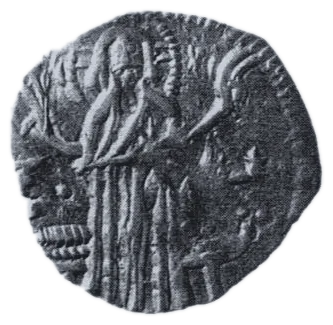
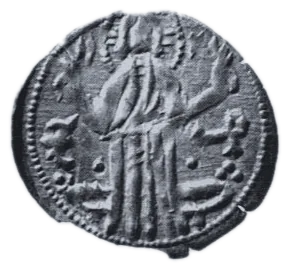
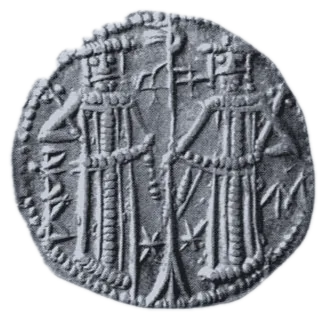
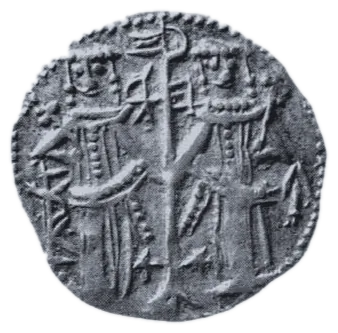
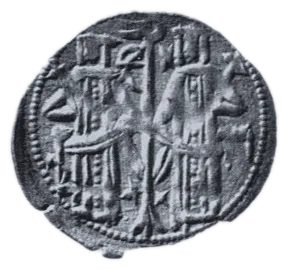
Coin photographs from A. Radushev & G. Zhekov, Catalogue of Bulgarian Medieval Coins IX–XV c. (Agató, 1999).
In the news
- The lords of Sredets/Sofia in the 14th century8 February 2025 · Prof. Plamen Pavlov, Trud