
Shishman dynasty
Ivan Shishman
Son of Ivan Alexander by his second marriage to Sara-Theodora. Last tsar of the Tarnovo realm; ruled a shrunken, besieged state that fell to the Ottomans in 1393–1395.
Biography
Ivan Shishman was born in 1350 into the ruling Shishman dynasty, whose court ideology also claimed the inheritance of the Asenid tsars. He was the elder of the two sons of Tsar Ivan Alexander by his second wife, Sara-Theodora, a Jewish convert to Christianity whom the sources call Theodora II. A contemporary formulation describes her as the pious empress of Jewish lineage and the mother of the “great tsar Ivan Shishman.” His birth followed the deaths of Ivan Alexander’s earlier sons Ivan Asen and the designated heir Michael Asen and transformed an already delicate succession. Ivan Shishman’s principal rival in dynastic seniority was his older half-brother Ivan Sratsimir, son of Ivan Alexander’s first marriage and, by 1352, holder of the explicitly succession-bearing title “young tsar.”
Ivan Alexander displaced Ivan Sratsimir in favor of the child of his second marriage, perhaps under Sara-Theodora’s influence, although the sources cannot establish her personal responsibility. The legal argument adopted from Byzantine practice was that Ivan Shishman, unlike Ivan Sratsimir, had been born after his father became tsar and could therefore be styled porphyrogenitus, or “born in the purple.” By 1355–1356 he possessed the title tsar and had apparently replaced Sratsimir as young tsar and heir. The family miniatures in the Four Gospels of 1355–1356, British Museum Additional Manuscript 39627, portray Ivan Alexander, Theodora II, Ivan Shishman, his younger brother Ivan Asen, their sisters, and the imperial son-in-law Despot Constantine, but conspicuously omit Ivan Sratsimir. A note in the German Collection attests Ivan Shishman’s porphyrogenite status in 1359, while manuscript colophons document the progression of his titles.
Little is securely known of Ivan Shishman’s activity before his accession. His only clearly attested participation in public life was at the anti-heretical council convened in Tarnovo in 1360, where the Life of Theodosius of Tarnovo mentions him and his younger brother Ivan Asen beside their father. Attempts to insert him into the international conflict over Hungarian-occupied Vidin in 1365–1369 depend on an erroneous date for Ivan Alexander’s death in the Anonymous Bulgarian Chronicle and should be rejected. Ivan Sratsimir, meanwhile, had received Vidin and its surrounding territory, the traditional western appanage of the Shishman-Asen family, together with the title tsar. The settlement prevented an immediate contest for Tarnovo but institutionalized the political separation between the two brothers.
Ivan Alexander died on 17 February 1371, and Ivan Shishman succeeded him without a recorded challenge. Such an orderly father-to-son transfer was unusual in the preceding history of the Second Bulgarian Empire, but it transmitted much less than the universal monarchy proclaimed by court tradition. Ivan Shishman ruled the Tarnovo realm, while Ivan Sratsimir governed an increasingly independent Vidin Tsardom and the rulers of Karvuna and Kaliakra controlled the Dobruja despotate. The later traveler Hans Schiltberger summarized this disintegration as the existence of “three Bulgarias.” Ivan Sratsimir apparently judged that civil war would bring him only a diminished state exposed directly to Ottoman expansion and therefore retained Vidin rather than contesting his brother’s accession. Tarnovo itself had lost access to much of Thrace and was separated from the Black Sea interests dominated by Dobrotitsa.
The year 1371 also brought the Christian catastrophe at Chernomen, or the Battle of the Maritsa. The defeat opened the Balkan interior to Ottoman pressure and defined the strategic conditions of Ivan Shishman’s reign, even though the supplied evidence does not permit a detailed reconstruction of his personal role in that battle. His government inherited a policy that had previously amounted largely to passive resistance: the central authority tried to preserve a continuously shrinking realm, while inhabitants of individual towns and fortresses bore much of the immediate burden of defense. For 1372–1377 the quoted sources provide no reliable year-by-year sequence of campaigns, commanders, or captured strongholds. They establish only the growing Ottoman danger and the progressive erosion of Tarnovo’s ability to conduct an independent regional policy.
Ivan Shishman nevertheless maintained the full ideological language of Bulgarian emperorship. In his documents he styled himself “tsar and autocrat of all Bulgarians and Greeks,” even though he was not an autocrat in the practical sense and did not rule all Bulgarians. The discrepancy was not mere personal vanity: it expressed the continuity claimed by the Tarnovo chancery with the “first-throned” and saintly departed tsars. The Rila charter states that his tsardom possessed their throne by divine indication and angelic transmission. Such language also asserted his precedence over Ivan Sratsimir, but by the later fourteenth century it survived principally in ceremonial subscriptions and monastic grants. Political reality recognized Tarnovo and Vidin as distinct powers; the ancient universal title could not restore the territorial unity that Ivan Alexander’s dynastic settlement had helped dissolve.
Under Ottoman pressure Ivan Shishman was at times compelled to acknowledge the suzerainty of Sultan Murad I. The surviving extracts do not preserve the date, text, tribute provisions, or military obligations of any vassal agreement, so these arrangements should not be reconstructed more precisely than the evidence allows. As part of this policy of accommodation, Ivan Shishman gave his sister Kera Tamara in marriage to Murad. The union was an act of dynastic diplomacy intended to postpone destruction rather than evidence of a stable alliance, and it did not prevent Ottoman forces from taking Bulgarian fortresses in succession. His policy consequently alternated between submission imposed by necessity and continued resistance whenever circumstances permitted; portraying either posture as permanent oversimplifies a reign conducted under extreme strategic constraint.
In 1378 Ivan Shishman issued the Rila chrysobull, one of the principal surviving acts of his reign. It confirmed royal patronage of the Rila Monastery and embedded that patronage in an elaborate statement of sacred legitimacy. The charter shows that, even as Ottoman pressure mounted, the Tarnovo court retained a functioning chancery capable of issuing solemn gold-sealed grants and of articulating the traditional symbiosis between monarchy and Orthodox monasticism. It is also one of the chief sources for Ivan Shishman’s title “tsar and autocrat of all Bulgarians and Greeks.” No securely dated military action for 1378 is supplied by the excerpts, making the charter far more informative about royal ideology and ecclesiastical policy than about the contemporary frontiers of the state.
A second important grant, the Vitosha or Dragalevtsi chrysobull, was issued before 1385, its terminus ante quem. Together with the Rila charter, it demonstrates sustained patronage of monasteries in the wider region of Serdica, or Sofia. Some historians have interpreted the two grants as instruments in a struggle between Ivan Shishman and Ivan Sratsimir for control of Serdica and its surroundings. The narrative source excerpt expressly warns that neither charter nor any other cited text supports that conclusion. Ecclesiastical disagreements may have affected the region, but a territorial war between the brothers cannot be inferred from monastic benefactions alone. For 1379–1384 the quoted evidence again offers no trustworthy annual campaign narrative, and the Dragalevtsi act must therefore be read primarily as evidence for religious patronage, administration, and royal self-presentation.
By 1386 Byzantine observers treated the Vidin and Tarnovo realms as essentially equal political entities, despite the ceremonially superior claims of Ivan Shishman’s chancery. Ecclesiastical correspondence is revealing: the Constantinopolitan patriarch maintained relations with the patriarch of Tarnovo and “all Bulgaria,” while communications to the Tarnovo ruler could pass through a metropolitan. The material does not prove the superiority of Vidin, but it does show that the Byzantines no longer regarded Ivan Shishman as the unquestioned ruler of a single Bulgarian state. Ivan Sratsimir had also sought to alter Vidin’s ecclesiastical alignment by strengthening ties with Constantinople. Thus Ivan Shishman faced not a rebellion that he could simply suppress but an entrenched division of sovereignty, jurisdiction, and diplomatic orientation.
The military history of the later 1380s and the opening years of the 1390s is exceptionally obscure in the supplied sources. They describe an exhausting defensive struggle lasting more than two decades and the gradual Ottoman acquisition of Bulgarian fortresses, but they do not name additional battles, give dependable capture dates, or identify the commanders involved. It would therefore be unsafe to construct a detailed itinerary of Ottoman advances or to attribute particular engagements to Ivan Shishman. What can be said is that the Tarnovo realm became increasingly encircled and that resistance was often local, undertaken by the defenders of individual settlements as central resources diminished. Literary works, inscriptions, and manuscript notes from the period convey fear, resignation, disbelief, and a pervasive expectation of disaster rather than confidence in organized victory.
The decisive blow came in the summer of 1393, when Tarnovo fell after a prolonged Ottoman siege. The sources supplied here do not provide an exact beginning date or a day-by-day account, but they agree on the significance of the event: the ancient capital and institutional center of the Tarnovo Tsardom was captured, and the territorial state over which Ivan Shishman had ruled was effectively broken. Patriarch Euthymius, the leading spiritual authority of the Bulgarians, was sent into exile. The fall of the capital also severed the normal relationship between court, patriarchate, aristocracy, and the literary culture associated with Tarnovo. Ivan Shishman was not thereby immediately removed from history, however, for he continued to hold out from the Danubian fortress of Nikopol.
From 1393 until 1395 Ivan Shishman’s remaining authority was centered at Nikopol. The established account presents him as continuing resistance from that fortress after the loss of Tarnovo, but the excerpts do not permit a detailed reconstruction of his administration, forces, or relations with the Ottomans during these final years. He died in 1395, aged about forty-five. Neither a precise date nor the exact circumstances of his death are securely established in the material provided, and later descriptions of capture or execution should not be treated as certain without additional testimony. His death marked the end of the Tarnovo monarchy: there was no effective successor on its throne, although the separate Vidin realm of Ivan Sratsimir survived beyond the destruction of Ivan Shishman’s state.
Ivan Shishman’s ecclesiastical policy continued important traditions of his father’s reign. His appearance at the anti-heretical council of 1360 linked him from youth with the defense of Orthodoxy, while the Rila and Dragalevtsi chrysobulls show him as a patron of monastic institutions. The Prayer Canon for the Tsar by Ephrem has plausibly been associated with him because it evokes a youthful ruler, a capital most probably identifiable as Tarnovo, danger to Bulgaria in the last quarter of the fourteenth century, and the anti-heretical concerns of the Tarnovo Church. The identification is persuasive rather than absolutely explicit. Patriarch Euthymius and the literary milieu whose orthographic principles appear in the manuscript tradition furnished the spiritual setting of the reign, but the surviving evidence reveals more about religious ideals and anxiety than about routine internal administration.
Economic and monetary evidence for Ivan Shishman’s reign is notably deficient in the quoted material. The two chrysobulls prove that the crown could still grant or confirm monastic rights and privileges, yet the excerpts do not reproduce their fiscal clauses in sufficient detail to reconstruct taxation, landholding, market regulation, or state revenue. Nor do they identify a coin type, mint, denomination, weight standard, or monetary reform securely attributable to Ivan Shishman. It would therefore be misleading to claim either economic recovery or a specific monetary collapse from this dossier alone. The shrinking territorial base, warfare, and loss of fortresses necessarily constrained royal resources, but the precise scale and mechanism of that contraction remain undocumented here. Chancery production and monastery patronage nevertheless indicate that royal institutions continued to function even under acute military pressure.
No spouse of Ivan Shishman is securely identified in the established record supplied here. His known children are Alexander Shishmanov, Fruzhin, and Keratsa Shishmanova, but the material gives no reliable information about their mother or about a marriage settlement designed to secure the succession. A manuscript, Laurentianus plut. LIX, codex 13, folio 171, claims that a Bulgarian ruler named Shishman was the father of the future patriarch Joseph II of Constantinople, who held office from 1416 to 1439. The genealogical study cautions that this Shishman was probably not Tsar Ivan Shishman, and Joseph II should consequently not be added to his children. Within the wider dynasty, the most consequential family policies were Ivan Alexander’s preference for Ivan Shishman over Ivan Sratsimir and Ivan Shishman’s later marriage diplomacy involving his sister Kera Tamara and Murad I.
Ivan Shishman entered Bulgarian historiography as a helpless and tragic ruler, while folklore often transformed him into a heroic symbol of resistance. Both images simplify a poorly documented reign. He inherited a fractured state, confronted Ottoman expansion after the disaster at Chernomen, used vassalage and dynastic diplomacy to gain time, patronized major monasteries, and continued resistance after the fall of Tarnovo. Yet his chancery’s universal claims could not overcome the political reality of the “three Bulgarias.” The source base is exceptionally uneven: the Life of Theodosius of Tarnovo, manuscript colophons, the 1355–1356 Four Gospels, Ephrem’s Prayer Canon, the Rila and Dragalevtsi chrysobulls, ecclesiastical correspondence, inscriptions, and later testimony such as Schiltberger preserve isolated points rather than a continuous narrative. Modern reconstructions must therefore distinguish sharply between dated evidence, plausible interpretation, and unsupported tradition. His enduring significance lies less in demonstrable battlefield success than in his position as the last tsar of the Tarnovo realm and the tragic representative of Bulgaria’s final, protracted resistance before Ottoman conquest.
Sources
“Иван Шишман, син на Иван Александър от брака му със Сара-Теодора, бил последният търновски цар.”
— The Asen Family (1186–1460): Genealogy and Prosopography, p. 19
Images
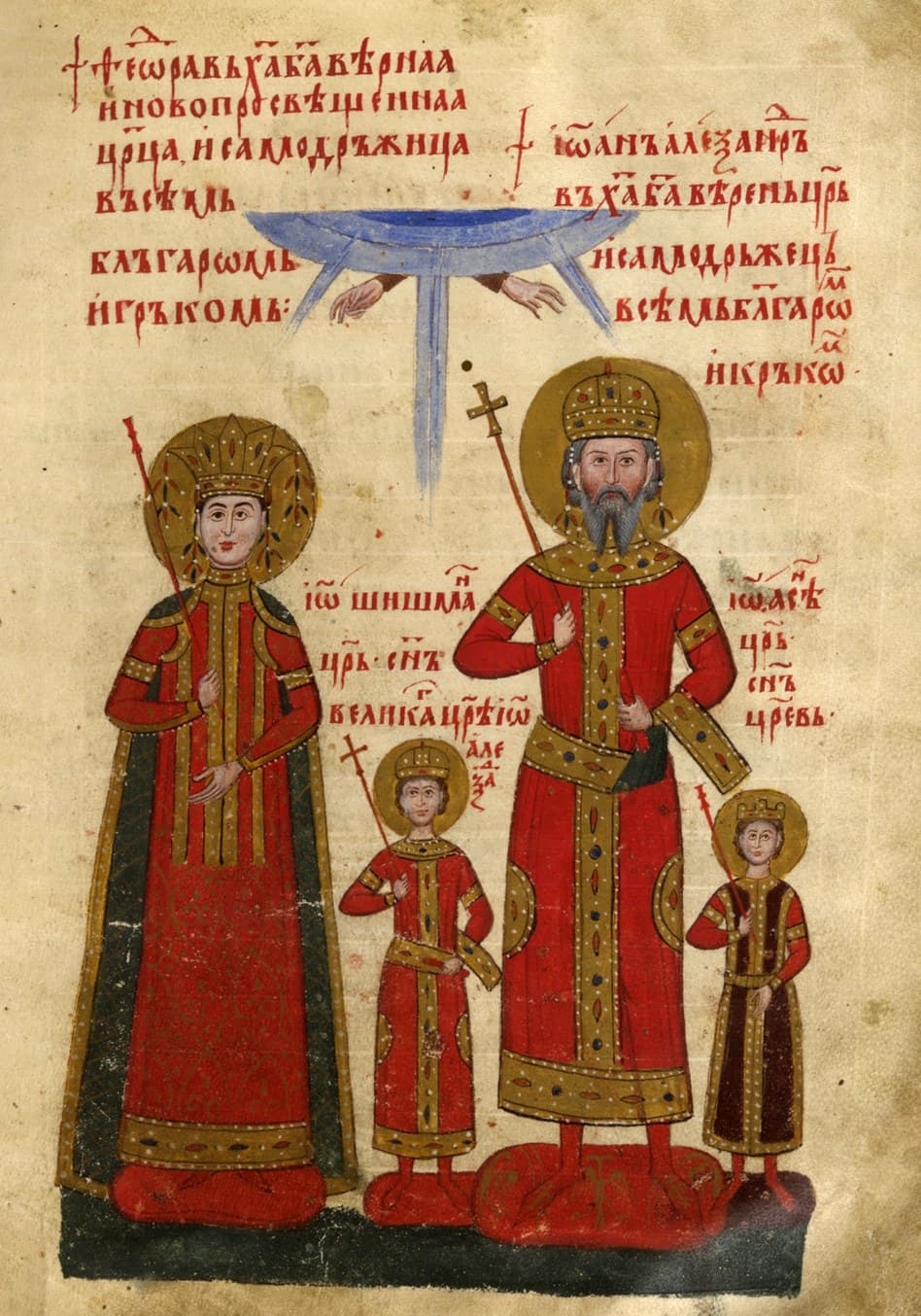
The royal family: Tsar Ivan Alexander, Tsaritsa Theodora and their sons (Gospels of Tsar Ivan Alexander)British Library, Add MS 39627 — Public domain
Coins (48)
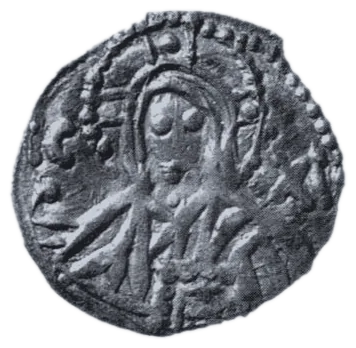
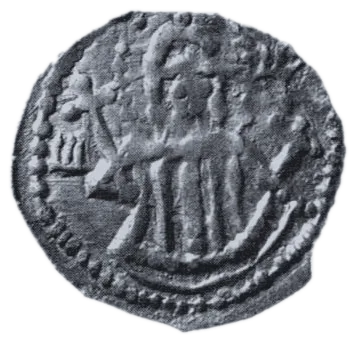
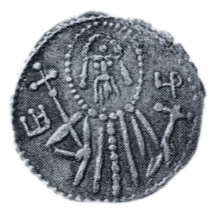
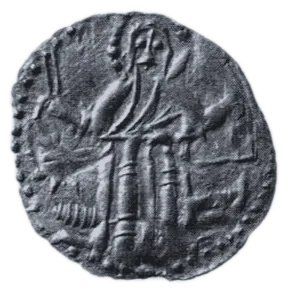
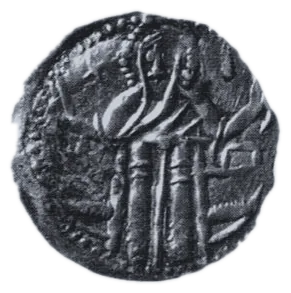
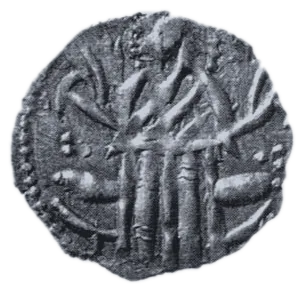
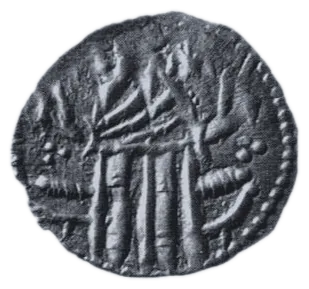
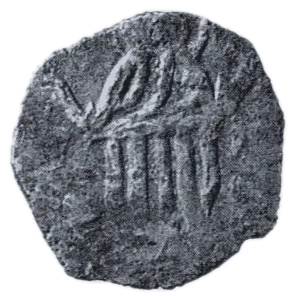
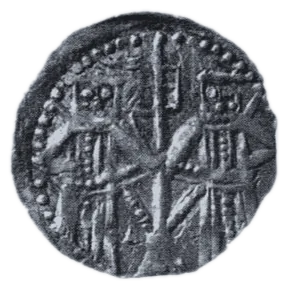
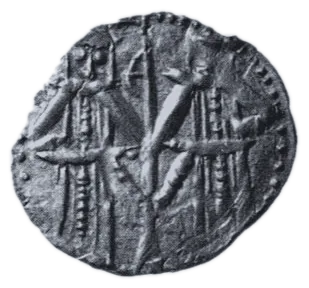
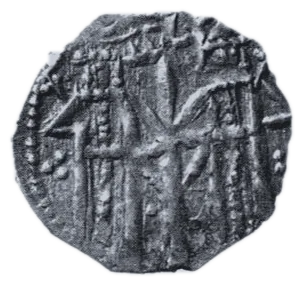
Coin photographs from A. Radushev & G. Zhekov, Catalogue of Bulgarian Medieval Coins IX–XV c. (Agató, 1999).
In the news
- The Battle of Nicopolis (25 September 1396) and the fate of Tsar Ivan Sratsimir27 September 2026 · Prof. Plamen Pavlov, Trud
- 'Sratsimir, Tsar of the Bulgarians': a riddle in the memoirs of Kiro Tuleshkov28 February 2026 · Prof. Plamen Pavlov, Trud
- St Patriarch Evtimiy: the 'good shepherd' in a time of trial17 January 2026 · Prof. Plamen Pavlov, Trud
- Tsar Ivan Shishman and his sons7 June 2025 · Prof. Plamen Pavlov, Trud
- The diplomacy of Tsar Ivan Shishman31 May 2025 · Prof. Plamen Pavlov, Trud
- Coins as a key to understanding the Bulgarian Middle Ages29 March 2025 · Prof. Plamen Pavlov, Trud
- The lords of Sredets/Sofia in the 14th century8 February 2025 · Prof. Plamen Pavlov, Trud