
Shishman dynasty
Ivan Sratsimir
Son of Ivan Alexander by his first marriage; received the Tsardom of Vidin as a separate appanage around 1356. Ruled Vidin until the Ottoman conquest in 1396; died in captivity.
Biography
Ivan Sratsimir was born in 1324, the second son of Tsar Ivan Alexander by his first marriage to Theodora Basaraba. He belonged to the Shishman dynasty, whose political fortunes were closely connected with northwestern Bulgaria: Vidin had earlier been ruled with considerable autonomy by Shishman, had furnished Bulgaria with Tsar Michael III Shishman, and had subsequently been governed by the despot Belaur. After Belaur’s defeat, Vidin was generally regarded as reintegrated into the Tarnovo state, although some scholars allow that it retained a special status. This regional tradition made the city and its surrounding Danubian lands an appropriate appanage for Ivan Sratsimir when the succession at Tarnovo turned against him.
The decisive event of Ivan Sratsimir’s youth was the rupture in the royal family. Ivan Alexander repudiated Theodora Basaraba, married Sarah-Theodora, and designated their son Ivan Shishman as heir at Tarnovo. John V. A. Fine emphasizes the influence of the second tsaritsa, while the much later Mavro Orbini supplied a personal explanation for the breakdown of the first marriage; such retrospective testimony cannot be treated as certain. Ivan Sratsimir’s displacement from the succession created lasting political estrangement. His numerous siblings included Mihail Asen IV, Ivan Asen IV, Ivan Shishman, Kera Tamara, Keratsa-Maria, Ivan Asen Aleksandrov, Desislava and Vasilisa, but Ivan Shishman, his younger half-brother and rival heir, was the most consequential for his career.
As compensation, Ivan Alexander granted Ivan Sratsimir the old dynastic possession of Vidin and its environs. The chronology is not perfectly secure: proposed dates range from between 1352 and 1355/56 to shortly before 1360, while the established beginning of his reign is conventionally placed in 1356 and the colophon of the Bdin Miscellany supplies a terminus ante quem in 1359/60. No separate ceremonial accession is recorded. Ivan Sratsimir already possessed a tsar’s dignity in his youth and retained it at Vidin, gradually converting an appanage into an autonomous state. The Bdin colophon calls him “autocratic tsar of Bulgarians and Greeks,” probably an expression of courtly exaltation; his Brașov Charter uses the more restrained formula “Ivan Sratsimir, ruling tsar,” and another scholarly reconstruction summarizes his usage as “tsar of the Bulgarians.” Until 1371 he nevertheless had to acknowledge, at least formally, his father’s senior authority.
The first great test came from Hungary. King Louis I of Hungary, whose royal style included the traditional claim rex Bulgariae, demanded that Ivan Sratsimir recognize Hungarian overlordship. His refusal led to invasion in 1365. Louis’s army assembled at the end of April, set out on 1 May, crossed the Danube near Orșova late in the month, and reached Vidin on 30 May. Ivan Sratsimir withdrew behind the city’s walls, apparently expecting assistance from his father, but Vidin fell on 2 June 1365. During the following three months the Hungarians occupied almost the whole principality. Benedict Himfi, ban of Pressburg, was initially appointed governor; he was later followed by Dionysius Lackfi, who styled himself voivode of Transylvania, governor of Vidin, and lord of the counties of Temes and Szolnok.
Ivan Sratsimir and his family were removed from Vidin and imprisoned in the fortress of Humnik, identified with modern Bosiljevo in Croatia. Secure evidence indicates that they were compelled to accept Catholicism, although it is uncertain whether this occurred before or after their removal. The Hungarian authorities also attempted to convert the Orthodox population through Franciscan missionaries. A claim that approximately 200,000 people—supposedly one third of the principality’s inhabitants—were converted is almost certainly exaggerated, but the coercive campaign itself is well attested. Its human impact appears in the colophon written by the brothers Dragan and Rayko in an Apostle manuscript now at the Athonite monastery of Saint Paul: they remembered the days “when the Hungarians ruled Vidin and there was great sorrow for the people.”
While Ivan Sratsimir remained captive, the Vidin question became part of a wider diplomatic crisis in 1366. Emperor John V Palaiologos travelled with his sons Manuel and Michael and George Manikaites to Buda, seeking Hungarian and papal assistance against the Ottomans. On his return, his onward passage from Vidin through Bulgarian territory was denied on Ivan Alexander’s orders. Count Amadeus VI of Savoy responded with a Black Sea expedition in the autumn of 1366, capturing Agathopolis, Skafida, Sozopolis, Anchialos, Mesembria and Emona and even besieging Varna. Negotiations in which Dobrotitsa played an important role secured John V’s passage. The Savoyards relinquished their conquests from Mesembria to Agathopolis to the emperor, while John V undertook to assist in liberating Vidin and provided the Wallachian voivode Vladislav Vlaicu with 180,000 florins for the campaign.
Plans for a broader coalition produced no immediate change in 1367. In 1368 the war between Hungary and Vladislav Vlaicu became central; the defeat of a Hungarian force near the Dâmbovița weakened Hungary’s position south of the Danube. In 1369 the inhabitants of Vidin rose against the occupation and the Franciscans, and Vlaicu, aided by local support, captured the city. The Hungarians recovered it after roughly six months, but negotiations then brought their rule to an end. A letter of Louis I to Master Peter Himfi, dated 29 August 1369, states that the “emperor of Vidin” was to be released under the guarantees of Vlaicu and Dobrotitsa and restored to his land, while daughters of the ruler were to be delivered as hostages. Ivan Sratsimir returned to Vidin in the autumn of 1369, after four years of captivity and occupation.
Fine interprets the settlement as Ivan Sratsimir’s acceptance of Hungarian suzerainty: Louis preferred a locally legitimate vassal capable of defending Vidin to a Hungarian-appointed ban. The Bulgarian narrative places greater emphasis on the negotiated restoration organized by Ivan Alexander, Vlaicu and Dobrotitsa, and the precise legal balance between vassalage and practical autonomy cannot be reconstructed completely. Ivan Sratsimir resumed the exercise of sovereign powers, but for about a year and a half he still had to reckon with his father. Ivan Alexander died on 17 February 1371, and Ivan Shishman succeeded without obstruction at Tarnovo. From that point Ivan Sratsimir added formal independence to the political autonomy already achieved at Vidin.
The relationship between the two Bulgarian tsars after 1371 is disputed. Fine states that Ivan Sratsimir attempted to conquer all Bulgaria, seized Sofia, and retained it for only a year or two. The Bulgarian narrative scholarship represented in the excerpts rejects confident claims of warfare between Vidin and Tarnovo, stressing that no secure source records military clashes between the brothers and that such reconstructions rest largely on legend and presumed hostility. Ivan Sratsimir’s resentment and the political separation of the two realms are evident, but a sustained civil war cannot be asserted. He apparently judged that Vidin, with a secure capital and full royal honors, was preferable to a ruinous contest for a Tarnovo realm already deprived of much of Thrace and the Black Sea region. Vidin consequently became one of the “three Bulgarias” later described by Hans Schiltberger.
Ecclesiastical policy was an essential instrument of Ivan Sratsimir’s sovereignty. He removed the Church of Vidin from the jurisdiction of the patriarch of Tarnovo and placed it under the ecumenical patriarch of Constantinople, thereby severing its institutional dependence on his brother’s capital without abandoning Orthodoxy. The chronology is again debated. Fine associates the measure with the freedom gained through Hungarian support after 1369, whereas the Bulgarian reconstruction sees cautious preliminary steps in late 1369 or early 1370 and formal completion after Ivan Alexander’s death. A document of that period names the metropolitan of Vidin and dikaiophylax Daniel Kritopoulos in connection with an ecclesiastical mission. Constantinopolitan patriarchal correspondence addressed Ivan Sratsimir in exalted imperial language and did not place him below Ivan Shishman, confirming that internationally his tsarship was treated as genuine.
His government displayed the other material attributes of independent kingship. Ivan Sratsimir issued coins bearing his own image, although the excerpts do not establish a precise chronology, denominations or volume of production. He issued the Brașov Charter for foreign merchants, demonstrating an autonomous capacity to regulate trade and grant legal privileges. Vidin functioned as a true capital rather than merely as the residence of an appanage-holder, while its formidable walls remained the principal military foundation of his state. The Bdin Miscellany reflects a courtly literary environment and a deliberate assertion of local identity. Some of its orthographic features have been interpreted as Serbian influence, but the Bulgarian study argues that they represented a limited cultural reaction against Tarnovo rather than evidence of enduring Serbian domination. The sources reveal almost nothing definite about taxation, agrarian administration or institutional reform, so these cannot safely be reconstructed.
No spouse of Ivan Sratsimir can be securely identified from the supplied evidence. His established children were his son and heir Constantine Sratsimirov and his daughter Doroteya. Hungarian custody of members of the royal family became an instrument of marriage diplomacy after the restoration of 1369. Fine reports that Louis retained two of Ivan Sratsimir’s daughters as hostages: one soon died, while the other was married through Hungarian negotiations to Tvrtko I of Bosnia in 1374. The excerpt does not name the bride, and its reference to two daughters sits uneasily with the supplied genealogy, which securely lists only Doroteya; the discrepancy should therefore remain explicit. Ivan Sratsimir later proclaimed Constantine co-ruler with the title tsar, providing for an orderly dynastic succession within the Vidin realm.
For much of the 1370s and early 1380s Vidin enjoyed a precarious respite. Political geography helped: Tarnovo Bulgaria stood between it and the main lines of Ottoman advance, while Ivan Shishman’s resistance and the unhappy diplomatic fate of their sister Kera Tamara helped preserve a fragile peace. This relative security should not be mistaken for strength. The catastrophe at Chernomen had already warned of the changing balance in the Balkans, and Ottoman power continued to expand. It is generally accepted that after Ali Pasha’s campaign against Tarnovo Bulgaria and Dobruja in 1388, Ivan Sratsimir was compelled to acknowledge Ottoman suzerainty and admit an Ottoman garrison to Vidin. Yet the excerpts explicitly stress the lack of direct evidence, and the terms and even the precise process of his submission remain uncertain. No reliable account permits his actions during the battles of Kosovo or Rovine to be reconstructed.
Tarnovo fell to the Ottomans in 1393, and after Ivan Shishman’s death Ivan Sratsimir remained the last Bulgarian tsar ruling from a Bulgarian capital, although his probable vassal status complicates the description “independent.” In 1395, the second year after Tarnovo’s fall according to Metropolitan Joasaph of Vidin, Ivan Sratsimir sent Constantine and Joasaph to the conquered capital on “necessary and great royal affairs.” The political purpose of the mission is unknown, but its recorded result was the transfer to Vidin of the relics of Saint Philothea, which had been kept at Tarnovo since the reign of Kaloyan. Joasaph’s testimony also securely confirms Constantine’s prominence and his father’s continuing exercise of royal authority. Constantine of Kostenets likewise calls the prince a co-ruler, though Joasaph’s contemporary ecclesiastical testimony is the stronger evidence.
In 1396 Ivan Sratsimir sided with the Christian crusading forces. Their campaign ended in the Battle of Nicopolis on 25 September 1396, where the crusading army was decisively defeated. The Ottoman response eliminated the remaining Vidin state: Vidin was occupied late in 1396, Ivan Sratsimir was captured, and Constantine escaped under circumstances the sources do not describe. The deposed tsar died in captivity in 1397. A tradition that he was strangled at Bursa is plausible but not securely demonstrated by the evidence presented and must remain qualified. His reign, conventionally dated from 1356 to 1396, therefore ended with the Ottoman conquest, not with an abdication or an orderly succession.
Ivan Sratsimir’s historical significance lies in both the success and the ultimate failure of his political project. He transformed Vidin from a dynastic appanage into a self-governing tsardom with its own church alignment, coinage, diplomacy, commercial charter and co-ruler, but the same achievement embodied the fragmentation that prevented a unified Bulgarian response to Hungary and the Ottomans. The territorial state ended in 1396, yet its dynastic claim did not immediately disappear: Constantine fled first toward Hungary and later reached the court of Despot Stefan Lazarević; a letter of King Sigismund to Philip of Burgundy dated 16 April 1404 calls him “Constantinus, imperator Bulgariae magnificus” and places him in an alliance with Stefan Lazarević and Mircea the Elder. Reconstruction of Ivan Sratsimir’s life remains unusually dependent on fragments—the Bdin colophon, the Brașov Charter, coins, patriarchal documents, Louis I’s letter, Dragan and Rayko’s marginal note, Joasaph’s narrative, Constantine of Kostenets and Schiltberger. Fine accepts some claims, notably the seizure of Sofia and explicit Hungarian vassalage, more readily than the Bulgarian narrative; Donald M. Nicol’s Byzantine synthesis chiefly supplies the setting of John V’s diplomacy and the Ottoman crisis. The scarcity, partisanship and retrospective character of these sources require caution, especially regarding internal warfare, family details and the circumstances of Ivan Sratsimir’s death.
Sources
“Иван Срацимир, син на Иван Александър от първия му брак, получил във владение Видинското царство.”
— History of Medieval Bulgaria, 7th–14th Century, p. 862
Coins (48)
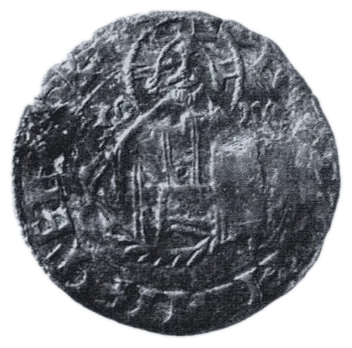
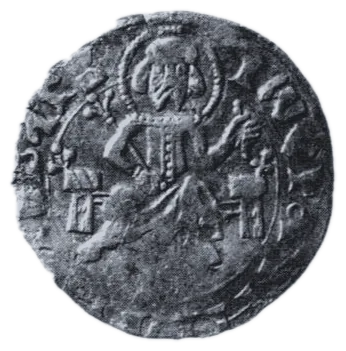
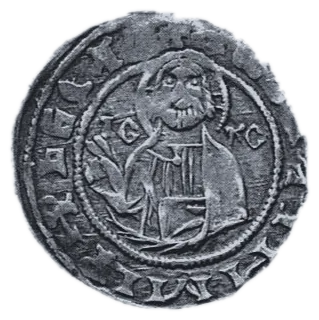
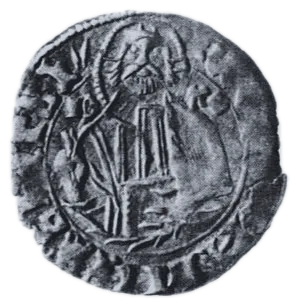
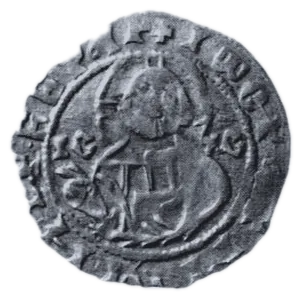
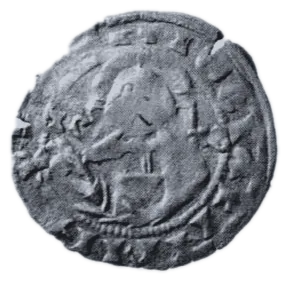
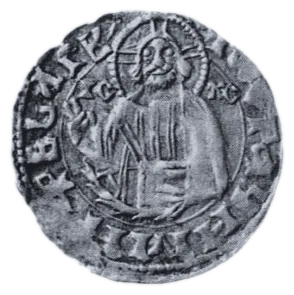
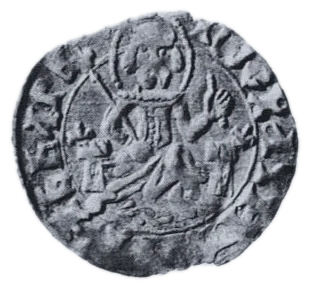
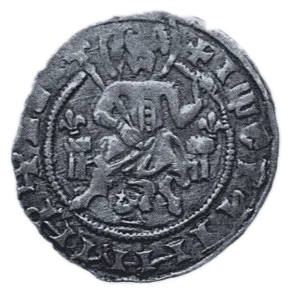
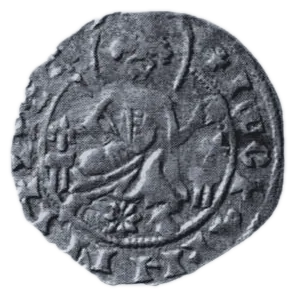
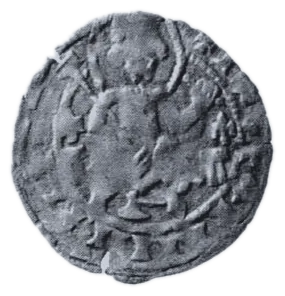
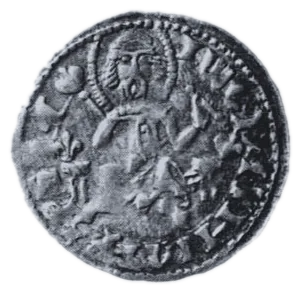
Coin photographs from A. Radushev & G. Zhekov, Catalogue of Bulgarian Medieval Coins IX–XV c. (Agató, 1999).
In the news
- The Battle of Nicopolis (25 September 1396) and the fate of Tsar Ivan Sratsimir27 September 2026 · Prof. Plamen Pavlov, Trud
- The women who ruled the Bulgarians of Macedonia in the 14th century7 March 2026 · Prof. Plamen Pavlov, Trud
- 'Sratsimir, Tsar of the Bulgarians': a riddle in the memoirs of Kiro Tuleshkov28 February 2026 · Prof. Plamen Pavlov, Trud
- The diplomacy of Tsar Ivan Shishman31 May 2025 · Prof. Plamen Pavlov, Trud
- The lords of Sredets/Sofia in the 14th century8 February 2025 · Prof. Plamen Pavlov, Trud
- Tsar Konstantin II Asen (1397–1422) revisited6 December 2024 · Prof. Plamen Pavlov, Trud
- The 'enigma' of Tsar Konstantin II Asen29 March 2019 · Prof. Plamen Pavlov, Trud