
Terter dynasty
George Terter II
Son of Theodore Svetoslav, the last ruler of the Terter dynasty. Reigned barely a year and died childless in 1322, extinguishing the dynasty.
Biography
George Terter II was tsar of Bulgaria from 1321 until his death in 1322, a reign of barely a year that closed the history of the Terter dynasty. He was the son and successor of Theodore Svetoslav and the grandson of George Terter I. No securely documented information survives about his date of birth, childhood, education, or activities before his accession. His mother is not identified in the supplied evidence, and no sibling, spouse, or child is known. Because he died childless, the direct dynastic line ended with him.
George belonged to a ruling house described in the Bulgarian narrative as Cuman in origin but long integrated into the Bulgarian aristocracy and into the political, ecclesiastical, and cultural traditions of the Bulgarian state. His grandfather George Terter I had ruled from 1280 to 1292 during a period of civil conflict, aristocratic separatism, foreign invasion, and domination by the Golden Horde. George I was characterized by the Byzantine historian George Pachymeres as intelligent and brave, yet his government succumbed to internal weakness and pressure from Khan Nogai. The contrast between that troubled era and the position inherited by George II was substantial: Theodore Svetoslav had overcome much of the opposition among the boyars and higher clergy, regulated relations with the Golden Horde, partially restored central authority, and reopened an active southern policy against Byzantium.
Theodore Svetoslav's reign formed the indispensable foundation of his son's brief kingship. After gaining the throne in 1300, Theodore defeated Byzantine forces at the River Skafida in 1304 and concluded a durable peace with Byzantium in 1307. He also reasserted Tarnovo's authority over important territories and left a state appreciably stronger and more stable than the one inherited by him. George II therefore did not need to establish a new regime after prolonged anarchy; rather, he inherited an existing dynastic government, a restored royal authority, and a frontier system whose most contested sectors lay in Zagore, northern Thrace, and the southern Black Sea region.
The chronology of George's accession is nevertheless one of the central source problems of his biography. The established chronology places his succession to Theodore Svetoslav in 1321 and his death in 1322. The Bulgarian narrative excerpts instead give Theodore's reign as 1300–1322, George's as 1322–1323, and in one passage place Theodore's death in August 1322 and George's death in the spring of 1323. A genealogical discussion cited in the excerpts further warns that George II's direct succession from his father is not entirely clear in its details. No evidence supplied here establishes a coronation date, a period of co-rule, or the precise mechanism by which power passed to him, so those possibilities cannot safely be asserted. The most defensible account follows the established reign of 1321–1322 while explicitly acknowledging the rival medievalist chronology.
For 1321, the first year of the established reign, the surviving evidence records no individual decree, campaign, ecclesiastical appointment, or diplomatic mission undertaken by George. His initial position must instead be understood through the state he inherited and through the widening conflict within the Byzantine Empire. The rival emperors Andronikos II Palaiologos and his grandson Andronikos III Palaiologos were struggling for power, destabilizing the Byzantine provinces adjacent to Bulgaria. One narrative remarks that Theodore Svetoslav died without having made Bulgaria's orientation in this dispute entirely clear. George's subsequent conduct was not a formal declaration preserved in a treaty, but an opportunistic military intervention designed to exploit the temporary evacuation and political disorganization of Byzantine northern Thrace.
The decisive events of George's reign belong to 1322. Andronikos Palaiologos, the Byzantine governor of the Rhodope region and northern Thrace, abandoned the young emperor Andronikos III and transferred his allegiance to Andronikos II. He then left the province with his troops in order to assist the threatened capital, Constantinople. The removal of this field force exposed the frontier cities and fortresses. George responded by leading or dispatching Bulgarian forces into the unprotected region. The evidence does not name a formal Bulgarian-Byzantine declaration of war, nor does it identify a treaty by which George joined either Palaiologan faction; his policy appears in the sources principally through military action.
During the harvesting season, dated in the narrative to August–September 1322, the Bulgarians captured a series of cities and fortresses in northern Thrace, including the populous city of Philippopolis, modern Plovdiv. Its seizure was the outstanding success of George's reign. Because Philippopolis stood near the disputed Bulgarian-Byzantine frontier, the tsar installed an unusually substantial garrison: 1,000 Bulgarian and Alan cavalry and 2,000 selected, heavily armed infantry. Overall command was entrusted to Ivan the Russian, while the Alan commanders Itil and Temir and the Hungarian Inas led individual contingents. These names reveal the ethnically varied military personnel available to the Tarnovo monarchy, although the excerpts do not explain their earlier careers or subsequent fate.
After taking Philippopolis and a considerable part of northern Thrace, George sent another army farther southeast. It devastated part of eastern Thrace and the settlements around Adrianople, modern Edirne. No named battle is recorded during this advance, and the sources supply neither troop totals for the raiding army nor a detailed itinerary. The timing of the expedition during the harvest gave it an immediate economic as well as military effect, since the occupation and devastation fell upon a productive agricultural region. Yet the campaign did not end in an unqualified Bulgarian victory. While withdrawing, the Bulgarian force was surprised in a night attack and defeated; the location and conventional name of this engagement are not given, and it would be unsafe to invent either.
The reversal resulted from a sudden change in the Byzantine civil war. At the end of July 1322 Andronikos II and Andronikos III concluded peace at Epivates, temporarily freeing the younger emperor to organize the defence of the threatened Thracian provinces. Following the nocturnal victory over the retreating Bulgarians, Andronikos III went to Constantinople to report the details to his grandfather. George's intervention had therefore achieved rapid territorial gains while Byzantine authority was divided, but it could not secure an enduring strategic settlement once the two emperors suspended their quarrel. No Bulgarian-Byzantine peace treaty concluded by George, no tribute arrangement, and no surviving diplomatic correspondence are mentioned in the excerpts.
The occupation of Philippopolis shows that George attempted more than a passing raid. The large permanent garrison and its carefully differentiated commands indicate an intention to hold the city as a frontier stronghold. Nevertheless, the evidence does not establish how long Bulgarian control lasted or whether George personally entered the city. Nor does it identify further battles for the fortress during his lifetime. His policy continued the active southern orientation made possible by Theodore Svetoslav's stabilization of the kingdom, but the scale and brevity of the surviving operations do not justify attributing to George a comprehensive plan for conquering Thrace or intervening decisively in the Byzantine succession.
Almost nothing is recorded about George's internal administration. There is no surviving charter in the excerpts issued in his name, no named minister, no recorded assembly of boyars, and no law, fiscal measure, or provincial reorganization attributable to him. The narrative of his death and its aftermath nevertheless suggests that royal authority remained vulnerable to the great aristocratic families. The later rapid movement of the émigré boyar Voysil into his family's former domain between Sliven and Kopsis, together with the temporary confusion among the aristocracy, demonstrates how quickly local powers could re-emerge once the tsar disappeared. This does not prove that George faced an organized rebellion during his reign, but it helps explain why a sudden death could destabilize the realm.
Direct evidence for George's ecclesiastical policy is equally sparse. No patriarch, synod, church appointment, monastery grant, or negotiation with Rome is connected to his government in the supplied material. The Terters as a dynasty are described as organically attached to Bulgaria's established church and cultural traditions, and George's personal possessions display conventional Christian kingship. His gilded pectoral cross, set with pearls and now preserved at the Athonite monastery of Vatopedi, bears an inscription asking the cross to protect the ruler George Terter in battles, deliver him from danger, and serve as the strength of kings and support of the faithful. The object attests to royal devotion and martial ideology, but it cannot by itself establish a particular ecclesiastical programme.
The economic and monetary record is similarly limited. The excerpts emphasize the growing Venetian and Genoese interest in the Bulgarian Black Sea coast and its rich agricultural hinterland during the late thirteenth and early fourteenth centuries, but they preserve no commercial treaty, customs privilege, market regulation, or fiscal grant issued by George II. They also do not securely attribute a coin type or monetary reform to him. Coins of his grandfather George I, some bearing the crescent, star, and a human figure associated with Tatar domination after 1285, belong to a different reign and must not be used as evidence for George II's policy. His capture of Philippopolis during harvest and the devastation around Adrianople inevitably affected agricultural production and frontier exchange, but the exact revenues sought or obtained are unknown.
George's family policy can be described only in negative terms. No marriage is documented, no consort is named, and no diplomatic alliance formed through a marriage of his own is recorded. He left no children and consequently no direct heir. This absence was politically decisive because dynastic marriages had repeatedly shaped Bulgarian relations with Serbia, Byzantium, the Golden Horde, and regional aristocratic houses during the preceding generations. George's death therefore created not merely a personal vacancy but the extinction of the ruling Terter line and the loss of an uncontested hereditary successor.
The established chronology places George's death in 1322. The alternative narrative chronology places it in the spring of 1323, while Byzantine authors are said to provide no further details about its circumstances. A Middle Bulgarian inscription in the rock churches near Ivanovo records the words of Ivo the Grammarian: he wrote when Tsar George “perished,” had come from Romania—that is, Byzantine territory—fled to the Church of the Archangels in great sorrow, and was assisted by Archimandrite Dionysios, to whom he later bequeathed his horse. A modern interpretation of the verb and context proposes that George was killed, perhaps by Bulgarian boyars rather than Byzantines, but the inscription neither names an assassin nor describes a conspiracy. His murder must therefore remain a hypothesis, not an established fact.
The posthumous crisis was immediate. In the narrative that dates his death to spring 1323, the Bulgarian towns between Mesembria and Sliven—Ahtopol, Sozopol, Anchialos, Rusokastro, Ktenia, Lardea, and Yambol—voluntarily transferred their allegiance to the Byzantine emperors, after which Andronikos II personally selected governors for them. Their action is explained by the repeated Bulgarian-Byzantine wars that had ravaged Zagore and the southern Black Sea coast: exposed communities tended to recognize whichever power momentarily possessed the military advantage. At approximately the same time, Voysil entered the former family domain between Sliven and Kopsis without battle and offered his territory and army to Andronikos II. The exact dating depends upon the disputed chronology, but the sequence illustrates the territorial and political fragility created by George's death.
The vacant throne ultimately passed to Michael III Shishman, the despot of Vidin, whose accession inaugurated the Shishman dynasty. A Venetian list compiled around 1313 had described him as “Michael, despot of Bulgaria, lord of Vidin, son-in-law of King Uroš,” showing that he already possessed an established regional power base and international standing before becoming tsar. George's personal reign was too short to transform Bulgarian institutions, but its end marked a major dynastic rupture. His most tangible legacy consists of the Thracian campaign, the formidable garrison placed in Philippopolis, and the personal objects later preserved on Mount Athos: his Gospel and the pearl-studded cross at Vatopedi. How these objects reached Athonite monasteries is unknown; the suggestion that they passed through the hands of those responsible for his death is conjectural.
The sources for George II are exceptionally fragmentary and chronologically inconsistent. The Ivanovo inscription and the Vatopedi cross are rare contemporary or near-contemporary material witnesses, while the Bulgarian narrative preserves military detail unavailable from the bare regnal lists. The wider age is illuminated by Byzantine writers named in the excerpts, including George Pachymeres and Nikephoros Gregoras, and by the statesman Theodore Metochites, but the dossier does not furnish a direct, continuous account of George's reign from any of them. Nor do the supplied passages from the modern works of John V. A. Fine and Donald M. Nicol add a separately quoted narrative that resolves the dating conflict. Consequently, George Terter II remains a ruler known chiefly through one campaign, a disputed death tradition, two remarkable personal possessions, and the dynastic crisis that followed his childless death in 1322.
Sources
“Георги Тертер II, син на Тодор Светослав, починал бездетен през 1322 г. и с него угаснала династията на Тертеровци.”
— The Asen Family (1186–1460): Genealogy and Prosopography, p. 120
Coins (5)
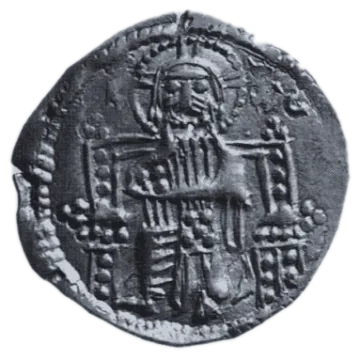
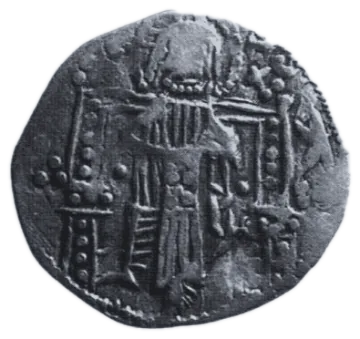
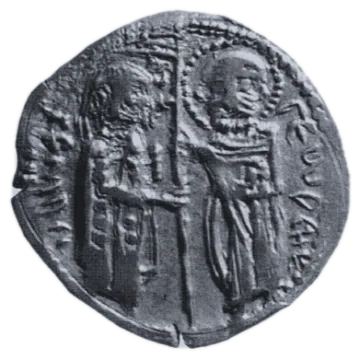
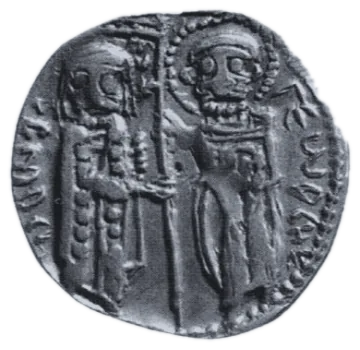
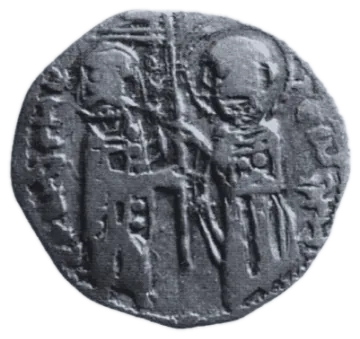
Coin photographs from A. Radushev & G. Zhekov, Catalogue of Bulgarian Medieval Coins IX–XV c. (Agató, 1999).