
Shishman dynasty
Elena of Bulgaria„the nun Elisaveta”
Sister of Ivan Alexander, married to the Serbian king (later tsar) Stefan Dušan — a marriage that sealed the Bulgarian-Serbian alliance after Velbazhd.
Biography
Elena of Bulgaria, later the nun Elisaveta, was a Bulgarian princess of the Shishman dynasty and one of the most politically consequential royal women of the fourteenth-century Balkans. Her birth date and birthplace are unknown. She was a daughter of Despot Sratsimir and the despotissa Keratsa Petritsa and a sister of Tsar Ivan Alexander Asen, John Komnenos Asen, Michael Asen Sratsimirov, Dragushin and Theodora. Through Keratsa, Elena claimed descent from the Asen dynasty: the reconstruction of the family tree at Matejče makes her mother a descendant of Theodora-Anna, daughter of Tsar Ivan II Asen and Irene Komnene. Elena's ancestry therefore joined the ruling Shishman house to the dynastic traditions of the Asens and, through them, to prominent Byzantine imperial families. Nothing definite is known of her childhood or education before she entered international politics in 1332.
Elena's marriage arose from the reordering of Bulgarian-Serbian relations after the Bulgarian defeat at the Battle of Velbazhd in 1330. The settlement became possible amid rapid political change in both kingdoms. Following the peace of Rusokastro in 1331, Ivan Alexander sought to stabilize relations with Serbia. There, after the civil conflict had reached its decisive stage after 21 August 1331, supporters of Stefan Dušan captured his father, Stefan Uroš III Dečanski; Dušan was crowned king on 8 or 9 September, and Dečanski was killed on 11 November. The surviving sources do not disclose whether the Bulgarian-Serbian negotiations were difficult or preserve the clauses of a formal treaty, but their result is clear: on 19 April 1332, Easter Sunday, Elena married the young Serbian king. The marriage sealed the alliance between Bulgaria and Serbia and replaced the hostility associated with Velbazhd with a durable dynastic partnership.
During the first four or five years of her queenship Elena's position remained vulnerable because she had not produced the expected heir. The excerpts report that Stefan Dušan even considered negotiations for another marriage, although no replacement occurred. In 1336 or 1337 Elena gave birth to Stefan Uroš, the future Serbian emperor, an event that strengthened her standing within the royal family and gave her a direct interest in the succession. A genealogical summary in the supplied material additionally attributes two daughters to the marriage, but provides neither their names nor information about their lives; Stefan Uroš is the only child whose political role is documented in detail and who appears with Elena in the surviving visual record. No later marriage of Elena is recorded.
The Byzantine civil war that began in the autumn of 1341 created the setting for Elena's emergence as an active diplomat. In the summer of 1342 she travelled to Tarnovo to meet her brother Ivan Alexander. John Kantakouzenos, the principal narrative witness, gives too little detail to reconstruct the conversations, and it would be unsafe to claim that Elena carried a specific plan for partitioning Byzantine territory or defining spheres of influence. The timing nevertheless indicates a political mission rather than a merely private family visit. During the ensuing Byzantine conflict Ivan Alexander did not pursue expansion into Macedonia, while Dušan enjoyed freedom to act there; Elena's diplomacy may have contributed to this alignment, but the exact commitments exchanged at Tarnovo remain unknown.
Later in 1342, after Kantakouzenos had failed to secure Byzantine western territories and sought Serbian assistance, Elena took a conspicuous part in the negotiations at Dušan's court. She and her husband received the claimant, and she then addressed an assembly of Serbian magnates. According to Kantakouzenos, her speech won strong approval. The powerful noble John Oliver praised her wisdom and prudence, while Dušan thanked his wife for advising him properly and persuading him that the proposed course would bring great glory. Kantakouzenos stresses that the decision for alliance was made with Elena's participation. In the approximately three years that followed, Serbian forces destroyed Byzantine rule in the Albanian lands and conquered Macedonia as far as the Mesta, with Thessalonica remaining outside their power. These campaigns formed the military setting of Elena's ascent, but no supplied source says that she personally commanded troops or fought in a battle.
Serbian occupation of Serres, later the center of Elena's own authority, dated from 25 September 1345. At the end of November or beginning of December that year, after his sweeping conquests, Dušan proclaimed himself emperor of the Serbs and Greeks. On 14 April 1346, Easter Sunday, he received the imperial crown at Skopje from the head of the Serbian Church. Elena thereby passed from the rank of queen to that of Serbian tsaritsa or empress, although the excerpts do not attest a separate coronation ceremony for her. Her elevation expressed the same imperial program that had transformed the Serbian kingdom into an empire claiming succession to Byzantine power in the Balkans.
The surviving record for Elena between 1346 and 1355 is not annalistic, and it does not permit a year-by-year reconstruction of all her activities. Her prominence is nevertheless evident from her participation in earlier high-level deliberations and from courtly and ecclesiastical imagery. A portrait at the Dečani monastery dates from 1348, while other representations belong to Sopoćani, the church of St Nicholas at Ljuboten and Lesnovo. Dušan's sudden death on 20 December 1355, at the age of forty-eight, ended the political structure within which Elena had exercised influence as his consort. The imperial title and supreme authority passed to their nineteen-year-old son Stefan Uroš, leaving the widowed empress to redefine her status amid an increasingly contested succession.
Elena adopted the monastic name Elisaveta between Dušan's death and May 1356, when a charter of Stefan Uroš already refers to her by that name. On the evidence of her patronal portrait in the Church of the Holy Mother of God at Matejče, where she appears in white widow's clothing, historians have cautiously placed her taking of the habit in the early spring of 1356. This was not a withdrawal into secluded religious life. The nun Elisaveta retained the external marks, titles and political habits of imperial authority, and documents and manuscript colophons continued to call her Augusta, lady and despoina. Her monastic profession thus altered her religious identity without extinguishing her position in secular government.
Soon after Dušan's death Elena established herself in Serres, the major urban center of eastern Macedonia, during the struggle between Stefan Uroš and Dušan's half-brother Simeon Uroš Palaiologos. Kantakouzenos portrays her as fighting on her own account, subjecting numerous towns and seeking an independent dominion. Georg Ostrogorsky challenged this vivid account as an arbitrary attribution of Machiavellian conduct to the empress-mother. The documentary evidence supports a more nuanced interpretation: Elena backed the lawful succession of her son and initially recognized his supremacy, while simultaneously constructing an increasingly autonomous territorial power in Serres. Her position was therefore neither simple rebellion nor passive retirement, but a form of regional rule maintained under the formal sovereignty of Stefan Uroš.
A manuscript colophon of September 1359 records the reign of “our pious emperors Stefan Uroš and his mother, the nun Elisaveta,” striking evidence of their formal association. In 1360–1361 Stefan Uroš confirmed a donation made by Elena to the Hilandar monastery, yet the wording shows that she governed Serres independently in practice. A judgment of the metropolitan court of Serres from November 1360 addresses her with exalted language as the mighty and holy lady and despoina. She possessed her own court and a body of personal dependants or retainers described in documents as members of her household. The sources consequently reveal a dual structure: the son's theoretical imperial supremacy coexisted with the mother's effective command of Serres and its district.
Elena's religious patronage reinforced rather than contradicted her temporal authority. Her donation to Hilandar required imperial confirmation but originated from her own initiative, demonstrating her capacity to dispose of property and cultivate ties with the leading Athonite institution. Her most ambitious memorial was the Church of the Holy Mother of God at Matejče near Kumanovo, where she commissioned a monumental genealogical tree. It represented her as the product of a centuries-long Bulgarian-Byzantine dynastic synthesis, with ancestors said to include three or four Bulgarian tsars, four Byzantine emperors, and princesses such as Maria, daughter of Trajan and granddaughter of Tsar Ivan Vladislav, as well as Irene Doukaina and Anna Komnene. Reconstructed figures in the damaged composition include Theodore Angelos Komnenos, his daughter Irene Komnene and probably Tsar Ivan II Asen; immediately below Elena stood her mother Keratsa, her father Sratsimir and her brother Ivan Alexander. The tree was both a devotional monument and an assertion that her authority rested upon ancestry equal to that of the foremost Balkan dynasties.
The surviving evidence illuminates property administration and jurisdiction in Elena's lordship more clearly than it does taxation, commerce or monetary policy. Metropolitan court decisions, monastic acts and confirmations show a government concerned with landed rights, donations and relations among secular, ecclesiastical and monastic holders. An August 1365 judgment of the Serres metropolitan court concerning property identifies Alexios Asen as Elena's cousin and servant; he appears again among the signatories of a metropolitan act in 1375, although the sources reveal little else about him. No coin type, mint, fiscal reform, commercial privilege or tariff is attributed to Elena in the supplied record. It would therefore be unjustified to claim that she issued an independent coinage, even though her documents, court and titulature demonstrate substantial sovereign functions.
The last clear phase of Elena's rule in Serres belongs to 1365. An act preserved by the Esphigmenou monastery, dated August of that year, is an important chronological marker for her authority. In September, a chrysobull of the Byzantine emperor John V Palaiologos confirmed Hilandar's possession of two properties, one near Serres and another in Kalamaria, at the request of Elena-Elisaveta and “the despot of Serbia, lord John Uglješa.” On this evidence Ostrogorsky placed Uglješa's arrival and ascendancy in Serres in August or September 1365. Elena then relinquished her nearly decade-long regional government and withdrew to the court of Stefan Uroš. The excerpts do not provide a continuous account of her movements or political activity during the remaining years of her life.
Dynastic policy unified the principal stages of Elena's career. Her marriage in 1332 secured the Bulgarian-Serbian rapprochement after Velbazhd; the birth of Stefan Uroš secured her place at the Nemanjić court; her intervention in the Kantakouzenos negotiations supported Dušan's expansion; and after 1355 she defended her son's legitimacy against Simeon Uroš while preserving a power base of her own. At the same time, the Matejče genealogy emphasized that she was not merely Dušan's widow or Uroš's mother, but a Bulgarian princess descended through her mother from the Asens and from Byzantine imperial houses. Her sustained links with Ivan Alexander and the prominence given to Bulgarian ancestors demonstrate that marriage into Serbia did not efface her original dynastic identity.
Elena died on 7 November 1376. Neither the place and cause of her death nor her burial arrangements are specified in the supplied excerpts. Her visual commemoration is unusually rich for a medieval Balkan princess: portraits are known at Sopoćani, after 1337; St Nicholas at Ljuboten; Dečani, in 1348; Lesnovo; and Matejče, where she appears with Stefan Uroš and where the genealogical composition proclaimed her lineage. These images trace her successive identities as Bulgarian-born Serbian queen, imperial consort, widow, dynastic mother, monastic patron and regional ruler. Their survival materially confirms the exceptional public visibility that written documents assign to her.
Elena's significance lies in her ability to operate across several political worlds without surrendering her own dynastic authority. She helped embody the Bulgarian-Serbian alliance, participated directly in the diplomacy of the Byzantine civil war, became empress during Dušan's imperial transformation and, as the nun Elisaveta, governed Serres with a court, documents, titles and extensive practical independence. The sources, however, are uneven and must be handled critically. John Kantakouzenos provides the fullest narrative of her diplomacy and the most controversial account of her post-1355 ambitions; charters of Stefan Uroš, the September 1359 colophon, decisions of the Serres metropolitan court, the Esphigmenou act and John V Palaiologos's chrysobull offer firmer institutional evidence. Frescoes and inscriptions supply her public image, while the damaged Matejče tree—studied in detail by Ivan Božilov—preserves her genealogical program. Modern reconstructions, including those associated with Božilov and Ostrogorsky and the wider Balkan and Byzantine syntheses of John V. A. Fine and Donald M. Nicol, provide the framework for interpretation, but the lack of a continuous contemporary biography leaves important aspects of her early life, daily administration and final years unknown.
Sources
“Елена е дъщеря на деспотица Кера[ца] Петрица и деспот Срацимир; сестра на Иван Александър Асен, Йоан Комнин Асен, Михаил [и Драгушин].”
— The Asen Family (1186–1460): Genealogy and Prosopography, p. 186
Images
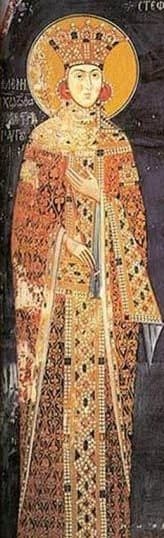
Fresco portrait of Elena of Bulgaria, wife of the Serbian ruler Stefan DušanPublic domain
In the news
- Noble ladies of medieval Dobrudzha and the Black Sea coast in the 14th century22 March 2026 · Prof. Plamen Pavlov, Trud
- More on the women rulers of Macedonia and present-day Albania, 14th–15th centuries14 March 2026 · Prof. Plamen Pavlov, Trud
- The women who ruled the Bulgarians of Macedonia in the 14th century7 March 2026 · Prof. Plamen Pavlov, Trud