
1.A Cuman boyar in Tarnovo
The Terters were a Cuman family. George Pachymeres, the Byzantine historian who knew most about them, says so outright. They were not newcomers, though. The Cumans had fought beside the first Asens from the very start of the revolt, and over three generations many of their leading families had settled in Bulgaria, taken Christian names and entered the boyar class. By the 1270s George Terter was one of them, and by the time of the civil war that ended the reign of Constantine Tih he was the most prominent man among the boyars of Tarnovo. Pachymeres calls him clever and brave.
He came to the throne through the last Asen. When Ivan Asen III was installed in Tarnovo by a Byzantine army in 1279, much of the aristocracy saw him not as an heir of the old house but as the emperor's man. To neutralise Terter, Ivan Asen III, acting, Pachymeres insists, on Michael VIII's behalf, made him divorce his wife and married him to his own sister Maria, and gave him the title of despot. Terter's first wife and their young son, Theodore Svetoslav, were sent to Nicaea as hostages. The marriage did not buy his loyalty. Within months Ivan Asen III saw that he could not hold the capital, and early in 1280 he slipped away to Mesembria with the royal treasury and sailed to Constantinople. In Tarnovo the boyars proclaimed George Terter tsar.
The Terters held the throne twice, in 1280–1292 and 1300–1323, for about thirty-four years in all. Historians of the period stress the paradox: a Cuman dynasty that ruled at the lowest point of the medieval state, against boyar separatism and the domination of the Golden Horde, and still showed at decisive moments a statesman's grasp of what Bulgaria needed.
2.George Terter I between Anjou and Nogai (1280–1292)
The new tsar's first moves were ambitious. Charles of Anjou, king of Naples, was building a coalition to restore the Latin Empire, and in July 1281 envoys of "the emperor of Zagora", as the Angevin chancery called the Bulgarian tsar, were in Naples arranging an alliance. Terter drew in John I Angelos, sebastokrator of Thessaly, and betrothed his son Theodore Svetoslav to John's young daughter, although the boy was still a hostage in Nicaea. Byzantine diplomacy answered by calling in the Tatars. Khan Nogai sent a large horde across north-eastern Bulgaria, and on 31 March 1282 the Sicilian Vespers broke Charles's power in the south and buried the whole plan.
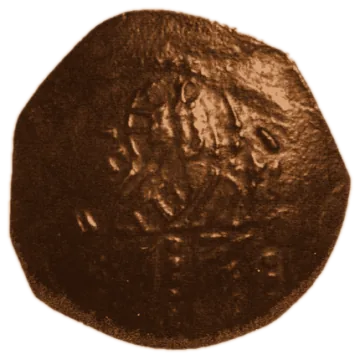
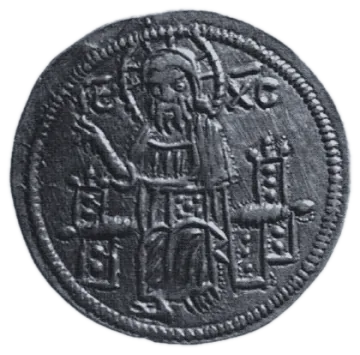
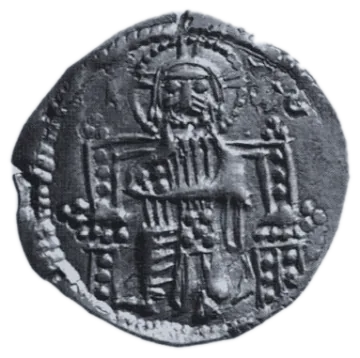
The cost fell on the western frontier. In the autumn of 1282 the Serbs occupied the lands of Velbazhd, Skopje, Tetovo and Ovche Pole, and for the first time settled there for good. Terter did not resist; in August 1284 he married his daughter Anna to the Serbian king Stefan Uroš II Milutin. The same year he made peace with Byzantium. His first wife came home from Nicaea and Ivan Asen III's sister was sent back, and the patriarch Joachim III went to Constantinople to secure the return of Theodore Svetoslav. The young man came back, was proclaimed co-ruler, and appears beside his father on two copper coins.
Then the Tatars returned. In 1285 a horde ravaged Bulgaria, the Black Sea coast and Thrace. To save the country Terter had to submit to Nogai as a vassal without conditions. He sent Theodore Svetoslav to the Horde as a hostage and gave his second daughter to Nogai's son Chaka. The coins he struck afterwards carry a crescent, a star and a figure taken to stand for the khan. An inscription found in the fortress of Shumen, attributed to this time, sums up the mood: a man named George prays to God to deliver them from the Tatars.
By 1292 the boyars had turned Nogai against him. Rather than face a new invasion, Terter left the throne and fled to Byzantium. Andronikos II, unwilling to anger the khan, refused him asylum; the former tsar wandered for a while near Adrianople and was then held in exile. Pachymeres' verdict is one line: Terter could not help himself, let alone anyone else. The throne passed to Smilets, a boyar from Sredna Gora with ties to the Palaiologoi and Nogai's favour.
3.The years of Smilets and Chaka
Smilets ruled for about six years (1292–1298) as a quiet vassal of the Horde. His death in 1298 left a child heir, Ivan, and a regency led by his widow and her son-in-law, the despot Aldemir (Eltimir), who was George Terter I's own brother. Aldemir had married a daughter of Smilets and received the region of Kran as her dowry; he would become one of the hinges of the next reign.
Rescue came from the steppe. In 1299 Nogai was defeated and killed by his rival Tokhta. His son Chaka, Theodore Svetoslav's brother-in-law, fled south with Theodore and a small band, and they reached the walls of Tarnovo. Theodore had married Enkona-Euphrosyne, daughter of a rich Venetian merchant and goddaughter of Nogai's wife, and the money from that marriage now bought him the city. Smilets's widow and her son fled to Kran and then to Constantinople.
4.Theodore Svetoslav takes back the throne
The new tsar's first acts were hard ones. Under pressure from the boyars, who feared Tokhta, and at the khan's own demand, Theodore Svetoslav had Chaka arrested and strangled in prison, and his salted head was sent to the Horde. He then had the patriarch Joachim III, long suspected of wanting to hand the Bulgarians over to the Tatars, thrown to his death from the cliffs of Tsarevets. It was the patriarch who, fifteen years earlier, had negotiated Theodore's own return from Nicaea; the historian of the reign sees personal vengeance and public necessity tangled together.
Tokhta rewarded him with the lands between the Danube mouths and the lower Dniester, with the fortress of Maurocastro, and the relationship with the Horde turned from tribute to alliance. For half a century the Tatars had been Bulgaria's scourge; from now on they were more often its auxiliaries.
5.War for the Black Sea coast (1301–1307)
Byzantium had a weapon against him: the Bulgarian émigrés in Constantinople. At the start of the fourteenth century three claimants to the Bulgarian throne were living in the city at once: Michael, son of Constantine Tih and Maria Palaiologina; Ivan Asen III, whose claim passed on his death in 1302 to his son Michael Asen; and Ivan, the son of Smilets. In 1301 the emperor sent Michael with an army; he found no support and wandered outside Tarnovo "living no better than a private man". In 1302 Smilets's brother Radoslav marched from Thessaloniki against Aldemir, now reconciled with his nephew; Aldemir defeated and captured him and had him blinded. Thirteen Byzantine nobles taken in that war were exchanged for the old tsar, George Terter I, who came home not to the throne but to the government of a single town, probably Cherven, where he lived out his days in comfort and, it seems, ended as a monk in the rock monasteries of Ivanovo.
In 1304, with Byzantium tied down by the Turks in Anatolia, Theodore Svetoslav went over to the attack. With Aldemir he took the fortresses south of the eastern Balkan range, many of them by agreement; near the Skafida river, in the summer of 1304, a Byzantine army under the co-emperor Michael IX was badly beaten. The Catalan Company, hired to fight the Turks, turned on its employers instead, and in 1305 Theodore Svetoslav used the chaos to take Aldemir's lands for himself and to bring Mesembria, Anchialos, Agathopolis and the coast as far as Midia into the tsardom. He offered the Catalans an alliance sealed by the hand of his widowed sister. The winter of 1306–1307 brought famine to Constantinople, and the peace of 1307 was signed on Bulgarian terms: Bulgaria kept the coastal cities, grain from its ports went to feed the starving capital, and Theodore Svetoslav married Theodora Palaiologina, the twelve-year-old daughter of Michael IX.
6.A Black Sea grain kingdom
The peace held for the rest of the reign and changed the country. Varna, Mesembria and Anchialos became the ports through which Venetian and Genoese ships loaded Bulgarian grain and wax, and "lord Svetoslav, emperor of Bulgaria" appears in a Venetian list of friendly rulers drawn up around 1313. Genoa was less happy: in 1316, after its merchants had been wronged in his lands, the republic forbade all Genoese trade with Zagora and with Sozopol, only to ignore its own ban within a year. Catholic missionaries worked in the Danube delta, and the queen Theodora persuaded her father in 1318 to restore Zograf's estates on Athos. In the north-west the despots of Vidin, Shishman and his son Michael, held back the Hungarians and the Serbs. The tsardom had not been so stable for half a century.
7.George Terter II and the end of the line (1322–1323)
When Byzantium fell into civil war in 1321, Theodore Svetoslav sent his brother-in-law Andronikos III a troop of 300 armoured horsemen under the voivode Martin. John Kantakouzenos later claimed the real aim was to seize the young emperor. Theodore died in August 1322 before his course was clear. His son, George Terter II, took Philippopolis and much of northern Thrace during the harvest of 1322 and left a strong garrison there under Ivan Rusina, which held off Andronikos III's siege engines the next year. His raid into eastern Thrace ended in a night ambush.
In the spring of 1323 George Terter II died, after barely a year on the throne and without an heir. An inscription by a scribe named Ivo in the rock churches of Ivanovo, written "when tsar George perished", suggests that he was killed, most likely by Bulgarian boyars rather than by the Byzantines. The coastal towns went over to Byzantium at once. His personal Gospel book is still kept at Hilandar, and a gilded pectoral cross bearing his name at Vatopedi. The boyars of Tarnovo turned to the despot of Vidin, Michael Shishman, and with him, in Božilov's view, the Asen line returned to the throne.
Rulers
Terter dynasty
- George Terter I1280–1292A boyar of Cuman origin, founder of the Terter dynasty. Took the throne after Ivan Asen III fled. Forced to acknowledge Tatar overlordship; abdicated in 1292.
- Theodore Svetoslav1300–1321Son of George Terter I. Restored the throne to the Terter dynasty, freed Bulgaria from Tatar dependence and stabilised the state. Married Theodora Palaiologina, daughter of the Byzantine co-emperor Michael IX.
- George Terter II1321–1322Son of Theodore Svetoslav, the last ruler of the Terter dynasty. Reigned barely a year and died childless in 1322, extinguishing the dynasty.
Members who did not reign
- Aldemir (Eltimir)Despot
Married into the house
- Maria (Kyramaria)Tsaritsa
- Theodora PalaiologinaTsaritsa