
Terter dynasty
George Terter I
A boyar of Cuman origin, founder of the Terter dynasty. Took the throne after Ivan Asen III fled. Forced to acknowledge Tatar overlordship; abdicated in 1292.
Biography
George Terter I was a powerful Bulgarian boyar of Cuman origin and the founder of the Terter dynasty. His family belonged to the Cuman aristocratic element that had long since entered the Bulgarian political elite and become integrated into the state, ecclesiastical and cultural traditions of the Second Bulgarian Empire. The Byzantine historian George Pachymeres characterizes George as an intelligent and courageous man, while the Bulgarian narrative tradition associates him with the anti-Byzantine wing of the Tărnovo aristocracy. He nevertheless rose at a moment when courage and personal influence could not compensate for the profound institutional weakness of the monarchy: civil war, foreign invasion, social and economic disruption, and the ambitions of regional magnates had reduced the authority of the crown to a fraction of what it had been under the first Asen rulers.
Before becoming tsar, George gained prominence during the struggles involving Ivaylo and the Byzantine-backed Ivan Asen III. His established wife was Maria, and their son Theodore Svetoslav became the eventual restorer of the dynasty. When George entered the political coalition surrounding Ivan Asen III, he sent Maria and Theodore into Byzantine custody, described in the sources as residence in Constantinople and, in connection with Theodore's later betrothal, as hostage status in Nicaea. George also accepted a dynastic union with a sister of Ivan Asen III, although the supplied evidence does not clarify every stage in the subsequent regulation of this marriage. These arrangements show that, even before his accession, George treated marriage and the custody of relatives as instruments of diplomacy, a practice imposed as much by his vulnerability as by ambition.
George's seizure of power began amid the chaos of late 1279, but the established chronology dates his reign from 1280. Fine describes him as elected in Tărnovo while the capital was under siege; the Bulgarian account emphasizes that Ivan Asen III, alarmed by George's growing influence, appropriated the royal treasure and escaped through Mesembria to Constantinople. With the treasury emptied and the Byzantine candidate gone, the Tărnovo boyars raised George to the throne. His accession was therefore neither a peaceful hereditary succession nor the result of a decisive military victory. It was a boyar election made possible by the collapse of Ivan Asen III's regime, and it left the new tsar dependent upon the same aristocratic interests that had enabled him to take the crown.
In 1280 George initially possessed little effective authority beyond Tărnovo. The Byzantine armies withdrew, and Ivaylo also abandoned the immediate contest before crossing the Danube with Kasim Beg to seek assistance from Nogai. Ivan Asen III likewise appeared at Nogai's court with Byzantine gifts, hoping to recover the Bulgarian throne. Nogai delayed all the claimants and then, during a drunken banquet, ordered Ivaylo and Kasim Beg killed; Pachymeres reports that Nogai called Ivaylo an enemy of his political “father,” Emperor Michael VIII Palaiologos. Ivan Asen III narrowly escaped and returned permanently to the Byzantine aristocracy. Their removal freed George from immediate rival claimants, but it did not restore the territorial unity or resources of Bulgaria.
During 1281 George pursued an ambitious anti-Byzantine policy despite the weakness of his state. He associated himself with the coalition organized by Charles I of Anjou against Michael VIII. Angevin documents dated 10 June and 9 July 1281 record financial and logistical arrangements for envoys travelling to negotiate with Charles at Viterbo. Late in that year George also drew the Thessalian ruler John I Angelos into the combination. The agreement was reinforced by the betrothal of Theodore Svetoslav to John Angelos's young daughter, who was sent to Tărnovo even though Theodore remained in Byzantine custody. George's policy was connected to the wider Catholic hostility toward Byzantium, which formally adhered to the union with Rome proclaimed at the Council of Lyon in 1274, but Bulgaria lacked the strength to exploit that hostility without substantial foreign military aid.
The projected offensive of 1282 never produced the territorial recovery George expected. Byzantine diplomacy obtained help from Nogai, who dispatched a force described in the Bulgarian narrative as 40,000 cavalry. On its way toward Thrace this army devastated northeastern Bulgaria and paralyzed Bulgarian action. The Sicilian Vespers of 31 March 1282 then destroyed Charles of Anjou's capacity to lead the planned coalition and ended the immediate prospect of restoring a Latin Empire at Constantinople. Serbian forces meanwhile advanced into Macedonia; after a temporary Tatar intervention on behalf of Andronikos II, the Serbs returned in the autumn of 1282 and occupied the regions of Velbazhd, Tetovo, Skopje and Pijanec, together with Ovče Pole. No named pitched battle personally commanded by George is securely recorded in the supplied evidence: the decisive military events of these years were invasions through or around his weakened kingdom rather than victories won by a coherent royal army.
By 1283 the failure of the Angevin project left George with little reason to continue an unaffordable confrontation with Byzantium. Bulgaria could not recover the southern Black Sea coast or western Thrace by its own forces, while the empire no longer had a realistic means of reinstalling Ivan Asen III without Nogai's assistance. In 1284 Emperor Andronikos II Palaiologos therefore concluded a treaty with George. The emperor recognized him as tsar of Bulgaria and also bestowed the Byzantine court dignity of despot. The settlement implicitly accepted Byzantine possession of former Bulgarian territories along the Black Sea from Mesembria southward and in western Thrace along the upper Maritsa. Theodore Svetoslav was returned from Byzantine custody together with his mother Maria. The sources do not supply a separate military campaign for 1283 or describe the precise clauses governing frontiers, tribute or trade, so the treaty must be understood chiefly through its political consequences.
A particularly destructive Tatar raid in 1285 forced a much deeper submission. Until then Bulgaria had maintained a tributary relationship with the central Golden Horde, but after the death of Mangu Timur in 1280 or 1281 Nogai had become virtually independent and was able to intervene in the Balkans at will. George recognized Nogai's suzerainty and agreed to pay him tribute. Theodore Svetoslav, only recently recovered from Byzantine custody, was sent to Nogai's court as a hostage. Fine's reconstruction also reports that an unnamed daughter of George was given to Nogai's son Chaka as a wife in his harem; because the supplied established genealogy securely lists Theodore but no daughter, this additional relationship should be treated as source-reported rather than as an independently fixed genealogical fact. Submission reduced most raids conducted under Nogai's direct authority, but it converted Bulgaria's earlier, partly formal tributary dependence into effective political subordination.
Peace with Byzantium and accommodation with Nogai did not restore the central government's control over the provinces. George soon ruled only part of eastern Bulgaria, and not all of that. Vidin became a separate center under Shishman, while the brothers Darman and Kudelin maintained the principality of Braničevo under Nogai's protection. A Hungarian charter of 8 January 1285 records three unsuccessful Hungarian campaigns against Braničevo in 1282–1284: in the first, the royal army was defeated and several barons captured, while later negotiations and an expedition of Transylvanians and Hungarian Cumans also failed. These were not George's victories; rather, they demonstrate how regional Bulgarian rulers could wage war independently of Tărnovo. Nogai's protection of Vidin and Braničevo prevented George from attempting to recover either territory.
The most dangerous separatist within closer reach of Tărnovo was Smilets, whose principality extended through the Sredna Gora region, along the upper Maritsa and between the rivers Strem and Tundzha toward Sliven, with Kopsis as an important center. Smilets was linked to the Palaiologoi through his marriage to a daughter of the sebastokrator Constantine, brother of Michael VIII, and he also cultivated relations with Nogai. Fine additionally identifies Eltimir as George's brother and places an appanage under him west of Sliven, possibly as a loyal means of attaching a distant region to Tărnovo. The supplied established genealogy, however, records no siblings for George, while the Bulgarian narrative argues that the Krăn territory was not an ancestral Terter possession and was acquired by Eltimir only later through marriage into Smilets's family. Eltimir's precise relationship to George and the chronology and status of his lands should consequently remain qualified rather than treated as completely settled.
For the years 1286–1290 the sources offer no reliable annual sequence of royal campaigns, legislation or administrative reform. The absence is itself revealing. Although the arrangements of 1284 and 1285 reduced the immediate pressure of major Byzantine and Nogai attacks, George could neither reunite the country nor compel the great boyars to obey. The monarchy was burdened by tribute, a depleted treasury and the consequences of repeated Tatar, Byzantine, Serbian and Hungarian incursions. Agricultural regions and communications had been devastated, while the crown had lost control of important frontier districts and much of the commercially valuable Black Sea coast. Venetian and Genoese economic interests were becoming increasingly important around the Black Sea, but the political fragmentation of Bulgaria and Byzantine control of the southern ports sharply limited the ability of George's government to turn that commerce into a secure royal resource.
The clearest ecclesiastical and diplomatic episode late in the reign occurred on 23 March 1291. Pope Nicholas IV, acting through the mediation of the Serbian queen Helena, sent Marin, archdeacon of Antivari, to Bulgaria with letters for George and the patriarch of Tărnovo, Joachim III. The surviving excerpt does not preserve a Bulgarian response, and there is no basis for claiming that George abandoned Orthodoxy or concluded a church union with Rome. The mission instead illustrates the continued papal interest in Bulgaria and George's potential value within wider anti-Byzantine diplomacy. Joachim III remained an important political figure and was executed under Theodore Svetoslav in 1300 on an accusation of treason. Fine suggests only as a possibility that the alleged treachery might have dated from Smilets's overthrow of George; neither the pope's mission nor the patriarch's later fate proves a defined ecclesiastical faction during George's reign.
The economic debasement of royal power was reflected both in the empty treasury left by Ivan Asen III and in George's post-1285 coinage. The Bulgarian narrative describes coins bearing a crescent, a star and a human figure, interpreted as Tatar signs and a representation of the Tatar ruler. If this iconographic interpretation is accepted, the issues provide unusually tangible evidence of Nogai's ascendancy over Tărnovo; they should not, however, be made to disclose fiscal arrangements that the written sources do not specify. An inscription from the fortress of Shumen, probably belonging to the same period, reads: “I, George, looking below and above, said: God, for the sake of your name, deliver us from the Tatars.” Coinage and inscription together convey the contradiction of his position: he remained a crowned Christian tsar with his own monetary and epigraphic representation, yet his security depended upon submission to a power whose raids had helped ruin his realm.
In 1292 a new major Tatar incursion accompanied the end of George's reign. He abdicated under overwhelming pressure and fled toward Byzantium, while Smilets emerged as tsar. The mechanism of the change remains contested. The Bulgarian narrative presents Smilets as the beneficiary of intrigue by hostile boyars, long-standing Palaiologan connections and Nogai's favor. Fine, following Nikov's reasoning, notes that Nogai had no obvious reason to remove a vassal who paid tribute and whose son remained a hostage; he therefore cautiously proposes that a boyar faction persuaded Nogai to support its own candidate, perhaps in return for increased tribute. It is also possible that an unknown action by George provoked Nogai, but no source identifies one. What is reasonably clear is that Nogai's troops or threats made George's continued rule impossible and that Smilets, rather than a hereditary Terter heir, became his immediate successor.
George's flight did not at once bring safety. Andronikos II hesitated to receive him formally because asylum might antagonize Nogai and because Smilets was already related to the imperial dynasty. The former tsar therefore hid for a time in the vicinity of Adrianople and wandered in conditions wholly unlike royal life. Pachymeres summarized his helplessness with the judgment that “Terter was not able to help himself, let alone others.” The emperor eventually took him into custody and sent him into temporary exile. Smilets ruled from 1292 to 1298, after which a minority regime and then Chaka's seizure of Tărnovo prolonged the crisis. Theodore Svetoslav, hardened by years of Byzantine and Tatar hostage life, organized support in the capital, overthrew and strangled Chaka, and became tsar in 1300, thereby restoring the Terter dynasty.
In 1302 Theodore Svetoslav secured his father's release. After forces associated with the Krăn ruler defeated a Byzantine-supported expedition, thirteen captured Byzantine archons were sent to Tărnovo and exchanged for George, who was still in Byzantine exile. The restored former ruler did not recover the crown. He received only one town and its surrounding district, where the source says that he lived out his remaining years in luxury and seclusion. Inscriptions in the rock churches near Ivanovo have encouraged the hypothesis that the town was Cherven and that George became a monk shortly before his death and was buried in one of the Ivanovo monasteries. These identifications remain conjectural, and neither the date nor the exact circumstances of his death are securely known; only a death after his return in 1302 can be maintained from the supplied evidence.
George Terter I's reign, conventionally dated 1280–1292, marked both the foundation of a new dynasty and the nadir of Tărnovo's independence from Nogai. His diplomacy was energetic—embracing Charles of Anjou, Thessaly, Byzantium, the papacy and finally the Tatars—but repeatedly exceeded the military and financial capacities of his fragmented kingdom. His lasting importance lies less in territorial achievement than in dynastic survival: his son Theodore Svetoslav later restored central authority and gave the Terter name a more successful political legacy. Reconstruction of George's life depends chiefly on George Pachymeres, with Nicephorus Gregoras cited for parts of the wider Byzantine context, supplemented by Angevin and papal documents, the Hungarian charter of 1285, coins, the Shumen inscription and the debated Ivanovo inscriptions. Modern Bulgarian narrative history and John V. A. Fine's synthesis differ over details such as Eltimir's position, Nogai's motive in 1292 and the interpretation of the appanages, while the dynastic chronology firmly fixes George between Ivan Asen III and Smilets. No royal charter of George quoted in the supplied material fills the major gaps, so his biography must distinguish carefully between contemporary testimony, modern reconstruction and later hypothesis.
Sources
“Георги Тертер, който произхождал от куманско болярско семейство, бил провъзгласен за български цар през 1280 г.”
— History of Medieval Bulgaria, 7th–14th Century, p. 764
Coins (2)
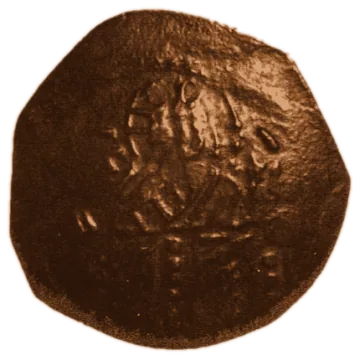
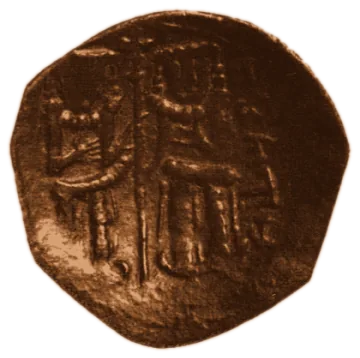
Coin photographs from A. Radushev & G. Zhekov, Catalogue of Bulgarian Medieval Coins IX–XV c. (Agató, 1999).
In the news
- Coins as a key to understanding the Bulgarian Middle Ages29 March 2025 · Prof. Plamen Pavlov, Trud
- The lords of medieval Sredets in the 13th century1 February 2025 · Prof. Plamen Pavlov, Trud
- Tsar Mihail III Shishman, the bold descendant of the Asenids11 February 2023 · Prof. Plamen Pavlov, Trud
- The 'blue blood' and youth of Theodore Svetoslav Terter30 July 2022 · Prof. Plamen Pavlov, Trud
- The Cumans, faithful allies of the Asenids22 February 2019 · Prof. Plamen Pavlov, Trud