
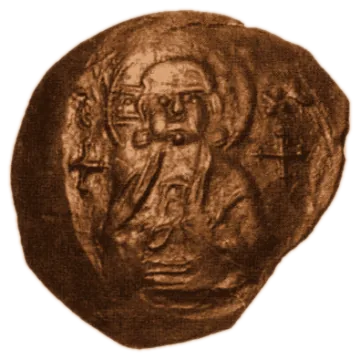
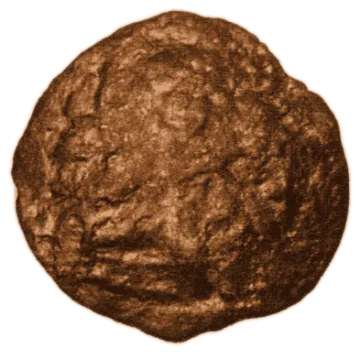
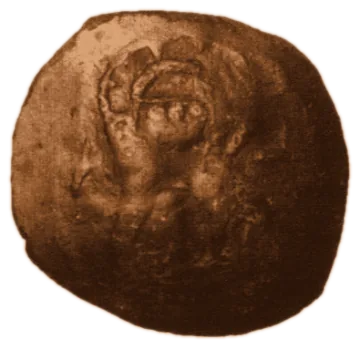
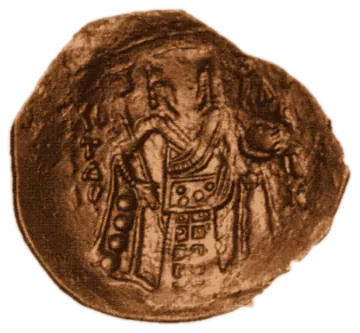
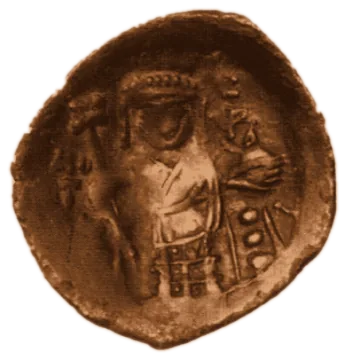
Copper scyphate coins, Tarnovo mint, fourth type (with family name Asen)
- Metal
- Copper
- Mint
- Tarnovo
- Found in Tarnovo
- 57 coins
Obverse
Half-length image of Jesus Christ, beardless (Emmanuel), with a nimbus around the head, in which a cross is inscribed. Christ is dressed in a chiton and sindon. In His left hand He holds a scroll, and with His right hand He blesses in front of His chest. In the field on both sides of the head are the initials ІС - ХС, below which two crosses are depicted. The arms of the crosses are outlined with solid lines.
Reverse
Variant A. The tsar, standing, full-length, with a stemma with pendilia. The ruler has a beard and mustache. He is dressed in a sakkos. Draped over his arms and shoulders is a loros, studded with pearls. In his right hand he holds a labarum with a short handle, and in his left hand a globus cruciger. On both sides of the figure there is a multi-line inscription: on the left КО/СТ/АД/Н, and on the right the abbreviation of the title царъ - Ф, followed by the family name А/С/Ъ/Н. Variant B. The image is as in Variant A, but on the right the inscription АСЪН is placed horizontally above the globus cruciger. Variant C. The image is as in Variant A, but the inscription lacks the letter Ъ - А/С/Н.
Reconstructions
Line drawings reconstructing the coin's design from the surviving specimens.


Also struck by Constantine Tih Asen
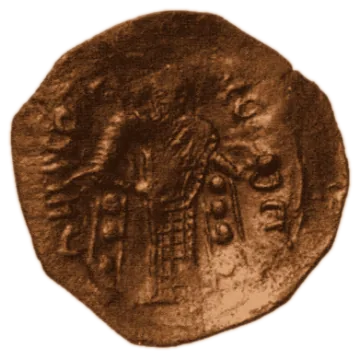 Copper scyphate coin, Tarnovo mint, first type (without family name)
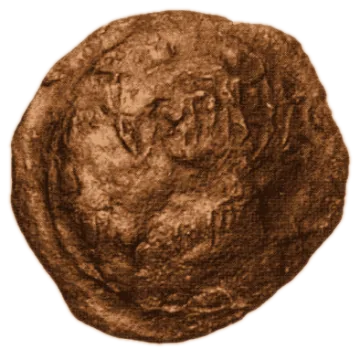 Copper scyphate coin, Tarnovo mint, second type (without family name)
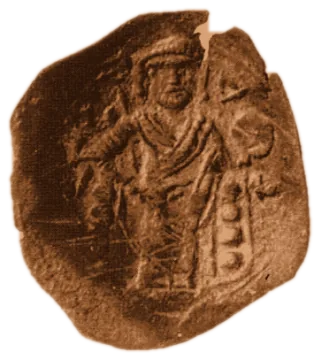 Copper scyphate coin, Tarnovo mint, third type (without family name)
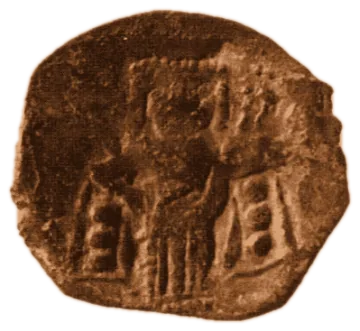 Copper scyphate coin, Tarnovo mint, fifth type (with family name Asen)
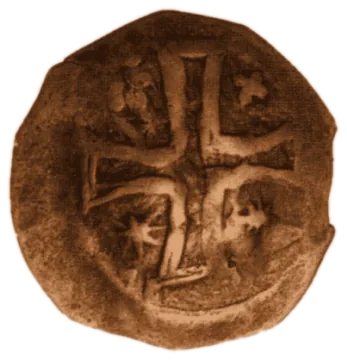 Copper scyphate coin, Tarnovo mint, sixth type
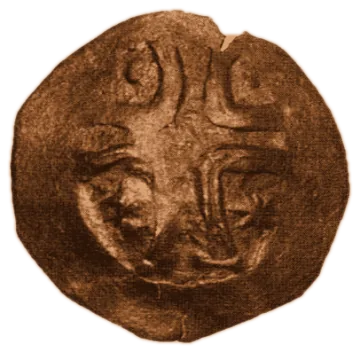 Copper scyphate coins, Tarnovo mint, seventh type
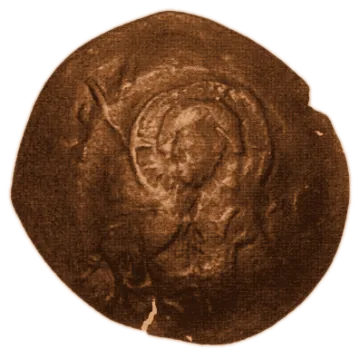 Copper scyphate coin, Tarnovo mint, eighth type
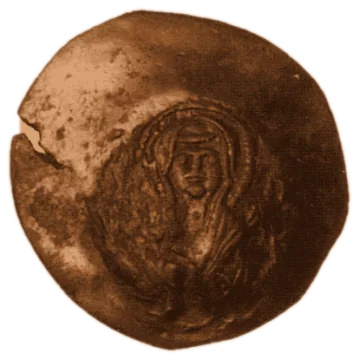 Copper scyphate coin, Tarnovo mint, ninth type
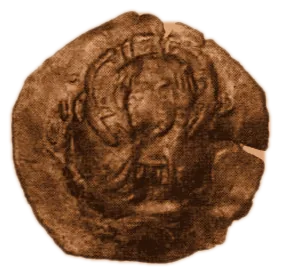 Copper scyphate coins, Tarnovo mint, tenth type
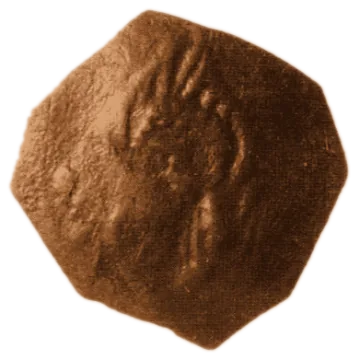 Copper scyphate coin, Tarnovo mint, eleventh type
Coin photographs and reconstruction drawings from A. Radushev & G. Zhekov, Catalogue of Bulgarian Medieval Coins IX–XV c. (Agató, 1999).