
Asen dynasty
Constantine Tih Asen„Tih”
A boyar of Serbian descent, elected tsar in 1257; he took the name Asen to tie himself to the dynasty through his marriage to Irene Laskarina. Killed in battle against the rebel Ivailo in 1277.
Biography
Constantine Tih Asen was tsar of Bulgaria from 1257 until his death in 1277, one of the longest reigns of the Second Bulgarian Empire after that of John Asen II. A boyar of Serbian descent, previously unknown in high politics, he rose amid the dynastic and aristocratic conflict that followed the murder of Tsar Michael Asen. His accession marked a significant breach with precedent: about seventy years after the restoration of Bulgarian rule by Peter and Asen in 1186, the imperial insignia were entrusted to a man who did not belong by birth to the Asen family. His subsequent adoption of the name Asen, dynastic marriage, coinage and diplomacy all reveal how indispensable Asenid legitimacy remained even when the direct dynasty could no longer provide an uncontested ruler.
According to John V. A. Fine's reconstruction, Constantine was a substantial landholder with estates near Sardika, modern Sofia. He was half Serbian and related through his mother to the Serbian ruling dynasty, although the supplied evidence names neither parent and identifies no siblings. His opportunity arose from the crisis of late 1256 and early 1257. Michael Asen was mortally wounded in a boyar conspiracy, his cousin Koloman briefly attempted to seize power and was killed in flight, and Rostislav of Mačva invaded Bulgaria early in 1257 under the pretext of protecting his daughter, Michael's widow. Rostislav established himself at Vidin and bore the title Tsar of Bulgaria, while Mitso Asen, called Mico in Fine, emerged in southeastern Bulgaria as another claimant. Mitso, a relative of John Asen II and husband of Michael Asen's sister, apparently formed a separate principality but probably never secured Tărnovo.
The boyars controlling Tărnovo rejected both outside claimants and elected Constantine from among their own number in 1257. The established regnal sequence treats Mitso Asen as his predecessor, but the actual transition is obscured by rival titles and the fragmentation of authority. George Akropolites reports that Koloman succeeded Michael, was expelled, and was followed by further disorder during which a boyar faction governed Tărnovo until Constantine's election. George Pachymeres instead presents Constantine as directly succeeding Michael and does not recognize an intervening tsar in the capital. Neither account makes Rostislav ruler of Tărnovo, and Mitso's possession of the imperial title did not necessarily mean possession of the capital. Constantine's accession was therefore an election by the dominant aristocratic group rather than a straightforward hereditary succession.
Because Constantine lacked a blood connection to the Asenids, he quickly sought to manufacture a legitimate dynastic position. He adopted the name Asen and sent envoys to the Nicaean court to request the hand of Irene Laskarina, daughter of Emperor Theodore II Laskaris. Irene's mother was a daughter of John Asen II, making Irene the great Bulgarian ruler's granddaughter and the sister of the young Nicaean emperor John IV Laskaris. Akropolites states that Constantine already had a wife and had to divorce her before marrying Irene in 1258; the woman is not named in the supplied evidence. The genealogical tradition normally lists Irene and Maria Palaiologina as Constantine's consorts, so Akropolites' report complicates any simple numbering of his marriages. Through Irene, Constantine obtained a dynastic claim comparable to that of Mitso and could appear to reign by hereditary right rather than solely by boyar election.
The marriage of 1258 also sealed an alliance between Bulgaria and the Empire of Nicaea. The Nicaean official and historian Akropolites visited Tărnovo, probably in January 1260, to confirm the relationship. Fine argues that peace endured from 1258 until 1262; no separate military event for 1259 is preserved in the supplied material. Claims that Michael VIII Palaiologos aided Mitso at Mesembria in 1260 are based on an older chronology: more recent scholarship persuasively places the Mesembrian episode in 1263. The period of peace allowed Constantine to confront Rostislav, whose control of Vidin was supported by Hungary and constituted the most immediate challenge to Tărnovo's authority in northwestern Bulgaria.
Late in 1260 Constantine exploited Hungary's war against Bohemia. Rostislav had taken a large part of his forces to assist the Hungarians, leaving the Vidin region weakly defended. Constantine attacked, recovered Vidin and the surrounding province as far as the frontier of Braničevo, and temporarily removed a major rival. He then sent forces across the Danube into the Hungarian Banate of Severin, which they raided and briefly occupied. The operation was Constantine's clearest territorial success, but it overextended the Bulgarian recovery and provoked a powerful response. Western references to Bulgarians fighting in Bohemia at this time concern Rostislav's men in Hungarian service, not an army dispatched by Constantine.
After Hungary made peace with Bohemia in March 1261, Stephen V, co-king and heir to the Hungarian throne, invaded Bulgaria. The Hungarians overran the Vidin province, forced Constantine's troops to withdraw and restored Rostislav. They then advanced into Bulgaria proper, reached the walls of Tărnovo and besieged Lom, east of Vidin on the Danube. No pitched battle between Constantine and Stephen is recorded; Constantine apparently preserved his army by retreating toward the capital. The Hungarians withdrew at the end of the campaigning season, but there is no evidence for the Bulgarian-Hungarian treaty sometimes said to have caused their departure. Vidin remained under Rostislav, again styling himself Tsar of Bulgaria, and it became an enduring focus of separatism from the central government at Tărnovo.
A second decisive change occurred in 1261. In July Michael VIII recovered Constantinople for the Nicaean state and restored the Byzantine Empire, but he alone was crowned there. John IV Laskaris was left in Nicaea, blinded and deposed at the end of the year. Because John IV was Irene's brother, Constantine's former alliance with Nicaea immediately deteriorated. Byzantine sources give Irene an important role in inciting her husband against Michael VIII, although the degree of her influence cannot be measured securely. At approximately the same time Michael VIII entered into contact with Mitso; it is uncertain whether this approach helped provoke Constantine's hostility or was a Byzantine response to it. In 1262 Bulgarian forces invaded Byzantine Thrace and apparently took several fortresses, including Stanimaka and Philippopolis.
The Byzantines recovered Stanimaka, Philippopolis and the other lost positions in 1263. The events involving Mitso and Mesembria are also best placed in that year rather than in 1260: Constantine was associated with pressure on Mitso at Mesembria, while Michael VIII supported Constantine's rival. The result did not restore the Bulgarian lands lost during the decade 1246–1256, and Constantine never recovered the commanding international position enjoyed by John Asen II. For the years 1264–1270 the supplied excerpts do not permit a reliable annual military narrative. They also do not date the end of Constantine's marriage to Irene or specify the circumstances in which Maria Palaiologina subsequently became his consort; filling those gaps with exact dates would exceed the evidence.
Maria Palaiologina, Constantine's later wife, was a niece of Michael VIII, but the kinship did not produce a durable Bulgarian-Byzantine partnership. She became a forceful political actor and, especially after Constantine suffered a grave physical disability, assumed a substantial share of government. Their known son was Michael Asen Konstantinov, still a child at his father's death. Maria's religious and familial loyalties also affected relations with Constantinople: Michael VIII detested her because she supported her mother's opposition to his ecclesiastical policy and because Constantine had aligned himself with Charles of Anjou. The excerpts preserve no detailed record of Constantine's own church councils, episcopal appointments or monastic charters, so a broader ecclesiastical programme cannot safely be reconstructed. What can be said is that church controversy at the Palaiologan court became inseparable from his marriage diplomacy and foreign policy.
A later agreement with Byzantium required Michael VIII to surrender certain towns to Constantine, although the isolated excerpt does not identify them or preserve the full terms. When the moment for transfer came, Michael refused. Constantine retaliated by raiding Thrace, probably in 1271. The Byzantines then appealed to their new ally Nogai, who, acting without consultation with the Golden Horde ruler Möngke-Temür, launched a massive raid across the Danube and severely plundered Bulgaria. Constantine could obtain no effective protection from Bulgaria's nominal Tatar suzerain, whose power lay farther east and was weaker than Nogai's. Surrounded by Byzantium to the south, Hungary to the northwest and Nogai's Tatars to the north and northeast, Constantine had little choice but to yield and make peace with Michael VIII.
In 1272 or 1273 Constantine nevertheless joined the anti-Byzantine coalition organized by Charles of Anjou. This was diplomatically bold but militarily ineffective: the alliances linking Byzantium, Hungary and Nogai left Bulgaria unable to take active advantage of the Angevin connection. Stephen V of Hungary died on 1 August 1272 and was succeeded by his ten-year-old son Ladislas IV under the regency of his mother Elizabeth; Rostislav's son Bela, lord of Mačva, Belgrade and Braničevo, was also killed that year. These changes did not restore Constantine's freedom of action. The supplied evidence records no discrete Bulgarian campaigns for 1274–1276, while Nogai's incursions south of the Danube became an increasingly persistent and destructive feature of the decade.
Internally, Constantine's reign was weakened by the same aristocratic particularism that had brought him to power. Vidin had already demonstrated that a powerful regional lord, backed by Hungary, could maintain a rival Bulgarian centre, and separatist tendencies among the boyars continued elsewhere. Near the end of his life Constantine suffered a severe bodily injury that left him almost immobile and unable to command armies personally. The sources provided do not state when or how the injury occurred, so it should not be attached to a particular battle. His incapacity magnified Maria's role but further reduced the prestige of the central monarchy at a moment when the population expected protection from recurrent Tatar plundering.
The economic evidence is limited but revealing. Constantine possessed large estates near Sardika before his accession, indicating the landed basis of his aristocratic power. His first known coin issue bore the name Constantine but not the adopted dynastic name Asen, a significant numismatic sign that his identification with the dynasty developed rather than appearing fully formed at the moment of election. Later use of Asen publicly advertised the legitimacy gained through Irene. No mint, denomination, tax reform, commercial charter or quantified revenue survives in the supplied excerpts. The broader economic trend was adverse: Hungarian invasion, repeated Byzantine warfare and especially Nogai's raids devastated territory, carried away movable wealth and weakened the crown's capacity to defend and administer the countryside.
By 1277 resentment at aristocratic separatism, weak central protection and incessant Tatar depredation had developed into a broad popular uprising led by the peasant Ivailo. Constantine marched against the rebels despite his disability, but many supporters deserted him. At the end of 1277 his army was defeated and Constantine was killed in battle; the source does not preserve a secure name or location for the engagement. His death ended a reign of twenty years. Ivailo became his effective successor and captured a succession of towns, although Maria continued for a time to govern Tărnovo as regent for the young Michael. Michael VIII responded by proclaiming Mitso's son John Asen III as tsar, binding him by an oath and marrying him to the emperor's daughter Irene, thereby reopening the contest over Asenid legitimacy after Constantine's death.
Constantine Tih Asen's historical significance lies less in conquest than in the political problems his reign exposes. He demonstrated both the power of the Bulgarian boyars to elect a ruler and their inability to dispense with the sacral and hereditary prestige of the first Asenids. His reign survived for two decades through dynastic marriage, shifting alliances and defensive calculation, yet Bulgaria recovered neither the territories lost before his accession nor its former Balkan predominance. The principal narrative evidence comes from Byzantine historians, especially Akropolites and Pachymeres, whose accounts disagree over the succession after Michael Asen and must be reconciled cautiously. Fine supplies the modern geopolitical reconstruction, while the Bulgarian narrative history and Asen genealogy emphasize legitimacy and numismatic evidence; Nicol's work provides the larger setting of restored Byzantine power and Mongol pressure. No charter or ruler's inscription attributable to Constantine is included in the supplied excerpts, and numerous later figures named Constantine Asen must not be confused with him. The resulting biography is necessarily uneven: unusually precise for the crises of 1257, 1260–1263, about 1271 and 1277, but markedly silent for much of the intervening reign.
Sources
“Константин Тих, който произхождал от знатен болярски род, бил избран за български цар през 1257 г. и приел името Асен.”
— The Asen Family (1186–1460): Genealogy and Prosopography, p. 116
Coins (33)
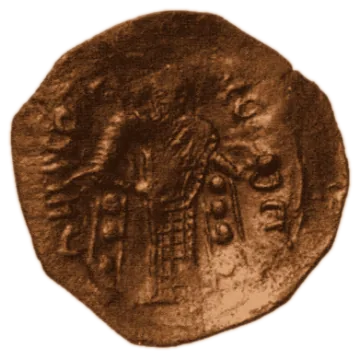
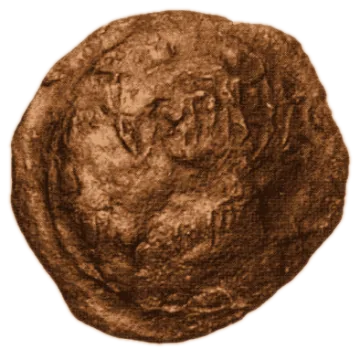
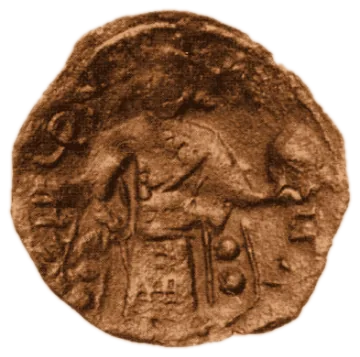
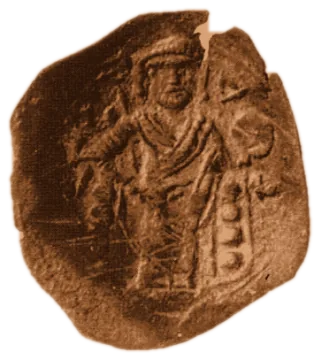
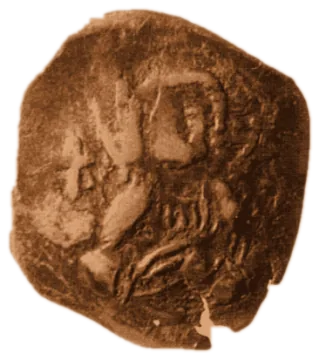
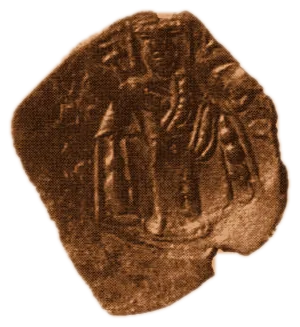
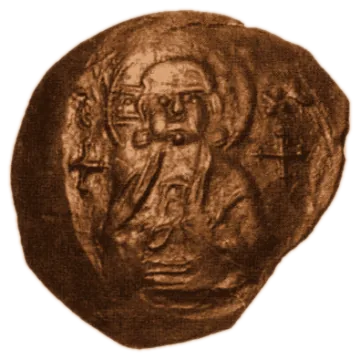
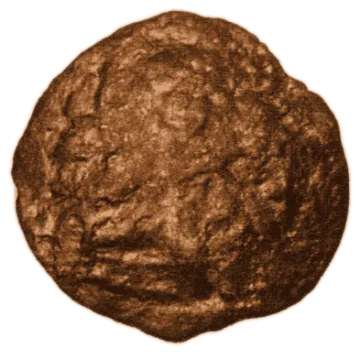
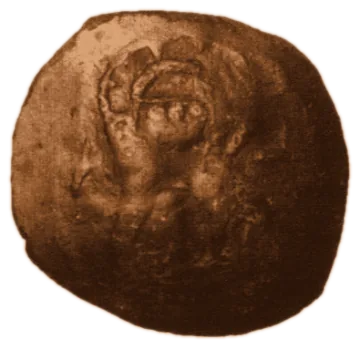
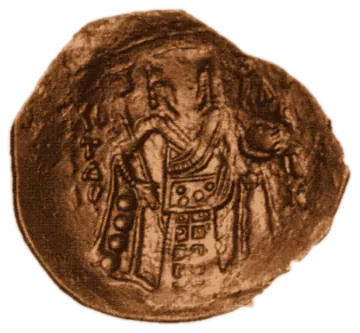
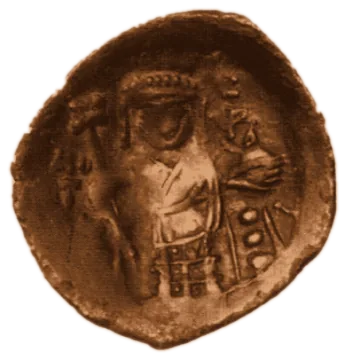
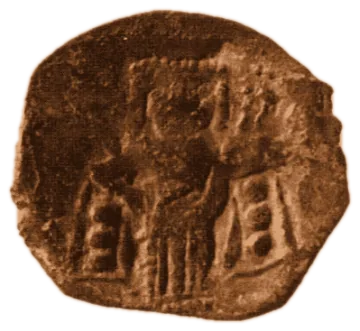
Coin photographs from A. Radushev & G. Zhekov, Catalogue of Bulgarian Medieval Coins IX–XV c. (Agató, 1999).
In the news
- Sredets/Sofia and the art of the Second Bulgarian Tsardom beyond the capital9 August 2025 · Prof. Plamen Pavlov, Trud
- Tsar Konstantin Tih, Irene the Asenid, Maria 'the lioness' and Ivaylo the rebel27 April 2025 · Prof. Plamen Pavlov, Trud
- Coins as a key to understanding the Bulgarian Middle Ages29 March 2025 · Prof. Plamen Pavlov, Trud
- The lords of medieval Sredets in the 13th century1 February 2025 · Prof. Plamen Pavlov, Trud
- Plots and coups for the crown of the Asenids31 May 2019 · Prof. Plamen Pavlov, Trud