
1.Political Narrative
His death in June 1241 left the state in the hands of a child and marked the abrupt end of the Asenid triumph, with the succession passing unchallenged to the seven-year-old Kaliman I. For the first time in the history of the restored kingdom, the throne passed directly from father to son, and this fact mattered as much as the boy’s age: dynastic legitimacy, not seniority among kinsmen, now began to define royal succession in Tarnovo. Yet the new order could exist only through regency, and the sources make clear that Kaliman’s authority was real in title alone. The regents quickly did what the late Ivan Asen II had done in his final years by other means: they sought to secure the frontiers through diplomacy, renewing the agreements with Nicaea and concluding a two-year truce with the Latin Empire. For a moment Bulgaria seemed protected from both of its old rivals, but that calm was deceptive. Even before the boy-king had grown beyond his early years, the kingdom was struck by the Mongol storm that was sweeping across Eastern Europe.
The first Mongol invasion reached Bulgaria in 1242, after the Tatars had ravaged Hungary, Serbia, and the Adriatic hinterland and then crossed into Bulgarian territory on their way back east. They met little resistance, yet they did not need to conquer fortresses or occupy lands permanently in order to damage the kingdom profoundly. They passed through, carrying off booty and prisoners, and left behind a country made more vulnerable by fear and by the failure of any coordinated defense. The most likely consequence was the imposition of tribute, later documented as already existing by 1253, so that the invasion became not only a military shock but also the beginning of a longer relationship of subordination to the Horde. In the wider Balkan balance this proved decisive. Nicaea, distracted by the Mongol threat in Anatolia, was for the moment spared the full burden of a struggle with Bulgaria; but in Tarnovo the regency had already lost the initiative, and the kingdom’s outward security concealed a growing internal weakness.
Kaliman I did not live to see the consequences fully unfold. He died unexpectedly in the late summer or first days of September 1246, at about twelve years of age, and the sources preserve both the statement of an apparently natural death and the rumor that he had been poisoned. His death brought another child to the throne, Michael II Asen, who was at most eight years old when he became tsar. Once again Bulgaria was ruled through a regency, whose precise composition remains obscure, though the widow Irene clearly occupied the leading place at first, and later the sevastokrator Peter emerged at court. The dynastic principle continued to deepen: the notion of the boyar, the mother-queen, and the child-tsar now stood beside a new and increasingly explicit language of legitimacy. The title of bagrenoroden, the formula of the three generations named together, and the emphasis on father, son, and grandfather all testify that the Asenid house was trying to turn succession into a doctrine. But ideology could not prevent territorial collapse. In 1246 John III Doukas Vatatzes took advantage of the change of ruler and the weakness of the regency, and Nicaean forces seized important positions in Thrace and Macedonia, including Serres, while other borderlands slipped away to the Hungarians.
The result was a sharp and humiliating contraction of Bulgaria’s power. By the end of 1246 the kingdom had been forced out of large parts of Macedonia and much of Thrace, and the loss of the Braničevo and Belgrade region further exposed the northern frontier. Bulgaria no longer stood first among the Balkan states, but had become a secondary power compelled to adapt to the ambitions of others. The regency’s foreign policy in the first years of Michael II’s reign reflects this decline. In 1247 the Bulgarians again cooperated with Nicaea against the Latin Empire, but only as junior partners, their forces serving the wider Nicaean strategy rather than shaping events themselves. At the same time the court continued to seek ways back into diplomacy: the treaty with Dubrovnik in 1253 widened commercial relations while also signaling an anti-Serbian alignment, and there were even efforts to influence Nicaean affairs from the sidelines. Yet these were the gestures of a kingdom trying to remain visible after its strategic margin had narrowed dramatically.
The death of Vatatzes in November 1254 opened a brief opportunity, and the Bulgarian court, or those who spoke in its name, moved quickly. In the late months of 1254 Bulgarian forces advanced into the Rhodope region and recovered a series of strongpoints, among them Stanimaka, Perushtitsa, Krichim, Cepina, Ustra, Perperikon, Krivus, and Efraim, along with the district of Achrida apart from the fortress of Maniak. But this success proved fragile. Theodore II Laskaris answered at once, crossed to Europe, and drove the Bulgarians back in 1256 after two costly campaigns. The attempt to hold Macedonia and western Thrace thus failed, and the kingdom’s retreat from those lands became a lasting feature of its later policy. The Melnik uprising of 1255, led by Dragota, showed that local populations still looked to Tarnovo for support, but none came. By then the regency had already begun to seek peace where it could: negotiations with Hungary were pursued, and in the summer of 1256 a settlement with Nicaea was concluded that preserved the existing border but required the surrender of Cepina. That agreement, however, could not restore stability. Before the year ended, Michael II Asen was murdered by his cousin Kaliman, who briefly seized the throne and then fled from Tarnovo, bringing the age of the boy-tsars to a violent crisis and opening the way to civil war.
2.Wars and Warfare
The Mongol invasion of 1241–1242 reached Bulgaria at the moment when the kingdom was already strained by the shock of Ivan II Asen’s death and the problems of a minor ruler. The collapse of the Cuman polity north of the Danube had brought a new and far more formidable power to Bulgaria’s frontier, while the flight of Cumans and other refugees into neighbouring lands sharpened the instability of the whole region. In the spring of 1241 the Mongols shattered the Hungarian army at the Saj, swept on to the Adriatic, and then turned back through Serbia and Bulgaria. Their passage was not a conventional conquest. They moved swiftly, striking where resistance was weak, and in Bulgaria they encountered little opposition. The country was traversed as a corridor of devastation: the invaders took booty and prisoners, inflicted damage, and moved on. No fortress was stormed, no province occupied in a lasting way, and the speed of the campaign left little time for a coordinated defence or for any counterstroke from Tărnovo.
That the Mongols could cross Bulgaria in such a fashion revealed both the military character of their warfare and the weakness of the Balkan states they encountered. Their strength lay in mobility, in the ability to divide the army into detached bodies, to live off plunder, and to withdraw before a local enemy could gather his forces. They did not need to hold ground in order to compel submission. Bulgaria, by contrast, was governed by a regency for a child-king and could not readily mobilize a field army capable of meeting such raiders in open battle. The result was not only material loss but also a political humiliation: before crossing the Danube the Mongols probably imposed tribute, and by 1253 that obligation is already documented as an established fact. What had begun as a sudden raid thus hardened into a lasting relationship of dependency, marking Bulgaria out as one of the principal subjects of the Golden Horde in the Balkans.
The invasion also altered the strategic balance around Bulgaria’s western and southern borders. Hungary and Bulgaria had every reason to seek some accommodation in the face of the new eastern menace, since the Mongols had devastated both lands and demonstrated how vulnerable the region was to large-scale steppe warfare. Yet the Mongol thrust had also relieved the pressure on other powers. Nicaea escaped direct attack because the Mongols in Anatolia withdrew to participate in the election of a new khan, and this gave John III Vatatzes the breathing space to act with greater confidence in the Balkans. Thus the Mongol invasion, though not aimed at the conquest of Bulgaria alone, was felt everywhere in the wider theatre of war: it checked some enemies, empowered others, and exposed the fragility of Bulgarian frontiers at precisely the moment when Tărnovo was least able to defend them.
The military consequences became starkly visible after 1246. When Michael II Asen succeeded as a child, Bulgaria’s enemies seized the initiative. Vatatzes crossed to Europe and, in a rapid campaign, restored a large part of southern Bulgaria to Byzantine rule. The action was not a single dramatic battle but a systematic advance that combined field pressure with the seizure of positions and the appointment of imperial governors. The balance of power was now plainly against Bulgaria. The kingdom had lost Macedonia, was losing much of Thrace and the Rhodope region, and faced continuing pressure from Hungary in the northwest. The regency in Tărnovo could neither hold its inherited lands nor prevent enemies from taking advantage of the succession crisis. Bulgarian warfare in these years was therefore largely reactive: attempts to preserve what remained, to exploit temporary openings, and to survive amid stronger and better-coordinated neighbours.
By 1254–1256 the Bulgarians tried to reverse the tide and to profit from the transition after Vatatzes’ death, but the attempt ended badly. In Macedonia and Thrace they crossed the limits imposed by Nicaea, only to be pushed back in 1256 after two costly campaigns. The phrase itself captures the military reality of the struggle: expensive for Bulgaria, not because it won nothing, but because it could not sustain prolonged pressure against a more effective imperial army. These were not campaigns of conquest but of contest and failure, where the Bulgarians probed, advanced, and then retreated under heavier force. Their enemies were no longer only Mongol raiders from the steppe, but also the organized armies of Nicaea, acting with strategic purpose and exploiting every weakness of the boy-tsar regime.
The years 1241–1256 therefore mark a decisive shift in the warfare of the Second Bulgarian Empire. The country moved from the shock of a Mongol passage that brought tribute and insecurity to a defensive struggle against stronger neighbours on several fronts. The Mongols had shown that no frontier was safe; the Byzantines of Nicaea showed that lost ground could be retaken when Bulgaria was politically divided; and the failure of the campaigns of 1256 showed that the state’s military resources were no longer sufficient to restore its former reach. In this period the army was not a conquering instrument, as under Ivan II Asen, but a force repeatedly outpaced by events—used to resist, to delay, and at best to preserve fragments of a shrinking realm.
3.State and Institutions
The years after the death of Ivan II Asen exposed the machinery of the Second Bulgarian Empire to pressures that were at once dynastic, military, and fiscal. For the first time in the history of the restored kingdom the throne passed directly from father to son without dispute, first to the child Kaliman I and then, after his death, to the even younger Michael II Asen. This did not mean the emergence of a strong hereditary monarchy in the practical sense. It meant rather that the language of power was changing: the crown was increasingly understood as a father’s inheritance, a patrimony to be transmitted within the ruling house, while the actual exercise of rule had to be delegated to guardians and court circles. The old pattern of succession by brother or cousin gave way to a new dynastic logic, but that logic was still fragile, because the heirs were children and the state had to function through regency.
The regency under Kaliman I was an entirely new institution in Bulgarian political life, and the sources do not reveal its composition or internal workings. Even so, its existence shows that the state did not simply collapse when the ruler was a minor. Continuity had to be maintained: treaties with Nicaea were renewed, a truce was concluded with the Latin Empire, and the kingdom attempted to secure itself against the great external dangers that followed so closely upon Ivan II Asen’s death. Yet the very need for regency exposed the weakness of central authority. The crown could be preserved in theory, while in practice the day-to-day management of affairs depended on those around the child-king. The administration thus remained formally intact, but its centre of gravity shifted away from the sovereign himself and toward the court, where legitimacy, diplomacy, and survival had to be negotiated simultaneously.
The death of Kaliman I and the accession of Michael II Asen in 1246 did not remove this structural problem; it deepened it. Once again a boy sat on the throne, and once again the real power lay elsewhere. Here the role of the widowed queen Irene appears especially important. The available evidence points to her primacy in the regency, while leaving the rest of the ruling circle obscure. That obscurity itself is revealing. The monarchy had inherited a political culture in which the ruler’s person was the visible summit of power, but the minority of Michael II made that summit dependent on hidden supports. Court ideology responded to this uncertainty by strengthening dynastic language. The title of bagrenorodny, the equivalent of the Byzantine notion of porphyrogenitus, emerged precisely in this context, not as a claim that could by itself secure the throne, but as a retrospective embellishment of legitimacy. It signaled that the court was beginning to think more consciously in terms of lineage, birth order, and dynastic continuity.
At the same time, the crisis of the 1240s revealed how unevenly power was distributed beyond the capital. The campaign of John III Vatatzes in 1246, which cost Bulgaria important lands in Thrace and Macedonia, and the further weakening of Bulgarian positions in the west, showed that the kingdom’s hold over its provinces depended not only on royal authority but also on the loyalty and capacity of local elites. A figure such as Dragota, whose actions helped the Nicaeans at Serres, illustrates how decisive regional magnates could be when central coordination was weak. The loss of borderlands was therefore not merely a military setback; it was a sign that the state’s local machinery—its ability to command fortresses, hold districts, and retain the allegiance of provincial power holders—was under severe strain. Where the centre could no longer enforce its will consistently, local interests, opportunism, and survival could outweigh dynastic loyalty.
The same pressures affected taxation and the wider fiscal order. The Asenid monarchy had long rested on the careful organization of revenue, and the later tradition of rule in Bulgaria assumed that the crown must sustain itself through a workable balance of military control, provincial administration, and fiscal extraction. Under the boy-tsars this balance became harder to maintain. The Mongol invasion of the early 1240s added a new burden to an already vulnerable system, and the necessity of dealing with external powers narrowed the room for internal consolidation. Tribute and dependence did not simply mean a diplomatic humiliation; they implied that royal revenue and state planning were now shaped by the demands of a larger imperial order beyond the Danube. In such circumstances, the kingdom could still negotiate, make truces, and regulate commerce, but it did so from a weaker position, with fewer resources and less freedom of action than under Ivan II Asen.
By 1256 the fragility of this arrangement had become unmistakable. Michael II Asen had been raised to the throne through dynastic principle, yet his reign ended in murder, and the succession crisis that followed showed how far the state had moved from the confident centralism of the previous generation. The machinery of rule still existed: court, dynasty, provincial elites, fiscal obligations, and the claims of lawful inheritance. But during the years of the first Mongol invasion and its aftermath, each of these elements was exposed to pressure and redefinition. The Bulgarian monarchy survived the shock of 1241–1256, but it did so by becoming more dependent on regency, more conscious of dynastic propaganda, and more vulnerable to the authority of powerful men and women around the throne, while its local and fiscal foundations grew steadily less secure.
4.Church and Letters
The decades after Ivan Asen II’s death made the spiritual sphere part of the struggle for continuity. The Mongol raid of 1241 and the succession of child rulers did not merely unsettle politics; they altered the way authority itself had to be explained. In a kingdom where a seven-year-old boy could be raised to the throne and where real power passed into regency, the church became one of the principal languages of permanence. The patriarchate and the cultic vocabulary surrounding the ruler helped to bridge the gap between hereditary right and effective government. Even when the crown was held by children, the monarchy did not appear as an abandoned office: it was presented as a legitimate, dynastic and sacral institution whose continuity had to be publicly affirmed.
This is especially clear in the letter sent by Pope Innocent IV on 21 March 1241 to Kaliman I. The papacy still treated Bulgaria as a field of confessional competition and tried to draw the Bulgarian court back to the Catholic faith. Such a letter was not an isolated gesture of courtesy, but part of a wider effort to exploit the kingdom’s moment of vulnerability after Ivan Asen II’s death. Yet its very existence also reveals the limits of Latin influence. The appeal was addressed to a Bulgarian ruler who had just inherited his father’s authority, and whose realm remained anchored in its own ecclesiastical and political traditions. In the middle of the Mongol crisis, and under a regency that had to secure the borders against all possible enemies, religious alignment was not simply a matter of theology; it was bound to diplomacy, legitimacy and survival.
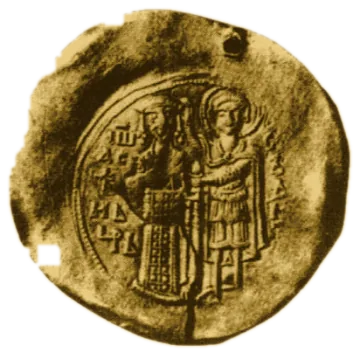
After 1246, when Michael II Asen came to the throne, the dynastic dimension of sanctified kingship became even more pronounced. The new language of legitimacy introduced in his time was not only hereditary but vertical: the ruler was now explicitly situated within a line of fathers and grandfathers. The appearance of the title bagrenoroden, the Bulgarian equivalent of porphyrogennetos, shows how strongly the court was drawn toward Byzantine modes of dynastic self-definition. This was not a mere ornament of style. It was a political theology of succession, a way of saying that legitimacy resided in blood, birth and lineage rather than in force alone. The Batosh inscription, though fragmentary, is especially revealing in this respect, because it names Michael as the great king Michael Asen, son of the great king Asen and grandson of the old Asen, turning dynastic memory into a visible monument of statehood.
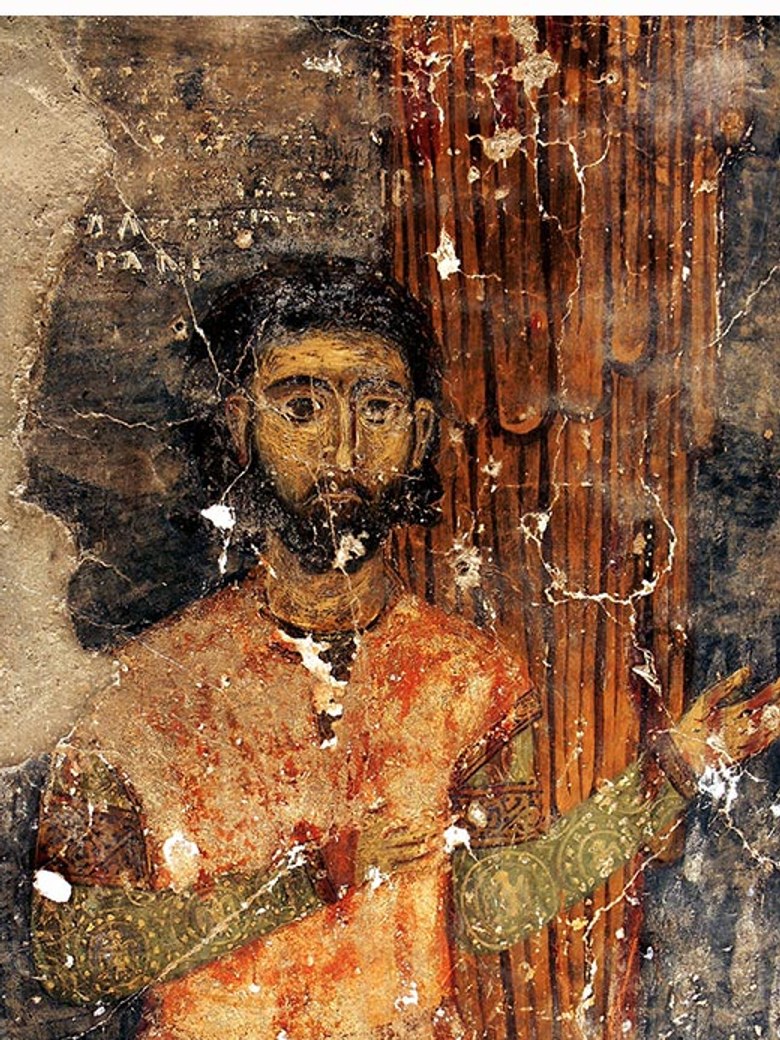
The regency that governed in the name of Michael II also gave a more public role to the king’s mother, Irene, whose position seems to have been more than ceremonial. The image of her authority is supported not only by the political narrative but also by visual representation, including the scene on the western outer wall of the church of St. Archangel Michael in Kastoria. In a period when power was fragile and often exercised behind the throne, such monuments mattered. They translated ruling relationships into sacred and durable forms. The church, the image and the inscription all worked together to render dynastic rule intelligible, especially at a moment when the state was being weakened from without by external pressure and from within by the instability inherent in minority kingship.
Within these years, therefore, the most important cultural fact is not the appearance of a wholly new ecclesiastical policy, but the tightening of the bond between church language and dynastic legitimacy. The patriarchate remained one of the foundations on which the court could rest its claims, even if the surviving narrative is sparse on the day-to-day life of monasteries or on any major doctrinal struggle. What is visible instead is the increased importance of written and monumental forms: papal correspondence, honorific titles, genealogical formulae and commemorative inscriptions. In an age of Mongol tribute and child rulers, the written word and the sacred image became instruments of rule no less than swords or treaties, because they helped preserve the idea that Bulgaria was still a kingdom ruled by lawful, consecrated heirs of Asen.
5.Economy and Charters
The years after the Mongol onslaught opened with a kingdom that was still territorially broad in name, but increasingly fragile in practice. The first invasion of 1242–1243 came at a moment when the crown was already adjusting to the unprecedented reality of a child king and regency, and the state’s first concern was no longer expansion but the preservation of movement, revenue, and political coherence. The years immediately after Ivan II Asen’s death had already shown that Bulgaria’s rulers had to secure themselves by treaty: the new regime renewed relations with Nicaea and concluded a truce with the Latin Empire, an unmistakable sign that diplomacy now had to protect the economic life of the realm as much as the frontier did. In such conditions, the countryside, the towns, and the roads between them remained exposed to disruption, but they also became the very substance of royal policy. The crown had to keep the channels of exchange open if it was to remain a functioning power.
The clearest witness to that policy is the Dubrovnik charter of 1253 issued by Michael II Asen. Its language reveals not merely a favor granted to foreign merchants, but a deliberate economic program. Dubrovnik’s traders were allowed to go through the whole kingdom with whatever goods they carried, to buy, to sell, to import and export freely, and to do so without injury to their merchandise. The exemption was comprehensive: no customs dues or other taxes were to be levied on them in the town, at assembly, in merchants’ villages, on bridges, at rivers, or along the roads. This is the language of a state that understood how commerce moved—not only through cities, but along a whole hierarchy of transit points, crossing bridges, fords, routes, and local markets. The charter did not simply protect merchants as private persons; it guaranteed the safety of their bodies and property, turning royal protection into an instrument of trade. In a period of political contraction, the monarchy sought to make the kingdom attractive to external commerce by lowering fiscal friction and promising security.
The geography embedded in the charter is just as revealing as its legal formulas. The list of places through which Dubrovnik’s men might travel maps a kingdom whose economic life was still organized around older centers and newer strongholds alike: Bdin, Braničevo, Belgrade, Tărnovo, the whole of Zagorje, Preslav, the Carvuna land, the Krăn district, the Boruy district, Adrianople, Demotika, the Skopje region, the Prilep region, the Devoll region, the Albanian land, and even as far as Thessaloniki. Whether every one of these places was equally secure or equally controlled is less important than the fact that the charter imagines them as parts of one commercial space. Old capitals and frontier fortresses, Danubian towns and southern urban centers, interior districts and road junctions all appear in the same legal horizon. The charter therefore shows a monarchy trying to hold together a scattered political landscape by means of an integrated mercantile privilege. Towns mattered not only as administrative centers, but as nodes where goods could be stored, exchanged, taxed, or exempted; roads and bridges mattered because they were the channels along which the kingdom’s remaining vitality flowed.
Fiscal policy in these years was evidently shaped by the same pressures. The charters do not present a kingdom rich enough to rely confidently on ordinary dues; instead, they show a government willing to surrender customs income in order to secure traffic and attract merchants. That in itself is a sign of strain. Customs, bridge tolls, market dues, and river charges were among the normal instruments by which medieval states turned mobility into revenue. By suspending them for Dubrovnik, the crown was not abolishing taxation in principle, but using exemption as a strategic privilege. The charter implies a world in which such charges were common enough to be waived, and in which the king’s promise mattered because local officials and holders of routes, crossings, and market sites might otherwise exact payment. In that sense, the document reflects both the fiscal fragmentation of the age and the continuing effort of the monarchy to impose a unifying commercial order over it. Even where direct royal power was weaker than before, the crown still claimed the authority to regulate the terms on which goods could move through the realm.
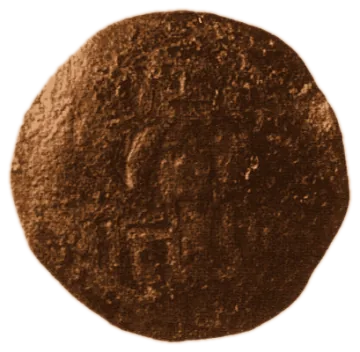
Money and lordship also belong to this picture, even if the record is more fragmentary. The reign of Michael II Asen is associated with the prominence of the widowed queen Irene, and the discussion of silver coinage shows that the exercise of power was visible not only in charters but in monetary forms as well. In a kingdom ruled by minors, coins and privileges alike helped to express continuity: one in circulation, the other in legal guarantee. Yet the same years also exposed the fragility of that continuity. The unsuccessful war with Nicaea in 1254–1256 and the final collapse of Michael II Asen’s rule in 1256 came after a period in which diplomacy and commerce had been used as substitutes for strength. The royal charters of the interval therefore do more than record a trade privilege; they reveal a state trying to preserve its economic fabric under the pressure of invasion, dynastic weakness, and territorial loss. In the first Mongol decade, Bulgaria’s towns, roads, dues, and merchants became the last broad field in which the monarchy could still act with confidence, even as the political foundation beneath them was steadily giving way.
6.Foreign Relations
The death of Ivan II Asen in 1241 opened a period in which Bulgaria’s foreign relations were dictated less by initiative from Tarnovo than by the weakness of a child’s government and by the pressure of events around it. His eldest son Kaliman I inherited the royal dignity, but the real conduct of affairs fell to a regency, and the first concern of that regency was to preserve what the late ruler had secured. The traditional settlement with Nicaea was renewed, and a two-year truce was concluded with the Latin Empire, so that Bulgaria at least began the boy-king’s reign with its western and eastern rivals temporarily contained. Even Rome still sought to intervene: a papal letter appealed to the young ruler to return the Bulgarians to Catholicism, showing that the Papacy continued to regard the Bulgarian throne as a prize to be won by persuasion as well as by diplomacy. Yet these gestures only underline how vulnerable the kingdom had become. The old balance of Ivan II Asen’s reign was gone, and the neighbors of Bulgaria were quick to sense that the center had weakened.
The first great external shock was the Mongol invasion. By 1242 the Tatars had swept through the Balkans, and Bulgaria lay directly in their path. They crossed the country with little resistance, but the damage was serious: booty and prisoners were carried off, and before they left the Danube frontier they probably imposed tribute, a burden that is already securely attested a little later and must have begun at this moment. The key fact is not that the Mongols occupied Bulgaria, for they did not; they had no time for fortresses or annexation. Their passage was instead a violent demonstration of the new order in eastern Europe. Bulgaria survived, but under changed conditions: tribute meant subordination, and the threat of a renewed raid hung over every subsequent decision. The invasion also altered the wider Balkan landscape. Vatatzes of Nicaea was forced to abandon immediate action in Europe when news of the Mongol advance reached him, and this interruption briefly preserved the balance around Constantinople; but once the storm had passed, Nicaea emerged stronger than Bulgaria, while the Bulgarian kingdom entered a decade of strategic contraction.
That contraction became plain in 1246, when the death of Kaliman brought to the throne another child, Michael II Asen. The minor tsar and his regents were no match for the diplomacy and military power of John III Vatatzes, who took advantage of the change of ruler and the uncertainty that always attended a regency. Nicaea moved into southern Bulgaria and in a short time restored a large part of Thrace and Macedonia to Byzantine rule. Serres fell, helped by the cooperation of a Bulgarian noble, and the losses widened until the kingdom had been stripped of much of the territory gained under Ivan II Asen. The regency at Tarnovo, dominated by the widowed Empress Irene and concerned above all with its own position, proved incapable of mounting an effective response. The result was not merely territorial loss but a decisive lowering of Bulgaria’s standing. From a power that had once shaped the balance of the peninsula, it became one state among others, compelled to accept the initiatives of stronger neighbors and to use diplomacy defensively rather than expansively.
These changes also affected Bulgaria’s relations with Serbia and Hungary. The Hungarian advance on the northwestern frontier remained a constant factor, and by the middle of the decade Braničevo and Belgrade were again outside effective Bulgarian control, or at least under severe threat. The Serbian kingdom, too, felt the pressure of the new situation. Vladislav, who had been linked to the Asen house, was overthrown in 1243, and the death of Ivan II Asen removed the powerful support that had sustained him. Uroš then took the throne, while the Tatar passage through Serbia had already caused destruction and may have shaken Vladislav’s authority further. Serbian rulers and magnates now had to navigate a landscape in which Hungary pressed from the north, Nicaea from the south, and the Mongols from the east. For Bulgaria, this meant that alliances on the western front became more important than ever. In 1253 Dubrovnik and Bulgaria concluded an agreement that regulated trade but also pointed to a political and military understanding directed against Serbia. This was a revealing move: Tarnovo sought not a grand offensive, but useful partnerships that might offset Serbian pressure and restore some leverage in the western Balkans.
Bulgaria’s diplomacy toward Nicaea after 1246 was correspondingly unstable. In 1247 the kingdom again cooperated with Vatatzes against the Latin Empire, but only as a subordinate partner, its troops assisting rather than directing the campaign. This was a far cry from the confident balancing of the days of Ivan II Asen. The next opportunity came only after the death of Vatatzes in 1254. Michael Asen and the men around him attempted to recover some of the ground lost in the preceding decade, and in late 1254 Bulgarian forces advanced into the Rhodope region, capturing a chain of strongholds. But the reaction of the new Nicaean ruler Theodore II Laskaris was swift. He crossed to Europe, confronted the Bulgarians on the Maritsa, and recovered much of the territory they had taken, leaving Bulgaria again on the defensive. The campaign revealed both the ambition of the Tarnovo court and the limits on what it could still achieve. It also showed that Michael Asen’s government, like that of his brother before him, depended heavily on regents and powerful relatives, making foreign policy hesitant and vulnerable to reversals.
By 1256 the kingdom had learned the hard lesson of the preceding fifteen years: survival required compromise. Bulgaria had tried to exploit the Nicaean succession crisis, but the result was a costly setback. Theodore II’s campaigns pushed the Bulgarians back, and at the end of June or the beginning of July 1256 a peace was concluded that preserved the existing frontier while requiring Bulgaria to surrender the fortress of Tsipina. The settlement was a confession of reduced strength. The same period also saw attempts to stabilize the western and northern diplomatic situation, including the arrangement with Hungary that cleared the way for action in the south, but none of these steps could restore the broader pre-1241 position. The great powers around Bulgaria—Nicaea, Hungary, Serbia, and the Golden Horde—now shaped the kingdom’s room for maneuver. Tarnovo could still make treaties, invoke marriage ties, and exploit rivalries, but it could no longer dictate the terms of Balkan politics. The first Mongol invasion had not destroyed the Bulgarian state; it had made it dependent on a more dangerous and less forgiving international order.
1.Political Story
When Ivan II Asen died in June 1241, the kingdom was left under the rule of his young son, Kaliman I, who was only seven years old. This marked a sudden end to the Asenid dynasty’s period of success. For the first time since the kingdom was restored, the crown passed directly from father to son. This was important because it shifted the idea of royal succession from being based on senior family members to being based on direct family lineage. However, since Kaliman was a child, he could not rule on his own. Instead, a group of regents governed in his name. While Kaliman held the title of king, real power rested with these regents.
The regents quickly worked to protect the kingdom’s borders through diplomacy, just as Ivan II Asen had done in his later years. They renewed agreements with the Empire of Nicaea and arranged a two-year truce with the Latin Empire. For a short time, Bulgaria seemed safe from its old enemies, but this peace was fragile. Before Kaliman grew up, the Mongols swept through Eastern Europe and reached Bulgaria.
The first Mongol invasion hit Bulgaria in 1242. After devastating Hungary, Serbia, and nearby coastal areas, the Mongols passed through Bulgaria on their way back east. They met little resistance and did not need to capture fortresses or settle the land to cause serious harm. They took loot and prisoners, leaving behind a frightened and vulnerable country without any organized defense. It’s likely that Bulgaria was forced to pay tribute to the Mongols, a fact confirmed by records from 1253. This invasion was not just a military blow; it started a long period where Bulgaria was under the influence of the Mongol Golden Horde. In the bigger picture of Balkan politics, this was a turning point. The Empire of Nicaea, distracted by Mongol threats in Asia Minor, avoided fighting Bulgaria directly for a while. But in Bulgaria, the regents had already lost control, and the kingdom’s outward calm hid growing internal problems.
Kaliman I died suddenly in late summer or early September 1246, around the age of twelve. Some sources say he died naturally, while others suggest he was poisoned. After his death, another child, Michael II Asen, became tsar at about eight years old. Again, Bulgaria was ruled by regents, though we don’t know exactly who they all were. The queen mother, Irene, seems to have taken the lead at first, and later a noble named Peter became influential at court. The idea of dynastic rule grew stronger: the roles of the nobles, the queen mother, and the child king became part of a clear message about legitimate succession. Titles and references to three generations of rulers—father, son, and grandfather—show that the Asen family was trying to turn succession into a formal principle. But this growing focus on legitimacy could not stop Bulgaria’s territory from shrinking. In 1246, John III Doukas Vatatzes of Nicaea took advantage of the weak regency and captured important parts of Thrace and Macedonia, including the city of Serres. Other border areas were lost to Hungary.
By the end of 1246, Bulgaria had lost large parts of Macedonia and much of Thrace. The loss of the Braničevo and Belgrade regions also weakened the northern border. Bulgaria was no longer the leading Balkan power but had become a secondary state forced to adjust to the ambitions of its neighbors. The regents’ foreign policy during Michael II’s early reign reflected this decline. In 1247, Bulgaria cooperated with Nicaea against the Latin Empire but only as a junior partner, following Nicaea’s lead rather than setting the agenda. At the same time, Bulgaria tried to maintain diplomatic ties, signing a trade agreement with Dubrovnik in 1253 that also showed an anti-Serbian stance. There were even attempts to influence Nicaean politics from the sidelines. These efforts showed a kingdom trying to stay relevant despite its shrinking influence.
When John III Vatatzes died in November 1254, Bulgaria saw a brief chance to regain strength. Late that year, Bulgarian forces moved into the Rhodope Mountains and recaptured several fortresses, including Stanimaka, Perushtitsa, Krichim, and others, as well as the district of Achrida (except for the fortress of Maniak). However, this success was short-lived. Theodore II Laskaris, the new Nicaean ruler, quickly responded by crossing into Europe and pushing the Bulgarians back in 1256 after two difficult campaigns. Bulgaria’s attempt to hold onto Macedonia and western Thrace failed, and its retreat from these areas became permanent. A local uprising in Melnik in 1255, led by Dragota, showed that some people still looked to Tarnovo for leadership, but no help arrived. By then, the regency was already seeking peace where possible. Talks with Hungary were underway, and in the summer of 1256, a treaty with Nicaea was signed that kept the border as it was but required Bulgaria to give up the fortress of Cepina. This agreement did not bring lasting stability. Before the year ended, Michael II Asen was murdered by his cousin Kaliman, who briefly took the throne before fleeing Tarnovo. This violent event ended the era of child kings and opened the door to civil war.
2.Wars and Fighting
The Mongol invasion of 1241–1242 struck Bulgaria at a time when the kingdom was already weakened by the death of Ivan II Asen and the challenges of having a child ruler. The collapse of the Cuman state north of the Danube River had brought a new, more powerful threat to Bulgaria’s borders. Refugees fleeing the Mongols added to the instability in the region. In spring 1241, the Mongols crushed the Hungarian army at the Saj River, moved on to the Adriatic coast, and then returned through Serbia and Bulgaria. Their invasion was not a typical conquest. They moved quickly, attacking where defenses were weak. In Bulgaria, they faced almost no resistance. The Mongols passed through, taking loot and prisoners, causing damage, and moving on. They did not storm fortresses or occupy provinces for long, and their fast campaign left little chance for Bulgaria to organize a defense or counterattack.
The Mongols’ ability to cross Bulgaria so easily showed both their military style and the weakness of the Balkan states. Their strength was in their speed, splitting their forces into smaller groups, living off the land, and retreating before enemies could gather. They didn’t need to hold territory to force submission. Bulgaria, ruled by regents for a child king, could not quickly raise an army to face such raiders in open battle. The result was not only material loss but also political humiliation. Before crossing the Danube, the Mongols probably forced Bulgaria to pay tribute, and by 1253 this tribute was officially recorded. What started as a sudden raid became a lasting relationship of dependence, making Bulgaria one of the main subjects of the Mongol Golden Horde in the Balkans.
The invasion also changed the balance of power around Bulgaria’s western and southern borders. Hungary and Bulgaria had good reasons to cooperate against the new eastern threat since both had been devastated by the Mongols and saw how vulnerable the region was to steppe warfare. However, the Mongol attack also eased pressure on other powers. The Empire of Nicaea avoided direct attack because the Mongols in Asia Minor withdrew to choose a new leader. This gave John III Vatatzes of Nicaea a chance to act more confidently in the Balkans. So, while the Mongol invasion was not aimed solely at Bulgaria, its effects were felt everywhere: it slowed some enemies, strengthened others, and exposed Bulgaria’s weak borders just when Tarnovo was least able to defend them.
The military consequences became clear after 1246. When Michael II Asen became king as a child, Bulgaria’s enemies took the lead. Vatatzes crossed into Europe and quickly regained much of southern Bulgaria for the Byzantine Empire. This was not a single big battle but a steady advance that combined pressure on the field with capturing key positions and appointing imperial governors. The balance of power was clearly against Bulgaria. The kingdom lost Macedonia, much of Thrace and the Rhodope Mountains, and faced ongoing threats from Hungary in the northwest. The regency in Tarnovo could neither hold its lands nor stop enemies from exploiting the succession crisis. Bulgaria’s military efforts during these years were mostly defensive: trying to keep what remained, take advantage of brief opportunities, and survive among stronger, better-organized neighbors.
Between 1254 and 1256, Bulgaria tried to turn things around after Vatatzes’ death but failed. They pushed into Macedonia and Thrace beyond what Nicaea would allow, only to be driven back in 1256 after two costly campaigns. These campaigns were expensive for Bulgaria—not because they gained nothing, but because they could not keep up pressure against a stronger imperial army. These were struggles of contest and failure, where Bulgarians advanced and then retreated under heavier force. Their enemies were no longer just Mongol raiders but also the well-organized armies of Nicaea, acting with clear strategy and taking advantage of Bulgaria’s weak child-king government.
From 1241 to 1256, Bulgaria’s warfare changed dramatically. The country went from being shocked by a Mongol raid that brought tribute and insecurity to fighting a defensive war against stronger neighbors on several fronts. The Mongols showed that no border was safe; the Byzantines of Nicaea showed that lost lands could be taken back when Bulgaria was politically divided; and the failed campaigns of 1256 showed that Bulgaria’s military was no longer strong enough to regain its former power. During this time, the army was no longer a conquering force like under Ivan II Asen but was instead used to resist, delay, and hold on to shrinking territory.
3.Government and Institutions
After Ivan II Asen’s death, the government of the Second Bulgarian Empire faced challenges from family succession, military threats, and financial strain. For the first time since the kingdom’s restoration, the crown passed directly from father to son without dispute—first to the child Kaliman I, then to the even younger Michael II Asen. This did not mean a strong hereditary monarchy had emerged in practice. Instead, the idea of power was changing: the crown was seen more as a family inheritance passed down within the ruling house, while actual rule had to be handled by guardians and court officials. The old tradition of passing the throne to brothers or cousins gave way to a new focus on direct family line, but this system was fragile because the heirs were children and the state had to be run by regents.
The regency during Kaliman I’s reign was a new institution in Bulgarian politics, but we don’t know who exactly made it up or how it worked internally. Still, its existence shows that the state did not fall apart when the ruler was a minor. Continuity was maintained: treaties with Nicaea were renewed, a truce was made with the Latin Empire, and the kingdom tried to protect itself from external threats that followed Ivan II Asen’s death. However, the need for regency revealed the weakness of central power. The crown existed in theory, but day-to-day decisions were made by those around the child king. The government stayed formally intact, but power shifted away from the sovereign to the court, where legitimacy, diplomacy, and survival had to be balanced.
When Kaliman I died and Michael II Asen became king in 1246, this problem deepened. Again, a child ruled, and real power lay elsewhere. The widowed queen Irene seems to have played a key role in the regency, though the rest of the ruling group remains unclear. This uncertainty is telling. The monarchy had a political culture where the ruler’s person was the visible center of power, but Michael II’s minority made that center dependent on hidden support. The court responded by strengthening dynastic language. The title bagrenorodny, similar to the Byzantine term porphyrogenitus (meaning "born in the purple," or born to ruling parents), appeared at this time. It was not a guarantee of the throne but a way to emphasize legitimacy after the fact. It showed that the court was thinking more carefully about family lineage, birth order, and dynastic continuity.
At the same time, the crisis of the 1240s showed that power was uneven outside the capital. John III Vatatzes’ campaign in 1246, which cost Bulgaria important lands in Thrace and Macedonia, along with losses in the west, showed that the kingdom’s control over its provinces depended not only on royal authority but also on the loyalty and strength of local nobles. For example, Dragota’s actions helped Nicaea capture Serres, showing how powerful regional leaders could be when central control was weak. Losing borderlands was not just a military failure; it showed that the state’s local systems—its ability to command fortresses, govern districts, and keep local leaders loyal—were under great strain. When the central government could not enforce its will, local interests and survival often took priority over loyalty to the dynasty.
These pressures also affected taxes and the kingdom’s finances. The Asenid monarchy had long depended on carefully organized revenue, and later rulers assumed that the crown needed a balance of military control, provincial administration, and tax collection. Under the child kings, this balance became harder to keep. The Mongol invasion in the early 1240s added new burdens to an already fragile system. Dealing with foreign powers limited the ability to strengthen internal control. Tribute and dependence on the Mongols were not just diplomatic humiliations; they meant that royal income and state planning had to fit within a larger empire’s demands beyond the Danube. In this situation, Bulgaria could still negotiate, make truces, and regulate trade, but it did so from a weaker position, with fewer resources and less freedom than under Ivan II Asen.
By 1256, this fragile situation was clear. Michael II Asen came to the throne based on dynastic right, but his reign ended in murder. The succession crisis that followed showed how far the state had moved from the confident, centralized rule of the previous generation. The government machinery still existed—court, dynasty, local nobles, taxes, and claims of lawful inheritance—but during the first Mongol invasion and its aftermath, all these elements were under pressure and changing. The Bulgarian monarchy survived the shock of 1241–1256, but it became more dependent on regents, more focused on dynastic propaganda, and more vulnerable to powerful individuals around the throne. Meanwhile, its local and financial foundations grew weaker.
4.Church and Culture
After Ivan Asen II’s death, the spiritual side of the kingdom became part of the struggle to maintain continuity. The Mongol raid of 1241 and the rule of child kings unsettled not only politics but also how authority was explained. In a kingdom where a seven-year-old could be king but real power was held by regents, the church became a key way to express permanence. The patriarchate (the highest church office) and religious language about the ruler helped connect hereditary right with actual government. Even when children held the crown, the monarchy was presented as a legitimate, dynastic, and sacred institution whose continuity had to be publicly confirmed.
This is clear in a letter sent by Pope Innocent IV on March 21, 1241, to Kaliman I. The pope still saw Bulgaria as a battleground for religious influence and tried to bring the Bulgarian court back to Catholicism. This letter was part of a larger effort to take advantage of Bulgaria’s vulnerability after Ivan Asen II’s death. But the letter also shows the limits of Latin influence. It was addressed to a Bulgarian ruler who had just inherited his father’s authority and whose kingdom remained rooted in its own church and political traditions. During the Mongol crisis and under regency, religious alignment was not just about faith; it was tied to diplomacy, legitimacy, and survival.
After 1246, when Michael II Asen became king, the religious aspect of royal legitimacy became even stronger. The new language of legitimacy emphasized not only family inheritance but also a vertical line of descent: the ruler was explicitly placed within a line of fathers and grandfathers. The title bagrenoroden, the Bulgarian version of porphyrogenitus, showed how much the court was influenced by Byzantine ideas about dynastic identity. This was more than decoration; it was a political theology of succession, saying that legitimacy came from blood, birth, and family, not just force. The Batosh inscription, though incomplete, is especially revealing because it names Michael as “great king Michael Asen, son of great king Asen and grandson of old Asen,” turning family memory into a public symbol of statehood.
The regency ruling for Michael II also gave the king’s mother, Irene, a more visible role. Her authority seems to have been more than symbolic. This is supported not only by political records but also by images, such as a scene on the western outer wall of the church of St. Archangel Michael in Kastoria. In a time when power was fragile and often exercised behind the throne, such monuments mattered. They turned ruling relationships into sacred, lasting forms. The church, images, and inscriptions worked together to make dynastic rule understandable, especially when the state was weakened by external threats and the instability of child kings.
During these years, the most important cultural development was not a new church policy but the closer link between church language and dynastic legitimacy. The patriarchate remained a key foundation for the court’s claims, even though we have little information about daily monastic life or major religious disputes. Instead, what stands out is the growing importance of written and monumental forms: papal letters, honorific titles, family genealogies, and commemorative inscriptions. In a time of Mongol tribute and child rulers, written words and sacred images became tools of rule as important as swords or treaties because they helped keep alive the idea that Bulgaria was still a kingdom ruled by lawful, consecrated heirs of the Asen family.
5.Economy and Documents
After the Mongol invasion, Bulgaria was still large in name but increasingly fragile in reality. The first invasion in 1242–1243 happened when the crown was already adjusting to the unusual situation of a child king and regency. The kingdom’s main goal was no longer expansion but keeping trade, revenue, and political unity alive. After Ivan II Asen’s death, Bulgaria’s rulers had already shown they needed treaties to secure themselves. The new government renewed relations with Nicaea and made a truce with the Latin Empire. This showed that diplomacy now had to protect the kingdom’s economy as much as its borders. Even though the countryside, towns, and roads were vulnerable to disruption, they became the focus of royal policy. The crown had to keep trade routes open to remain a functioning power.
The best example of this policy is the Dubrovnik charter of 1253, issued by Michael II Asen. This document did not just grant favors to foreign merchants; it laid out a deliberate economic plan. Traders from Dubrovnik were allowed to travel freely throughout the kingdom with their goods. They could buy, sell, import, and export without fear of harm to their merchandise. The charter exempted them from customs duties and taxes in towns, markets, villages, on bridges, rivers, and roads. This shows a state that understood how trade worked—not just in cities but along all the routes, crossings, and local markets. The charter did not just protect merchants as individuals; it guaranteed their safety and property, turning royal protection into a tool for trade. In a time of political decline, the monarchy tried to make the kingdom attractive to foreign commerce by reducing taxes and promising security.
The places listed in the charter are also telling. They include Bdin, Braničevo, Belgrade, Tarnovo, the Zagorje region, Preslav, Carvuna, Krăn, Boruy, Adrianople, Demotika, Skopje, Prilep, Devoll, Albanian lands, and even Thessaloniki. Whether all these places were equally secure or controlled is less important than the fact that the charter imagined them as part of one commercial area. Old capitals, frontier fortresses, Danube towns, southern cities, interior districts, and road junctions all appeared in the same legal framework. The charter shows a monarchy trying to hold together a scattered political landscape through a unified trade privilege. Towns mattered not only as administrative centers but as places where goods could be stored, exchanged, taxed, or exempted. Roads and bridges mattered because they were the channels through which the kingdom’s remaining vitality flowed.
Tax policy in these years reflected the same pressures. The charters do not describe a kingdom rich enough to rely confidently on regular taxes. Instead, they show a government willing to give up customs income to keep trade moving and attract merchants. This itself shows strain. Customs duties, bridge tolls, market fees, and river charges were common ways medieval states turned movement into revenue. By waiving these for Dubrovnik, the crown was not ending taxation but using exemptions as a strategic tool. The charter implies a world where such charges were common enough to be waived and where the king’s promise mattered because local officials might otherwise demand payments. In this way, the document reflects both the fiscal fragmentation of the time and the monarchy’s ongoing effort to impose a unified commercial order. Even where royal power was weaker, the crown still claimed authority to regulate how goods moved through the kingdom.
Money and lordship also fit into this picture, though the record is less complete. Michael II Asen’s reign is linked to the prominence of his widowed mother, Irene, and discussions about silver coins show that power was expressed not only in charters but also in currency. In a kingdom ruled by children, coins and privileges helped express continuity: coins circulated as symbols of authority, and charters guaranteed legal rights. Yet these years also revealed the fragility of that continuity. The failed war with Nicaea in 1254–1256 and Michael II Asen’s violent death in 1256 came after a period when diplomacy and trade were used as substitutes for strength. The royal charters from this time do more than record trade privileges; they reveal a state trying to preserve its economic life under invasion, dynastic weakness, and territorial loss. In the first decade after the Mongol invasion, Bulgaria’s towns, roads, taxes, and merchants became the last areas where the monarchy could still act confidently, even as the political foundation beneath them weakened.
6.Foreign Relations
After Ivan II Asen died in 1241, Bulgaria’s foreign relations were shaped less by its own plans and more by the weakness of a child ruler and the pressures around it. His eldest son, Kaliman I, inherited the throne, but real power was held by regents. Their first goal was to keep what Ivan II Asen had gained. They renewed the traditional agreement with Nicaea and made a two-year truce with the Latin Empire, so Bulgaria began Kaliman’s reign with its western and eastern rivals temporarily contained. Even the Pope tried to intervene: a letter urged the young king to bring Bulgaria back to the Catholic faith, showing that the Papacy still saw the Bulgarian throne as a prize to win through persuasion and diplomacy. But these gestures also showed how vulnerable Bulgaria had become. The balance that Ivan II Asen had maintained was gone, and Bulgaria’s neighbors quickly sensed the kingdom’s weakness.
The first major external shock was the Mongol invasion. By 1242, the Mongols had swept through the Balkans, and Bulgaria lay directly in their path. They crossed the country with little resistance but caused serious damage, taking loot and prisoners. Before leaving, they probably forced Bulgaria to pay tribute, a burden confirmed by later records and likely starting at this time. The key point is that the Mongols did not occupy Bulgaria—they had no time for fortresses or annexation. Their passage was a violent sign of the new order in Eastern Europe. Bulgaria survived but under changed conditions: tribute meant subordination, and the threat of another raid loomed over every decision. The invasion also changed the wider Balkan situation. Vatatzes of Nicaea had to stop immediate action in Europe when he heard of the Mongol advance, which briefly preserved the balance around Constantinople. But once the Mongol threat passed, Nicaea grew stronger than Bulgaria, which entered a decade of strategic decline.
This decline became clear in 1246 when Kaliman died and Michael II Asen, another child, became king. The young tsar and his regents could not match John III Vatatzes’ diplomacy and military power. Nicaea moved into southern Bulgaria and quickly took much of Thrace and Macedonia back under Byzantine control. The city of Serres fell with help from a Bulgarian noble, and losses continued until Bulgaria had lost much of the territory gained under Ivan II Asen. The regency in Tarnovo, led by Empress Irene and focused on its own survival, could not respond effectively. The result was not just lost land but a sharp drop in Bulgaria’s status. Once a power shaping the peninsula’s balance, Bulgaria became just one state among others, forced to accept the moves of stronger neighbors and to use diplomacy defensively rather than aggressively.
These changes also affected Bulgaria’s relations with Serbia and Hungary. Hungary’s advance on the northwest border was a constant threat, and by the mid-1240s, Braničevo and Belgrade were no longer under firm Bulgarian control. Serbia also felt the pressure. Vladislav, who had ties to the Asen family, was overthrown in 1243, and Ivan II Asen’s death removed his main support. Uroš took the Serbian throne, while the Mongol invasion had already caused destruction and may have weakened Vladislav’s rule. Serbian leaders now had to deal with pressure from Hungary in the north, Nicaea in the south, and the Mongols in the east. For Bulgaria, this meant that alliances on the western front became more important than ever. In 1253, Bulgaria and Dubrovnik signed an agreement regulating trade and signaling a political and military understanding against Serbia. This showed that Tarnovo was not planning a major offensive but seeking useful partnerships to counter Serbian pressure and regain some influence in the western Balkans.
Bulgaria’s diplomacy with Nicaea after 1246 was unstable. In 1247, Bulgaria again joined Vatatzes against the Latin Empire but only as a junior partner, with its troops supporting rather than leading the campaign. This was far from the confident balancing act of Ivan II Asen’s time. The next chance came after Vatatzes died in 1254. Michael II Asen and his advisors tried to recover lost lands, and late that year Bulgarian forces moved into the Rhodope Mountains, capturing several fortresses. But Theodore II Laskaris, the new Nicaean ruler, quickly responded. He crossed into Europe, confronted the Bulgarians on the Maritsa River, and took back much of the territory, leaving Bulgaria on the defensive again. This campaign showed both Tarnovo’s ambition and its limits. It also revealed that Michael II’s government, like his brother’s before him, depended heavily on regents and powerful relatives, making foreign policy cautious and vulnerable to setbacks.
By 1256, Bulgaria had learned a hard lesson: survival meant compromise. The kingdom had tried to take advantage of Nicaea’s succession crisis but suffered a costly defeat. Theodore II’s campaigns pushed Bulgaria back, and by mid-1256, a peace treaty kept the existing border but forced Bulgaria to give up the fortress of Tsipina. This agreement admitted Bulgaria’s reduced strength. At the same time, efforts were made to stabilize relations with Hungary in the west and north, clearing the way for action in the south. But none of these moves restored Bulgaria’s position before 1241. The great powers around Bulgaria—Nicaea, Hungary, Serbia, and the Mongol Golden Horde—now controlled the kingdom’s options. Tarnovo could still make treaties, arrange marriages, and exploit rivalries, but it no longer set the terms of Balkan politics. The first Mongol invasion did not destroy Bulgaria, but it made the kingdom dependent on a more dangerous and less forgiving international order.
In 1241, the Bulgarian ruler Ivan Asen II died, leaving his young son Kaliman I, only seven years old, as king. This was the first time the throne passed directly from father to son, but because Kaliman was a child, real power was held by regents. They tried to keep peace with neighbors like Nicaea and the Latin Empire, but soon the Mongols invaded in 1242. The Mongols moved quickly through Bulgaria, causing damage and forcing Bulgaria to pay tribute, making it weaker and dependent on the Mongol rulers.
Kaliman I died around 1246, and another child, Michael II Asen, became king. His regents struggled to keep control. Taking advantage of this, Nicaea captured important lands in Thrace and Macedonia, and Hungary also threatened Bulgaria’s borders. Bulgaria lost much of its power and territory, becoming a smaller and weaker state.
Bulgaria’s army was no longer strong enough to fight back effectively. After some attempts to regain land around 1254, Bulgaria was pushed back by Nicaea’s forces. The kingdom’s military role changed from conquering to defending what little it had left.
Politically, the kingdom relied more on regents and the royal family’s claim to power through bloodlines. The church helped support the idea that the young kings were rightful rulers. Queen Irene, Michael II’s mother, played an important role during his reign.
Economically, Bulgaria tried to keep trade alive despite its troubles. In 1253, Michael II gave special rights to merchants from Dubrovnik, allowing them to trade freely without paying taxes. This showed the kingdom’s effort to protect its economy even as its political power declined.
In foreign relations, Bulgaria’s neighbors saw its weakness. The Mongol invasion changed the region’s balance of power. Bulgaria had to accept a lower position among Balkan states and often acted defensively. It made alliances, like with Dubrovnik against Serbia, but could no longer control the region as before.
By 1256, after more fighting and losing territory, Bulgaria agreed to peace with Nicaea, keeping its remaining lands but admitting its reduced strength. The kingdom survived the Mongol invasion but became a smaller, less powerful state, dependent on stronger neighbors and forced to adapt to a new, more dangerous political world.
Key Events
- 11241 — Pope Innocent IV sends a letter to Kaliman I, urging a return to Catholicism.
- 2June 1241 — Ivan II Asen dies; the seven-year-old Kaliman I succeeds, and the regency renews ties with Nicaea and concludes a two-year truce with the Latin Empire.
- 31242 — The Mongols cross Bulgaria on their return east, ravaging the land, taking booty and prisoners, and likely imposing tribute.
- 4Late summer or early September 1246 — Kaliman I dies, reportedly perhaps by poisoning, and Michael II Asen, still a child, becomes tsar.
- 51246 — John III Doukas Vatatzes exploits the succession crisis and seizes Serres and other positions in Thrace and Macedonia, while other borderlands slip to the Hungarians.
- 61247 — Bulgaria cooperates with Nicaea against the Latin Empire, but only as a junior partner.
- 71253 — Michael II Asen issues a charter for Dubrovnik granting broad commercial privileges and waiving customs on trade routes, bridges, and markets.
- 8Late 1254 — After Vatatzes dies, Bulgarian forces advance into the Rhodope region and recover strongholds including Stanimaka, Perushtitsa, Krichim, Cepina, Ustra, Perperikon, Krivus, Efraim, and the Achrida district apart from Maniak.
- 91255 — The Melnik uprising led by Dragota shows local expectations of help from Tarnovo, but no support comes.
- 101256 — Theodore II Laskaris campaigns into Europe and drives the Bulgarians back after two costly offensives.
- 11Summer 1256 — Bulgaria and Nicaea conclude a peace that preserves the border but requires the surrender of Cepina.
- 12Late 1256 — Michael II Asen is murdered by his cousin Kaliman, who briefly seizes the throne and then flees Tarnovo.
Key People
Sources
Ivan Bozhilov, Vasil Gyuzelev, History of Medieval Bulgaria, 7th–14th Century. Sofia: Anubis, 1999.
Show the 7 quoted passages
„царското достойнство преминало от баща към син“
Read p. 733 in the book„подновила „договорите с император Йоан“
Read p. 734 in the book„да се върнат към католическата вяра“
Read p. 735 in the book„първенствуващата роля на вдовстващата царица Ирина“
Read p. 736 in the book„Така пет години след смъртта на цар Иван II Асен ... България загубила съществени части от своята територия.“
Read p. 737 in the book„тамошни български книжовници не преставали да идентифицират своите земи с България“
Read p. 752 in the book„1253 г. — Договор между България и Дубровник.“
Read p. 1032 in the bookIvan Bozhilov, The Asen Family (1186–1460): Genealogy and Prosopography. Sofia: Marin Drinov Academic Publishing House, 1994.
Show the 3 quoted passages
„Мирът от 1246 г. не само лишил България от първенствуващото място на Балканите, но и я превърнал във второстепенна сила“
Read p. 106 in the book„политически и военен съюз срещу Сърбия“
Read p. 107 in the book„българите се задължавали да предадат крепостта Цепина“
Read p. 108 in the book