
The denominations
Hyperpyron
Gold · cup-shaped · about 4.45 g, 1/72 of the pound
The gold coin of the 1092 reform and the measure against which everything else was reckoned. At first it was gold of about 20–22 carats; under John III Vatatzes it held 15–18 carats, under Michael VIII about 15, and from Andronikos II to John V it fell from 14 to 11 carats, electrum more than gold. John V stopped striking it altogether. In Bulgaria the hyperpyron was seldom a real coin – Tarnovo has yielded 13 of Vatatzes – but it stayed the unit in which deals, customs dues and silver were reckoned.
Ivan Asen II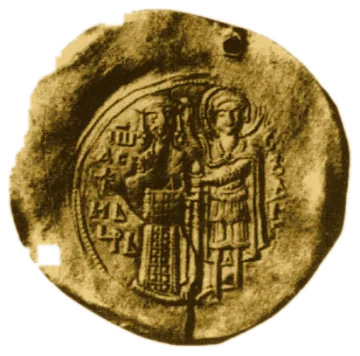
Electrum trachy
Electrum · cup-shaped · 6–7 carats of gold
A cup-shaped coin of gold-silver alloy, worth a third of a hyperpyron. It is rare in Tarnovo: a handful of Isaac II's.
Billon trachy
Billon · cup-shaped · 3.45 g and 5–9% silver → 2.95 g and 3% silver
A cup-shaped coin of copper with a little silver, Byzantium's everyday money in the 12th century. Manuel I's fourth billon issue alone is put at about 50 million coins. The average weight fell from 3.45 g under Manuel I to 2.95 g under Alexios III, and the silver from 5–9% to 3%; laboratory analysis of Tarnovo coins gives 4–5% for Manuel I, 4% for Isaac II and 3% for Alexios III. Its value against the hyperpyron fell with it, from 48 to 184 to one.
Tetarteron
Copper · flat
The smallest coin of the Komnenian system and the only flat one. The Palaiologoi took up striking it in quantity again after 1295.
Copper cup coin (scyphate)
Copper · cup-shaped · 1.0–1.5 g in 1220–1240; 2.0–3.0 g under Constantine Asen
The basic coin of the 13th century. The Latin and Thessalonian imitations that filled the market until 1257 were made to the lower Bulgarian standard of 1.0–1.5 g. Constantine Asen issued full-weight coppers of 2–3 g, which within a decade drove out the cut-up foreign coins. Then his own standard slipped too, by 0.5–0.75 g in 1265–1268, and his last type weighs under 1 g.
Constantine Tih Asen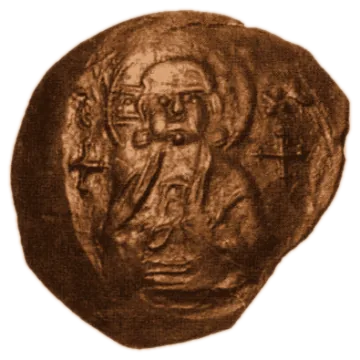
Venetian grosso
Silver · flat · 2.178 g
Venice's flat silver coin, its weight unchanged until the 1320s. It was the model for the first Bulgarian silver, yet it is rare in Bulgaria: here the measure was the hyperpyron, and the grosso was heavier than the Bulgarian coin and had to be clipped to fit.
The Bulgarian silver coin
Silver · flat · 1.70 g under George Terter → 0.50–0.70 g under Ivan Shishman
A flat silver coin on the model of the Venetian grosso, but lighter. Twelve made a hyperpyron. The so-called 'groats' and 'half-groats' of Ivan Alexander with Michael Asen are not two denominations but one and the same coin, struck for 40 years at an ever lower weight, from 1.60 g in 1337 to 0.60–0.80 g at the end.
Ivan Alexander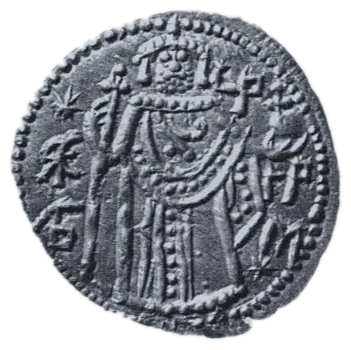
Basilikon
Silver · flat · about 2.0 g, later 1.0–1.5 g; 90–95% silver
The flat silver coin Andronikos II introduced in 1294–1295 on the model of the Venetian grosso. It soon got lighter but kept its high silver content until the 1370s.
Tornese
Billon · flat · 0.70–1.0 g, about 25% silver
A small flat billon coin brought into Byzantium by Andronikos II. The Frankish principalities in Greece and the despot of Epirus struck their own tornesi on the model of the French king Louis IX's denier, and it is these that reached Tarnovo.
Stamenon
Copper · cup-shaped
The Palaiologan cup-shaped copper coin; four small stamena made a tornese. From the end of the 13th century to about 1335, when Bulgarian coin ran short, much of Tarnovo's trade ran on them.
Ivan Shishman's billon coin
Billon · flat · 1.40–1.50 g, later 1.01–1.10 g
Short of silver, Ivan Shishman issued in 1371–1372 flat billon coins the size of the old silver but with an artificially inflated value. People did not trust them: only two hoards with them are known, so nobody saved them. The second type is lighter; in the mid-1380s the billon was clipped and in the end replaced with plain copper.
Ivan Shishman
How many small coins one gold hyperpyron bought
The hyperpyron stayed the measure everything was reckoned in, while the small coins lost value against it.
| When | Coins | Per hyperpyron |
|---|---|---|
| After Alexios I's reform1092 | billon trachea | 48 |
| Late in Manuel I's reign1170s | billon trachea | 120 |
| Under Isaac II and Alexios III1185–1203 | billon trachea | 184 |
| The Bulgarian imitationsc. 1200–1230 | Bulgarian imitations | about 250 |
| The Latin copper imitations1230s–1240s | Latin copper imitations | 350–400 |
| Constantine Asen's copper1260s | copper coins of Constantine Asen | about 200–250 |
| Bulgarian silver14th c. | silver coins | 12 |
How the Bulgarian silver coin got lighter
| Issue | Date | Average weight | Coins per pound |
|---|---|---|---|
| George I Terter | 1280–1292 | 1.70 g | 192 |
| Theodore Svetoslav | 1300–1321 | 1.50–1.60 g | — |
| Michael III Shishman | 1323–1330 | 1.60 g | — |
| Ivan Alexander, 'the tsar alone' | 1332 | 1.60–1.65 g | — |
| Ivan Alexander with Michael Asen, first issue | c. 1337 | 1.55–1.60 g | 204 |
| The same type, the main issue | 1340s | 1.45–1.55 g | — |
| The same type after Michael Asen's death | 1355–1371 | 1.00–1.30 g | 252–324 |
| The same type, the last issues | 1360s–1380 | 0.60–0.80 g | 418–564 |
| Ivan Shishman, third and fourth issues | from 1380 | 0.50–0.70 g | — |
What one coin was worth in another
As recorded at the time in Constantinople, in Bulgaria and in the lands around them.
Byzantium, 1092
1 gold hyperpyron=3 electrum trachea=48 billon trachea=~864 copper tetartera
Constantinople, 1330s, after the Florentine merchant Pegolotti
1 hyperpyron=12 silver basilika=12.5–13 Venetian grossi
1 basilikon=8 tornesi
1 tornese=4 small stamena
Bulgaria, 14th century
1 hyperpyron, real or only a unit of account=12 silver coins
Frankish Greece, 13th century
1 hyperpyron=80–96 silver tornesi
1 Venetian grosso=8–12 tornesi
The Golden Horde, 14th century
1 silver dirhem=2 silver danaks=32 copper puls
Wallachia, from 1365
1 silver mark, about 210 g=200 ducatsor300 dinarsor600 bani