
1.Political Narrative
In the violent vacuum left by Kaloyan’s death before the walls of Thessalonica, Boril seized the throne at Tarnovo in the autumn of 1207. His rise was rapid, but it was not secure, and the uncertainty of the succession haunted the first years of his reign. Boril’s claim rested on his place within the Asenid house, yet it was immediately shadowed by the absence of the legitimate heir, John Asen, whose supporters would continue to look to him as the dynastic alternative. Boril also appears to have strengthened his position by marrying Kaloyan’s widow, a step that did not so much create legitimacy as proclaim his control over it. By the spring of 1208 he had eliminated serious internal challengers within most of the kingdom, but the threat had not disappeared; it had simply moved beyond the frontiers, where rival Asenids and border magnates could draw support from Bulgaria’s enemies.
Boril therefore inherited not a settled state, but a battlefield. In the months after Kaloyan’s death the political struggle in the Balkans remained fluid, and the new ruler chose, as his uncle had done, to meet danger by offensive action. He continued the anti-Latin course that had become the hallmark of Kaloyan’s final years, aiming first at Constantinople and the Latin Empire, then at the wider Latin position in Thrace. In the spring of 1208 Bulgarian forces again appeared in Thrace, and the Latin emperor Henry moved quickly against them. The first clash, near Beroe, produced no decisive result, but Boril then shifted toward Plovdiv, where Henry followed and inflicted a clear defeat on him on 31 July 1208. The setback did not break Boril’s rule, yet it marked the opening of a difficult pattern: offensive intent, short-lived gains, and then a retreat under heavier pressure from the Latins. Even so, the Bulgarian king was not reduced to passivity. Early in 1209 his troops were again ready to move against imperial territory, and the fact that local communities could still prefer Bulgarian authority to Latin occupation showed that Boril’s prestige, though shaken, remained real.
The wider situation worsened because Boril was not fighting a single foe but a constellation of opponents. Strez entrenched himself in Macedonia with Serbian support, while Alexius Slav built up an independent position in the Rhodope region and could turn, at any moment, to Constantinople or Thessalonica. Boril’s answer was to keep pressing outward and to seek counterweights of his own. He aligned himself with Theodore Laskaris of Nicaea, repeating Kaloyan’s habit of using one eastern rival of the Latins against another. By 1211 this balancing act had become indispensable. In the spring Henry struck again, drove the Bulgarians out of Thrace, and then turned eastward to deal with Nicaea. Boril responded by coordinating with Strez and sending him substantial military support, but the effort failed at Pelagonia, where the barons of Thessalonica, reinforced by Michael I Angel, crushed Strez and destroyed part of his forces. Boril himself then tried to recover the initiative by attacking Thessalonica in the autumn of 1211, only to be defeated by the Lombard barons, now aided by Alexius Slav. The sequence of campaigns made one thing plain: the political space won by Kaloyan had not been consolidated, and Boril was struggling to hold together a kingdom whose western and southwestern margins were slipping from his grasp.
At home, military defeats fed religious and social tension. On 11 February 1211 Boril convened the first anti-Bogomil church council in Bulgarian history at Tarnovo. The Bogomils were exposed and anathematized, and the council gave the ruler a means to present himself as defender of Orthodoxy at precisely the moment when his military fortunes were declining. The translation of the Synodikon of Orthodoxy into Bulgarian turned that anti-heretical gathering into a lasting statement of dynastic and ecclesiastical self-definition. Yet the council could not heal the deeper political weakness of the reign. Even as Boril tried to impose confessional order, unrest flared in Vidin, where a rebellion of uncertain date—traditionally placed in 1211—forced him to call on King Andrew II of Hungary. The Hungarians helped suppress the revolt, but the price was high, and Boril appears to have made concessions in the region of Belgrade and Braničevo. The episode revealed the limits of his power: when local elites challenged him, he could not always respond alone.
The years after 1211 were years of attrition rather than recovery. Boril remained tied to the Latin alliance until the end, but the balance of power steadily turned against him. His external support became less reliable as Henry’s position strengthened, while the rise of Theodore of Epirus from 1215 added a new and energetic force to the southern Balkans. The Latin Empire was still dangerous, but it was no longer the only danger, and by the time Henry died in June 1216 the political environment had shifted decisively. Andrew II’s crusade in the following year further altered the field, leaving Boril increasingly isolated. In these last years Bulgaria’s losses were visible in territorial fragmentation: Alexius Slav ruled independently in the Rhodopes, Strez controlled a substantial Macedonian zone, and the royal government in Tarnovo no longer commanded the initiative across the entire realm. Boril had spent nearly a decade trying to preserve the outwardly aggressive politics of Kaloyan; in the end, that strategy had yielded not reconquest, but contraction.
The final reversal came in 1218. John Asen, summoned back from Russia by his supporters, returned as an adult of about twenty and marched on Tarnovo. The citizens of the capital opened the gates to him, and Boril was seized and blinded. John Asen II then took the throne, bringing Boril’s contested reign to a close and restoring the direct line of the dynasty. What began in 1207 as an uncertain succession under the pressure of war ended eleven years later with the return of the dynastic heir whose name had never ceased to animate opposition. Boril’s reign had been defined by civil rivalry, territorial shrinkage, and repeated attempts to compensate for weakness through diplomacy and force. Its end marked not simply the fall of one ruler, but the failure of the state to hold together around him until the rightful Asenid claimant could return.
2.Wars and Warfare
Boril came to power in a kingdom that was still organized for war, but now war worked against its own cohesion. The death of Kaloyan did not end the military pressure on Bulgaria; it merely exposed how dependent the state had become on dynastic authority, mobile allied horsemen, and the ability of the centre to direct campaigns on several frontiers at once. Almost immediately Boril had to contend with splintering within the Asenid world. Strez established himself in central Macedonia around Prosek, while Alexius Slav held the Rhodope region and the western approaches toward the Aegean. Their secessions meant that what had once been a single military space was now broken into rival commands, each controlling fortresses, passes, and local levies. Boril could still field the traditional mixed force of Bulgarians and Cumans, but he no longer commanded a unified frontier. Every offensive therefore carried an internal cost: men drawn south or west were men absent from the heartland, and every campaign risked exposing the king to further defections or opportunistic seizures of land.
The first great test came in Thrace, where Boril tried to continue Kaloyan’s policy against the Latins. In the spring of 1208 he appeared in the region with a force composed, in the familiar fashion of the Asenid wars, of Bulgarian troops reinforced by Cuman cavalry. The move was deliberately aggressive and relied on speed, sudden attack, and the tactical use of mounted auxiliaries. Henry of Flanders responded quickly, gathering his own forces from Silivria and Adrianople and moving to Beroe, where the two armies faced one another. On the next morning, at dawn, the Bulgarians struck. The attack repeated the hard-hitting style that had brought Kaloyan success against the crusaders: rapid contact, pressure on the enemy line, and an attempt to exploit any opening before the Latins could settle into formation. Yet this time the result was far less decisive. The assault produced only a narrow crisis around a single knight, and Henry saved him by moving out of the main body. The encounter at Beroe checked the Latin advance for the moment, but it did not give Boril a breakthrough.
The fighting then shifted toward Philippopolis, and there the campaign turned against Bulgaria. Boril’s troops pursued the retreating Latins and caught them near the city, but the ensuing battle ended in complete Latin victory. The defeat was strategically serious because it was not merely a setback in the field: it enabled the Latins to take and then hold Philippopolis, which became a Latin stronghold for more than two decades. In practical terms, Boril’s attempt to recover eastern Thrace had produced the opposite result. The campaign bled the kingdom of men and horses and left western Thrace under enemy control. The broader pattern of warfare in 1208 was therefore one of overextension. Boril sought to preserve Kaloyan’s offensive posture, but the combination of Latin recovery, Cuman mobility, and the fracture of Bulgarian authority meant that each advance could be answered, and each defeat widened the loss.
A new and even more revealing phase of warfare came in 1211, when Boril again moved into southeastern Thrace in coordination with Theodore Laskaris of Nicaea. This alliance shows that Boril’s wars were never fought in isolation from the wider Balkan and Aegean contest. The Bulgarian king was willing, as Kaloyan had been before him, to align with one Byzantine successor state against the Latins, hoping to divide their strength. His army now included not only Bulgarians and Cumans but also Vlachs, a reminder that the forces assembled under the Asenids could still be ethnically mixed and highly mobile. Henry’s own letter makes the scale of the danger plain: he had left Thessaloniki because of the Nicene threat, reached the area of Rousion around Easter, and then learned that Boril, with many Cumans, Bulgarians, and Vlachs, was lying in wait. The Latin host was tiny by comparison, only sixty knights, and prudence dictated that it avoid a direct encounter. The Latins therefore slipped south along the coast. Boril’s plan had been to catch them by surprise and force a battle on ground of his choosing, but the maneuver did not yield the expected result.
What made these campaigns so damaging to Boril was that his enemies were not only outside the kingdom. Alexius Slav was effectively at war with him, and that rivalry had direct military consequences. While Boril was occupied in Thrace, Alexius Slav remained entrenched in the Rhodope Mountains and exploited the absence of royal troops to seize Melnik, which became his principal residence. Henry’s side of the conflict benefited from this fragmentation, for Alexius Slav helped drive Boril out of Thessaloniki as well. The result was that Boril had to divide his available manpower between the Latin front and the internal Macedonian and Rhodope front, while Strez’s separate principality in the west and southwest further reduced the area from which the crown could draw reliable support. In this sense Boril’s wars were not a series of separate campaigns but one long struggle to keep military initiative from dissolving into territorial loss. Even when he marched aggressively, he was usually compelled to fight with one eye on his own vassals and cousins.
By the end of the reign the strategic balance had turned decisively against Tarnovo. Henry’s death in 1216 and the weakening of Latin leadership did not restore Boril’s fortunes, because his own alliances were disappearing at the same time and his opponents were gaining room to act. In 1218, while Theodore Doukas was beginning his own campaigns northward in the Balkans, the dynastic restoration that would end Boril’s rule was set in motion. John Asen’s supporters brought him back from Russia, and his advance on Tarnovo met little resistance: the citizens opened the gates, Boril was seized and blinded, and Ivan Asen II took the throne. The manner of the king’s fall is itself a measure of the military decade that preceded it. Boril had fought repeatedly, but his reign had been marked less by triumphs in open battle than by the steady erosion of the state’s military depth. The armies he led were still capable of swift marches, ambuscades, and hard-hitting attacks, yet they could no longer compensate for the loss of Thrace, the secession of great regional lords, and the exhaustion caused by fighting on too many fronts at once.
3.State and Institutions
Boril inherited not a blank slate but a monarchy already shaped by the long, Byzantine-influenced rebuilding of power begun by the Asenids. The kingdom’s administration was not an improvised wartime contrivance: it rested on courtly and provincial habits that had been consolidated in the decades before his accession, with a central authority at Tarnovo increasingly modeled on imperial patterns and with local government, fiscal collection, and military command tied together in a single political logic. Yet the first years of Boril’s reign showed how fragile that machinery could be when the throne itself was disputed. The death of Kaloyan in 1207 did not simply remove a ruler; it created a crisis of command, because the ruler was the pivot around which court offices, elite loyalties, and provincial obediences turned. Boril’s emergence as ruler meant that someone had managed to seize that pivot, but it did not mean that the state had become calm or settled.
The court at Tarnovo therefore functioned less as a secure administrative center than as a place where legitimacy had to be continually performed. Boril’s power rested on his ability to occupy the capital and to draw around him those men whose rank and armed followings mattered: dynastic kinsmen, court officials, and the wider boyar elite. The sources make clear that accusations of “usurpation” belong more to later reconstruction than to contemporary explanation; what contemporary observers register is simply that Boril “became master.” That phrase is revealing. It suggests that, in practice, the throne depended on mastery over people and institutions rather than on a formally insulated constitutional order. Dynastic blood mattered, but so did force, marriage alliance, and the ability to make the elite accept a new center of gravity. Boril’s marriage to Kaloyan’s widow belongs in this political world of legitimation, not as a decorative detail but as an attempt to bind the new ruler into the old dynastic frame.
The greatest strain on Boril’s state came from the growth of regional power. The years 1207–1208 especially exposed how readily important local lords could act as territorial rulers in their own right. Strrez, Alexius Slav, and other great men were not merely discontented courtiers; they represented alternative centers of authority, each with his own land, armed retainers, fortresses, and channels to outside support. The emergence of Alexius Slav is particularly important, because his position shows how thin the line could be between a servant of the kingdom, a provincial magnate, and an independent lord. Even when he did not directly challenge Tarnovo after his settlement with the Latin emperor, his power showed that the kingdom had to contend with internal polities nested inside it. For Boril, this meant that central rule was no longer simply a matter of commanding a unified realm; it was a continuous effort to prevent the disintegration of authority into competing lordships.
This competition also helps explain the importance of court titles and offices in the Boril years. The language of rulership in the Second Bulgarian Empire remained heavily marked by Byzantine models, and in the early thirteenth century titles still served as instruments for ranking power across the whole political landscape of the Balkans. The royal center in Tarnovo did not operate in isolation from this world of honors: it existed within it. Great men could be elevated, courted, or neutralized through titulature, and the title of despot, bestowed on Alexius Slav by the Latin emperor, shows how high-ranking terminology could underwrite a rival authority that was still recognizable within the political culture of the region. At the same time, the broader administrative vocabulary of the kingdom, including offices connected with military command and tax collection, indicates a state that continued to think in terms of ordered hierarchy, not mere personal lordship. What made Boril’s reign difficult was that such ranks and functions did not automatically secure obedience; they had to be made effective against magnates who were often powerful enough to ignore them.
The council of Tarnovo in 1211 marked a different but equally revealing face of state power. Here Boril used the assembled hierarchy of church and realm to define orthodoxy publicly and to turn doctrinal discipline into a matter of political order. The synod against the Bogomils was not only an ecclesiastical event; it was also an assertion that the royal center could speak in the name of public truth and public discipline. By condemning heresy, the ruler and the bishops were drawing a boundary around the community and identifying disobedience in religious terms that also had political implications. In a kingdom shaken by rival lords and contested loyalties, such a council mattered because it transformed the court into a law-making and law-enforcing arena. The circulation and translation of the Synodicon into Bulgarian gave this act a durable form, allowing the condemnation of heresy to become part of the kingdom’s public memory and of its normative order.
Taxation and revenue are less visibly documented for Boril’s own years than for the preceding Asenid expansion, but the logic of the state implies their continuing importance. A monarchy that depended on garrisons, fortresses, and the maintenance of court authority could not function without regular extraction from the land, and the repeated losses of territory, the rise of autonomous lords, and the pressure of war all must have narrowed the reach of central collection. The very fact that the kingdom’s opponents could defect with lands and resources shows that fiscal control was tied to military and administrative control together. Boril’s state was therefore a state under strain: it still possessed inherited structures of command and collection, but those structures could be bent or broken wherever the king’s grasp weakened. The internal wars of 1207–1218 were thus not merely dynastic quarrels; they were tests of whether the machinery of rule could still function when the realm itself was fracturing.
By 1217–1218, the return of Ivan Asen II exposed how personal Boril’s authority had always been. The coming of a new claimant, the siege of Tarnovo, and Boril’s capture show that the capital remained the key to power, but also that the kingdom’s institutions followed the fortunes of the dynastic struggle. Boril had governed a state that was real, structured, and legible in its offices and hierarchies; yet it was also a state in which those structures could be redirected rapidly when a more convincing claimant appeared. His reign therefore reveals the dual nature of Bulgarian rulership in this period: administrative continuity on the one hand, and intense dependence on the ruler’s own ability to command loyalty on the other. In that tension lay both the strength and the vulnerability of the state.
4.Church and Letters
In Boril’s reign, the most durable expression of royal authority was not a battlefield triumph but a book and a council. When the throne in Tarnovo remained vulnerable and the kingdom was still being pulled apart by rivals, the court turned to the language of orthodoxy to define who ruled and on what terms. The great ecclesiastical act associated with Boril was the translation into Bulgarian of the Synodikon of Orthodoxy in 1211, a text that was at once liturgical, doctrinal, and political. By placing such a work in the vernacular, the regime gave public form to the claim that the Bulgarian realm was not merely held by force but anchored in the true faith, and that the ruler in Tarnovo stood as its guardian.
The Tarnovo council against the Bogomils belonged to this same effort to bind power to doctrine. Its purpose was not only to condemn a heresy, but to mark the frontiers of the kingdom’s spiritual order. The Bogomils were treated as an old and persistent danger, rooted in the land itself and associated in the synodical tradition with the times of Tsar Peter, when the teaching had spread through towns and villages. In Boril’s hands, their condemnation became a public reaffirmation of Orthodox identity. The anathemas did more than denounce dissident belief; they proclaimed that the royal capital possessed the right to define orthodoxy for the realm. In a reign marked by political uncertainty, this was a way of restoring hierarchy in the realm of the soul when hierarchy in the realm of power was still contested.
The church settlement under Boril also shows how closely ecclesiastical and dynastic legitimacy were intertwined. The translation and promulgation of the Synodikon should be seen as a courtly act as much as a theological one. It gathered memory, doctrine, and condemnation into a single text that could be heard, read, and copied, and thus it helped create a shared language of loyalty. The very fact that the text was rendered in Bulgarian matters: it widened the reach of the church’s judgment beyond a narrow circle of clerics trained in the learned tongue. In this sense, the council was a cultural event as well as a dogmatic one, because it turned a policy of repression into a written monument that could outlast the immediate struggle for the throne.
Boril’s reign also unfolded in the shadow of relations with the Latin Church, and these relations remained visible even after the collapse of Kaloyan’s earlier union with Rome. The Roman Church continued to regard the Bulgarian ecclesiastical hierarchy as connected to its own orbit, enough to invite the Bulgarian primate to the Fourth Lateran Council in 1215. That invitation reveals the persistence of diplomatic and canonical contacts, but it did not signal a genuine confessional change in the kingdom. The Bulgarian Church remained Orthodox in orientation, and the very need to condemn Bogomils at Tarnovo shows that its public posture was shaped far more by the defense of Orthodoxy than by any lasting Latin alignment. Rome could still address Bulgaria, but Tarnovo answered by asserting its own doctrinal discipline.
What survives most clearly from this period is therefore a culture of writing at the service of authority. The Boril Synodikon stands as the principal literary monument of the reign, and it shows how the royal court used manuscript culture to govern belief. It linked the throne to ecclesiastical memory, turned heresy into a matter for public record, and transformed a moment of crisis into a durable text. In a reign otherwise remembered for struggle, loss, and instability, this was the realm in which Boril’s power was most visibly and most lastingly articulated: the realm of sacred writing, conciliar judgment, and the disciplined voice of the church in Tarnovo.
5.Economy and Charters
Boril inherited a kingdom whose economy had to function under the strain of dynastic contest and almost continuous military alarm. The countryside still rested on the familiar agrarian base of the Second Bulgarian Empire: the labor of village communities, stockraising, and the extraction of surplus from dependent people remained the foundation of royal power. Yet the first years of his reign were marked by political fracture, and that fracture mattered economically. In the aftermath of Kaloyan’s death, Boril had to secure the throne against other members of the ruling house and against regional lords whose ambitions could pull whole districts out of the king’s immediate control. Such instability limited the state’s ability to tap resources smoothly, to guarantee safe movement, and to transform local production into stable royal revenue. The very fact that by the spring of 1208 he had eliminated serious rivals inside most of the kingdom suggests that the preceding months had been consumed by struggle rather than consolidation.
Town life, however, did not cease to matter because of the fighting. Tarnovo remained the central political seat, but it was also the place where the kingdom’s administrative and fiscal habits were concentrated, and the capital’s role as a market and craft center cannot be separated from its role as a royal residence. The towns of the realm, especially those linked to roads, river crossings, and mountain passes, continued to serve as nodes for exchange between the interior and the wider Balkan world. War made those connections less secure, not irrelevant. Merchants, artisans, and transporters still depended on roads, passes, ferries, and markets, but the conditions of circulation were harsher than in a period of peace. The kingdom’s urban economy therefore seems to have functioned in a tense balance: on the one hand, the needs of defense and supply gave towns continuing importance; on the other, civil conflict and foreign pressure made the movement of goods more precarious and probably less profitable than the rulers would have wished.
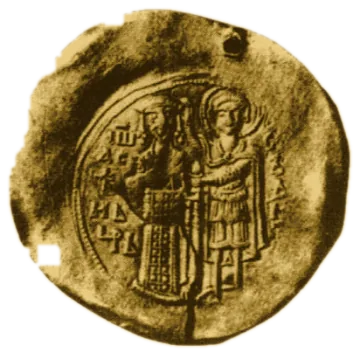
The most tangible sign of economic continuity under Boril is coinage. The monetary system of the early thirteenth century still rested heavily on copper issues that imitated Byzantine billon coinage, and this practice did not stop with Kaloyan’s death. Under Boril the imitative copper emissions continued, though with reduced weight, which points to a kingdom that still needed low-value currency for everyday circulation but lacked the resources or perhaps the political calm to maintain a fuller monetary reform. Such coinage was suited to the rhythms of local exchange: small purchases in towns, payments for transport, short-distance trade, and the countless minor transactions of an economy that was not exclusively rural. The reliance on copper also suggests a chronic shortage of precious metal and a fiscal environment in which the state had to make do with modest issues rather than with ambitious new coin types. Even in a troubled reign, the persistence of minting shows that royal authority remained active in the monetary sphere and that the state still sought to provide an instrument of exchange for the market.
The fiscal order that Boril inherited was equally shaped by older Byzantine-Balkan practice. Royal income was not drawn from a single source but from a layered system of dues, tolls, fines, and estate obligations. The terminology attached to medieval Bulgarian taxation and judicial penalties reveals a world in which customs were exacted at fords, bridges, roads, and markets, while fines flowed to the treasury and local holders could impose obligations on the dependent population. This was not a neatly codified system in the modern sense; rather, it was a practical and often flexible regime of exactions, shaped by authority on the ground. The rural population, especially dependants on lands held by rulers, lords, and churches, had to render labour and service in forms that could be broad and discretionary. Under Boril, when the monarchy was compelled to fight both external enemies and internal challengers, such resources must have been all the more important, because they were the material basis for military support, hospitality, and the upkeep of fortified centers.
Royal charters, even where the surviving examples belong more clearly to the stronger years that followed Boril, illuminate the institutional world in which his reign unfolded. They show a monarchy that could speak the language of protection and privilege: merchants were to move freely, tolls were to be remitted in specified circumstances, and interference with trade could be treated as an offence against the ruler himself. The same documentary culture also reveals the broad legal discretion enjoyed by ecclesiastical and lay holders over their dependants, for charters often define service in very elastic terms. Such documents are important not because they record a calm and prosperous age, but because they preserve the assumptions of medieval Bulgarian rule: the king stood at the center of exchange, taxation, and privilege; estates were productive units sustained by dependent labour; and written grants could formalize the rights of persons, institutions, and communities. In Boril’s reign, when the crown was still fighting for mastery, that documentary culture may have been less abundant than in later years, but the framework it reflects was already in place: a kingdom in which agriculture supplied the base, towns carried exchange, the mint provided small change, and royal authority tried to regulate a society of dues, services, and controlled privilege even while political unity remained fragile.
6.Foreign Relations
Boril inherited a throne that was only outwardly secure, and in foreign affairs that insecurity was immediate. By the spring of 1208 he had already overcome serious rivals inside much of the realm, but the men who could still endanger him stood beyond the borders: Strez in the Vardar region, supported by Serbia, and Alexius Slav, who could turn to Constantinople or Thessalonica for help. That made external policy a matter of survival rather than choice. Boril therefore tried to continue the line of Kaloyan, but he did so in a Balkans that had changed rapidly since 1207. The Latin Empire had a firmer hand under Henry, Nicaea had emerged as a real Byzantine center under Theodore Laskaris, and the old Cuman military setting of Kaloyan’s reign was no longer a decisive instrument in Boril’s hands; it survived chiefly as a dynastic memory, through his marriage to Kaloyan’s widow, rather than as an active foreign-policy asset.
The first phase of Boril’s rule was dominated by renewed war with the Latins in Thrace. In the spring of 1208 Bulgarian forces again appeared in the region, and Henry chose to meet them in person. The first clash, near Beroe, produced no decisive result, but the second encounter, at Plovdiv on 31 July 1208, ended in a clear Bulgarian defeat. Even so, the blow was not crippling. Boril’s troops were again prepared to move against imperial territory in early 1209, which suggests that the defeat did not destroy his capacity to campaign. Yet the strategic balance was moving against him. Henry could now concentrate more effectively on other fronts, while Boril’s offensive policy increasingly exposed the limits of a kingdom whose enemies were more cohesive than its own coalition. The anti-Latin line was still there, but it was no longer backed by the sort of sweeping success that had made Kaloyan feared across Thrace.
The most telling feature of Boril’s diplomacy was the way in which his rivals sought outside patrons. Alexius Slav, after losing the struggle for Tarnovo, entered Henry’s orbit. At Stanimaka he received support, a daughter of the emperor in marriage, and the rank of despot, and the arrangement was completed in Constantinople in November 1208. That alliance gave Alexius Slav a durable place between Bulgaria, the Latin Empire, and Epirus, and it turned him into one of Boril’s most dangerous opponents. Strez posed a similar problem in the west. He had already secured the backing of the Serbian grand župan Stefan Nemanja, and Boril’s own support for Strez in 1211, with fifty-two detachments, did not prevent disaster. In the same year Strez was struck by a serious defeat at Pelagonia, where the Thessalonian barons, joined by Michael I Angel, shattered part of his forces. Boril’s own autumn campaign against the Kingdom of Thessalonica also ended in defeat, this time at the hands of the Lombard barons, who were reinforced by Alexius Slav. The result was a fragmented frontier world in which Serbian, Latin, and Epirote interests intersected with Bulgarian ambitions and steadily narrowed Boril’s room for maneuver.
Against that encirclement Boril increasingly relied on Hungary. In 1211 a rebellion broke out in Vidin, and Boril, unable to deal with it alone, turned to Andrew II. Hungarian forces suppressed the uprising, but the aid came at a price: the Belgrade and Braničevo districts were very likely ceded to Hungary, either at that moment or in the process of securing assistance. The relationship, however, did not deteriorate. On the contrary, by 1213 Boril stood in close and somewhat dependent relations with the Hungarian king, and in 1214 Hungarian envoys came to arrange the betrothal of Andrew’s eldest son, the future Bela IV, to Boril’s daughter. That planned marriage was more than a family compact. It was a frontier settlement in dynastic form, a way of stabilizing the Danube border while giving Boril a powerful Catholic ally at a time when his standing in the south remained fragile. The marriage diplomacy of 1214 also shows how far his policy had moved from open warfare toward negotiated survival.
Boril’s religious policy belonged to the same search for authority. The anti-Bogomil council held in Tarnovo on 11 February 1211 was formally an internal ecclesiastical measure, but it also had an external meaning: it announced a ruler who wished to present himself as the defender of orthodoxy in a world divided between Latins, Nicaeans, and the rulers of Thessalonica. The translation and compilation of the Synodikon of Tsar Boril gave that posture a durable ideological form. If the earlier Kaloyan decade had been marked by dealings with Rome, Boril’s reign moved toward a harder Orthodox self-definition. That did not exclude practical accommodation with Catholic powers, but it did mean that the monarchy now claimed legitimacy by religious as well as political means. In a period when military success was elusive, such symbolic authority mattered greatly.
By the middle of the 1210s the external balance became increasingly unfavorable. Henry of Flanders died in June 1216, removing Boril’s most important Latin counterpart, and in the following year Andrew II went east on crusade, temporarily taking Hungary out of the equation. At the same time Theodore Doukas of Epirus began to press northward, taking advantage of the weakness of Serbia and Bulgaria alike. In 1218 the end came quickly. Boril’s enemies summoned Ivan Asen II back from Rus, and the young prince, now an adult, marched on Tarnovo. The city opened its gates, Boril was blinded, and the throne passed to Ivan Asen II. The last years of Boril’s reign thus reveal a monarchy that had survived by balancing against neighboring powers, but whose alliances were too contingent to endure once Henry was dead, Hungary was absent, and the initiative in the Balkans had shifted decisively to Epirus and to Boril’s own dynastic enemies.
After Kaloyan died during the siege of Thessalonica, Boril quickly took the throne at Tarnovo in the fall of 1207. Although he rose fast, his hold on power was shaky. The main problem was that the rightful heir, John Asen, was missing, and many supporters still backed him as the true ruler. Boril tried to strengthen his claim by marrying Kaloyan’s widow. This marriage didn’t so much make him legitimate as it showed he controlled the throne. By spring 1208, Boril had defeated most internal rivals, but the threat wasn’t gone—it had just moved beyond Bulgaria’s borders, where other members of the Asen family and powerful local leaders could get help from enemies of Bulgaria.
Boril didn’t inherit a peaceful kingdom; he inherited a battlefield. After Kaloyan’s death, the political situation in the Balkans was still unsettled. Like his uncle before him, Boril chose to fight back aggressively. He continued Kaloyan’s anti-Latin policy, focusing first on Constantinople and the Latin Empire, then on Latin-held areas in Thrace. In spring 1208, Bulgarian troops appeared again in Thrace, prompting the Latin emperor Henry to respond quickly. Their first battle near Beroe ended without a clear winner, but Boril then moved toward Plovdiv, where Henry defeated him decisively on July 31, 1208. This loss didn’t end Boril’s rule, but it started a pattern: Boril would attack, gain some ground briefly, then retreat under stronger Latin pressure. Still, he didn’t give up. Early in 1209, his forces were ready to strike again, and local communities sometimes preferred Bulgarian rule over Latin occupation, showing Boril still had some support despite setbacks.
Boril faced not just one enemy but many. Strez, backed by Serbia, took control of Macedonia, while Alexius Slav built his own power base in the Rhodope Mountains and could turn to Constantinople or Thessalonica for support. Boril responded by pushing outward and seeking allies. He teamed up with Theodore Laskaris of Nicaea, following Kaloyan’s strategy of using one Byzantine rival against another. By 1211, this balancing act was crucial. In spring, Henry pushed the Bulgarians out of Thrace and then turned east to confront Nicaea. Boril supported Strez with troops, but they were defeated at Pelagonia by Thessalonica’s barons and Michael I Angel. Later that year, Boril tried to attack Thessalonica but was beaten by Lombard barons helped by Alexius Slav. These battles showed that Boril hadn’t secured the gains Kaloyan made, and his kingdom’s western and southwestern borders were slipping away.
Inside Bulgaria, military defeats increased religious and social tensions. On February 11, 1211, Boril held the first church council against the Bogomils—a religious group considered heretical—in Tarnovo. The council condemned the Bogomils and gave Boril a way to present himself as a defender of Orthodox Christianity at a time when his military power was weakening. The Synodikon of Orthodoxy, a formal statement of faith, was translated into Bulgarian, turning this council into a lasting symbol of the kingdom’s religious and royal identity. However, the council couldn’t fix Boril’s deeper political problems. Around 1211, a rebellion broke out in Vidin, forcing Boril to ask King Andrew II of Hungary for help. The Hungarians helped crush the revolt but at a cost—Boril likely gave up control of areas near Belgrade and Braničevo. This showed Boril’s limits: when local leaders rebelled, he couldn’t always handle it alone.
After 1211, Boril’s reign was more about holding on than recovering. He stayed allied with the Latins, but their power grew stronger while his support weakened. Theodore of Epirus emerged around 1215 as a new threat in the southern Balkans. Though the Latin Empire remained dangerous, it was no longer the only challenge. When Henry died in June 1216, the political situation shifted sharply. Andrew II’s crusade in 1217 further isolated Boril. By then, Bulgaria was breaking apart: Alexius Slav ruled the Rhodopes independently, Strez controlled much of Macedonia, and Boril’s government in Tarnovo no longer led the whole kingdom. Boril had spent nearly ten years trying to keep Kaloyan’s aggressive policies alive, but instead of regaining lost lands, Bulgaria shrank.
Boril’s downfall came in 1218. His supporters called back John Asen from Russia. About twenty years old, John marched on Tarnovo, and the city’s people opened the gates to him. Boril was captured and blinded. John Asen II took the throne, ending Boril’s contested rule and restoring the direct line of the dynasty. What began in 1207 as a shaky succession under war pressure ended eleven years later with the return of the rightful heir, whose name had long inspired opposition. Boril’s reign was marked by civil conflict, loss of territory, and repeated efforts to make up for weakness through diplomacy and force. Its end showed not just the fall of a ruler but the failure of the state to hold together until the true heir returned.
---
Boril took power in a kingdom still prepared for war, but war now worked against its unity. Kaloyan’s death didn’t stop military pressure on Bulgaria; it revealed how much the state depended on strong dynastic leadership, mobile allied horsemen, and the ability to manage campaigns on several fronts. Almost immediately, Boril faced splits within the ruling family. Strez set up in central Macedonia near Prosek, and Alexius Slav controlled the Rhodope Mountains and the western routes to the Aegean Sea. Their breakaway meant that what had been a single military zone was now divided into rival commands, each controlling fortresses, mountain passes, and local troops. Boril still led a mixed army of Bulgarians and Cumans (a nomadic horseman group), but he no longer controlled a united frontier. Every attack carried risks: troops sent south or west were missing from the core lands, and each campaign risked more defections or land grabs.
Boril’s first major test was in Thrace, where he tried to follow Kaloyan’s policy against the Latins. In spring 1208, he appeared there with Bulgarian troops supported by Cuman cavalry. This attack relied on speed, surprise, and the use of mounted auxiliaries. Henry of Flanders responded quickly, gathering forces from Silivria and Adrianople and moving to Beroe to face Boril. At dawn, the Bulgarians attacked, using the fast, hard-hitting tactics that had worked for Kaloyan before. But this time, the attack wasn’t decisive. The fighting caused a crisis around one knight, but Henry saved him by moving out of the main battle. The fight at Beroe stopped the Latin advance temporarily but didn’t give Boril a breakthrough.
The battle then moved near Philippopolis (modern Plovdiv), where things went badly for Bulgaria. Boril’s troops chased the retreating Latins and caught them near the city, but the Latins won a clear victory. This loss was serious because it allowed the Latins to take and hold Philippopolis for over twenty years. Boril’s attempt to regain eastern Thrace ended up strengthening the enemy. The campaign drained men and horses and left western Thrace under Latin control. The pattern of 1208’s warfare showed Boril overextending himself. He tried to keep Kaloyan’s offensive approach, but Latin recovery, Cuman mobility, and Bulgaria’s internal divisions meant every advance could be countered, and every defeat led to more loss.
A new phase of warfare came in 1211, when Boril moved into southeastern Thrace again, this time working with Theodore Laskaris of Nicaea. This alliance shows that Boril’s wars were part of the wider struggle in the Balkans and Aegean. Like Kaloyan, Boril was willing to team up with one Byzantine successor state against the Latins to divide their strength. His army now included Bulgarians, Cumans, and Vlachs (a Balkan people), showing the ethnic mix and mobility of his forces. Henry’s own letter shows the danger: he left Thessaloniki because of the Nicene threat, reached Rousion around Easter, and learned Boril, with many troops, was waiting to ambush him. Henry’s force was small—only sixty knights—so he avoided battle and slipped south along the coast. Boril’s plan to surprise and fight on his own terms didn’t work out.
What made these wars so hard for Boril was that his enemies were not just outside Bulgaria. Alexius Slav was effectively at war with him, and this had direct military effects. While Boril was busy in Thrace, Alexius Slav stayed in the Rhodope Mountains and took Melnik, making it his main base. Alexius Slav also helped push Boril out of Thessaloniki. This forced Boril to split his troops between the Latin front and the internal Macedonian and Rhodope front. Meanwhile, Strez’s separate rule in the west and southwest further reduced the areas Boril could count on. Boril’s wars were not just separate battles but one long fight to keep military control from slipping into territorial loss. Even when he attacked aggressively, he had to watch his own vassals and relatives.
By the end of Boril’s reign, the strategic balance had turned clearly against Tarnovo. Henry’s death in 1216 and the weakening of Latin leadership didn’t improve Boril’s situation because his own alliances were falling apart and his enemies were gaining ground. In 1218, as Theodore Doukas began campaigns northward, the dynastic restoration that ended Boril’s rule started. John Asen was brought back from Rus, marched on Tarnovo, and the city opened its gates. Boril was captured and blinded, and Ivan Asen II took the throne. Boril’s fall shows the military decade before it: he fought many battles, but his reign was marked more by the slow loss of military strength. His armies could still move fast and strike hard, but they couldn’t make up for losing Thrace, the breakaway of powerful lords, and the exhaustion from fighting on too many fronts.
---
Boril did not start with a blank slate; he inherited a monarchy shaped by the Asenid dynasty’s long process of rebuilding power influenced by Byzantine models. The kingdom’s administration was not a makeshift wartime system. It was based on court and provincial customs that had developed over decades. Central authority at Tarnovo increasingly followed imperial patterns, linking local government, tax collection, and military command into a single system. But Boril’s early years showed how fragile this system was when the throne was disputed. Kaloyan’s death in 1207 didn’t just remove a ruler; it caused a leadership crisis because the ruler was the center around which court offices, elite loyalties, and provincial obedience turned. Boril’s rise meant someone had taken control of that center, but it didn’t mean the state was stable.
The court at Tarnovo functioned less as a secure administrative hub and more as a place where legitimacy had to be constantly proven. Boril’s power depended on holding the capital and gathering around him important people: family members, court officials, and the boyar elite (nobles). Historical sources suggest that accusations of “usurpation” are mostly later interpretations. Contemporary observers simply said Boril “became master.” This phrase shows that the throne depended on control over people and institutions rather than formal constitutional rules. Being part of the royal family mattered, but so did force, marriage alliances, and convincing the elite to accept a new center of power. Boril’s marriage to Kaloyan’s widow was part of this political effort to link the new ruler to the old dynasty.
The biggest challenge to Boril’s rule came from growing regional powers. The years 1207–1208 especially showed how local lords could act as independent rulers. Strez, Alexius Slav, and others were not just unhappy courtiers; they were alternative centers of power with their own lands, troops, fortresses, and outside connections. Alexius Slav’s rise is especially important because it shows how thin the line was between a kingdom servant, a provincial lord, and an independent ruler. Even when he didn’t openly challenge Tarnovo after making peace with the Latin emperor, his power showed the kingdom had to deal with internal polities within it. For Boril, this meant central rule was no longer just about commanding a unified realm; it was a constant effort to stop authority from breaking into competing lordships.
This competition also explains why court titles and offices were so important during Boril’s reign. The language of rulership in the Second Bulgarian Empire was heavily influenced by Byzantine models, and in the early 1200s, titles were used to rank power across the Balkans. The royal court in Tarnovo was part of this world of honors. Powerful men could be promoted, courted, or neutralized through titles. For example, the title of despot given to Alexius Slav by the Latin emperor showed how high-ranking titles could support rival authorities that were still recognized within the region’s political culture. At the same time, the kingdom’s administrative vocabulary, including military and tax offices, shows a state that still thought in terms of order and hierarchy, not just personal rule. What made Boril’s reign hard was that these ranks and offices didn’t guarantee obedience; they had to be enforced against powerful lords who often ignored them.
The 1211 council in Tarnovo showed another side of state power. Boril used the gathered church and state leaders to publicly define Orthodox Christianity and turn religious discipline into political order. The synod against the Bogomils was not just a church event; it was a statement that the royal center could speak for public truth and discipline. By condemning heresy, the ruler and bishops set boundaries for the community and linked religious disobedience to political rebellion. In a kingdom shaken by rival lords and divided loyalties, this council mattered because it made the court a place where laws were made and enforced. Translating the Synodikon into Bulgarian gave this act lasting power, making the condemnation of heresy part of the kingdom’s public memory and rules.
Taxation and revenue are less well documented during Boril’s reign than in the earlier Asenid expansion, but the state’s logic shows they remained important. A monarchy that relied on garrisons, fortresses, and court authority couldn’t work without steady income from the land. Losing territory, the rise of independent lords, and constant war must have made tax collection harder. The fact that enemies could take land and resources shows that fiscal control depended on military and administrative control. Boril’s state was under pressure: it still had inherited systems for command and collection, but these could be broken where the king’s power was weak. The internal wars from 1207 to 1218 were not just family fights; they tested whether the government could still work as the kingdom broke apart.
By 1217–1218, the return of Ivan Asen II showed how personal Boril’s authority had always been. The arrival of a new claimant, the siege of Tarnovo, and Boril’s capture showed the capital was still the key to power. But the kingdom’s institutions followed the ups and downs of the dynastic struggle. Boril ruled a real, structured state with offices and ranks, but these could be quickly redirected when a stronger claimant appeared. His reign reveals the dual nature of Bulgarian rule at this time: administrative continuity on one side, and heavy dependence on the ruler’s personal ability to command loyalty on the other. This tension was both the state’s strength and its weakness.
---
During Boril’s reign, the strongest sign of royal power was not military victories but a book and a church council. When the throne in Tarnovo was weak and the kingdom divided by rivals, the court used Orthodox Christianity to define who ruled and on what terms. The most important church act linked to Boril was the 1211 translation into Bulgarian of the Synodikon of Orthodoxy, a text that combined worship, doctrine, and politics. Putting this work in the local language gave public form to the claim that Bulgaria was not just held by force but rooted in true faith, with the ruler in Tarnovo as its protector.
The Tarnovo council against the Bogomils was part of this effort to link power and doctrine. Its goal was not only to condemn heresy but to set the boundaries of the kingdom’s spiritual order. The Bogomils were seen as an old, ongoing threat, rooted in the land and linked in church tradition to the time of Tsar Peter, when their teachings spread widely. Boril used their condemnation to publicly reaffirm Orthodox identity. The anathemas (formal curses) did more than denounce false beliefs; they declared that the royal capital had the right to define orthodoxy for the whole realm. In a reign marked by political uncertainty, this was a way to restore order in religion when political order was still shaky.
The church settlement under Boril also shows how closely church and royal legitimacy were connected. Translating and publishing the Synodikon was as much a court act as a theological one. It combined memory, doctrine, and condemnation into a single text that could be read, heard, and copied, helping create a shared language of loyalty. The fact that it was in Bulgarian mattered because it spread the church’s judgment beyond a small group of clerics who knew the old languages. So, the council was a cultural event as well as a religious one, turning repression into a written record that could last beyond the immediate struggle for the throne.
Boril’s reign also took place amid relations with the Latin Church, which remained visible even after Kaloyan’s earlier union with Rome collapsed. The Roman Church still saw the Bulgarian church as connected enough to invite its leader to the Fourth Lateran Council in 1215. This shows ongoing diplomatic and church contacts but did not mean Bulgaria changed its religious orientation. The Bulgarian Church stayed Orthodox, and the need to condemn the Bogomils at Tarnovo shows that its public stance was more about defending Orthodoxy than aligning with Rome. Rome could reach out to Bulgaria, but Tarnovo answered by asserting its own religious discipline.
The main surviving cultural product from this time is a culture of writing used to support authority. The Boril Synodikon is the key literary work of his reign. It shows how the royal court used manuscripts to control belief. It linked the throne to church memory, made heresy a public record, and turned a crisis into a lasting text. In a reign remembered for struggle and instability, this was where Boril’s power was most clearly and lastingly shown: in sacred writing, church councils, and the disciplined voice of the Tarnovo church.
---
Boril inherited a kingdom whose economy had to work under the strain of family conflict and almost constant war. The countryside still depended on farming, raising animals, and extracting surplus from dependent people, which remained the base of royal power. But the early years of his reign were marked by political division, and that division affected the economy. After Kaloyan’s death, Boril had to secure his throne against other family members and powerful local lords who could pull whole regions away from his control. This instability made it harder for the state to collect resources smoothly, keep trade routes safe, and turn local production into steady royal income. The fact that by spring 1208 he had defeated most rivals inside the kingdom suggests the previous months were spent fighting rather than building.
Town life remained important despite the fighting. Tarnovo was not only the political center but also the hub of administration and tax collection. It was a market and craft center as well as the royal residence. Towns near roads, river crossings, and mountain passes continued to be places where goods moved between the interior and the wider Balkans. War made travel and trade riskier but didn’t stop them. Merchants, craftsmen, and transporters still depended on roads, ferries, and markets, but conditions were tougher than in peaceful times. The kingdom’s towns balanced between serving defense and supply needs and dealing with the dangers and difficulties of civil war and foreign threats. Trade probably became less profitable, even if it remained necessary.
One clear sign of economic continuity under Boril was coinage. The kingdom’s money system still relied heavily on copper coins that copied Byzantine billon coins. This practice continued after Kaloyan’s death, though the coins became lighter. This suggests the kingdom still needed low-value coins for everyday use but lacked the resources or stability for a full monetary reform. Copper coins were good for small town purchases, transport payments, short-distance trade, and many minor transactions in a mainly rural economy. The use of copper also points to a shortage of precious metals and a fiscal environment where the state had to make do with modest coin issues rather than ambitious new types. Even in a troubled reign, minting coins shows royal authority remained active in money matters and tried to provide currency for the market.
The tax system Boril inherited was shaped by older Byzantine and Balkan practices. Royal income came from many sources: dues, tolls, fines, and obligations tied to estates. Medieval Bulgarian tax and penalty terms show a world where customs were collected at river crossings, bridges, roads, and markets, fines went to the treasury, and local lords could impose duties on dependent people. This was not a neatly written system like modern tax codes but a practical, flexible set of demands shaped by local authority. Rural people, especially those dependent on lands owned by rulers, lords, or churches, had to provide labor and services that could be broad and flexible. Under Boril, when the monarchy had to fight both foreign enemies and internal rivals, these resources were even more important because they supported the military, hospitality, and fortress upkeep.
Royal charters, even those mostly from stronger later years, shed light on the institutions of Boril’s time. They show a monarchy that spoke the language of protection and privilege: merchants were allowed free movement, tolls were sometimes waived, and interfering with trade was treated as an offense against the king. These documents also reveal the wide legal freedom enjoyed by church and lay landholders over their dependents, as charters often defined service in flexible terms. These records are important not because they describe a calm, prosperous time but because they preserve the assumptions of medieval Bulgarian rule: the king was at the center of trade, taxes, and privileges; estates were productive units supported by dependent labor; and written grants formalized rights of people, institutions, and communities. During Boril’s reign, when the crown was still fighting for control, this documentary culture may have been less common than later, but the framework was already in place: a kingdom where farming was the base, towns handled trade, the mint provided small change, and royal authority tried to regulate a society of dues, services, and controlled privileges even as political unity remained fragile.
---
Boril took the throne in a situation that looked stable from the outside but was insecure inside. By spring 1208, he had defeated most rivals within the kingdom, but dangerous men remained outside: Strez in the Vardar region, backed by Serbia, and Alexius Slav, who could turn to Constantinople or Thessalonica for help. This made foreign policy a matter of survival, not choice. Boril tried to continue Kaloyan’s policies, but the Balkans had changed quickly since 1207. The Latin Empire was stronger under Henry, Nicaea had become a real Byzantine center under Theodore Laskaris, and the Cuman military power that helped Kaloyan was no longer a decisive tool for Boril. It survived mainly as a family memory through his marriage to Kaloyan’s widow, not as an active foreign policy asset.
The first part of Boril’s rule was dominated by renewed war with the Latins in Thrace. In spring 1208, Bulgarian forces appeared there again, and Henry met them personally. Their first battle near Beroe had no clear winner, but the second fight at Plovdiv on July 31, 1208, ended with a clear Bulgarian defeat. Still, this loss wasn’t crippling. Boril’s troops were ready to campaign again in early 1209, showing the defeat didn’t destroy his military ability. But the strategic balance was shifting against him. Henry could focus more on other fronts, while Boril’s offensive policy increasingly showed the limits of a kingdom whose enemies were more united than his own allies. The anti-Latin stance remained, but it no longer had the sweeping success that made Kaloyan feared across Thrace.
A key feature of Boril’s diplomacy was how his rivals sought outside support. After losing the fight for Tarnovo, Alexius Slav joined Henry’s side. At Stanimaka, he got support, married the emperor’s daughter, and was given the title of despot. This alliance, completed in Constantinople in November 1208, gave Alexius Slav a strong position between Bulgaria, the Latin Empire, and Epirus, making him one of Boril’s most dangerous enemies. Strez was a similar problem in the west. He had Serbian backing from grand župan Stefan Nemanja, and Boril’s own support for Strez in 1211, sending fifty-two detachments, didn’t prevent disaster. That year, Strez was badly defeated at Pelagonia by Thessalonica’s barons and Michael I Angel. Boril’s autumn 1211 campaign against the Kingdom of Thessalonica also ended in defeat, this time by Lombard barons helped by Alexius Slav. The result was a fragmented border region where Serbian, Latin, and Epirote interests clashed with Bulgarian ambitions, steadily limiting Boril’s options.
To counter this encirclement, Boril increasingly relied on Hungary. In 1211, a rebellion broke out in Vidin, and Boril, unable to handle it alone, called on Andrew II. Hungarian forces crushed the revolt, but the help came at a price: Boril likely gave up the Belgrade and Braničevo areas, either then or during the process of securing aid. Despite this, relations with Hungary did not worsen. By 1213, Boril was closely tied to Andrew II, and in 1214 Hungarian envoys arranged the engagement of Andrew’s eldest son, future Bela IV, to Boril’s daughter. This marriage was more than a family deal; it was a frontier settlement in dynastic form, a way to stabilize the Danube border and give Boril a strong Catholic ally while his position in the south remained weak. This marriage diplomacy shows how far Boril’s policy had shifted from open warfare toward negotiated survival.
Boril’s religious policy was part of this search for authority. The 1211 anti-Bogomil council in Tarnovo was formally a church matter but also sent a message to the outside world: Boril wanted to present himself as the defender of Orthodoxy in a region divided among Latins, Nicaeans, and Thessalonica’s rulers. The translation and compilation of the Synodikon gave this stance a lasting ideological form. While Kaloyan’s decade had involved dealings with Rome, Boril’s reign moved toward a stronger Orthodox identity. This didn’t rule out practical deals with Catholic powers, but it meant the monarchy claimed legitimacy through religion as well as politics. When military success was hard to come by, this symbolic authority was very important.
By the mid-1210s, the external situation worsened. Henry of Flanders died in June 1216, removing Boril’s main Latin rival, and in 1217 Andrew II went on crusade, temporarily taking Hungary out of the picture. At the same time, Theodore Doukas of Epirus began pushing north, taking advantage of Serbia and Bulgaria’s weakness. In 1218, Boril’s reign ended quickly. His enemies brought Ivan Asen II back from Rus. The young prince marched on Tarnovo, the city opened its gates, Boril was blinded, and Ivan Asen II took the throne. The last years of Boril’s rule show a monarchy that survived by balancing neighboring powers but whose alliances were too fragile to last once Henry was dead, Hungary was absent, and the Balkans’ initiative shifted to Epirus and Boril’s own family rivals.
Boril became ruler of Bulgaria in 1207 after Kaloyan died. His rule was weak because the rightful heir, John Asen, was missing and many nobles did not fully support him. Boril married Kaloyan’s widow to strengthen his claim. He fought against the Latin Empire and tried to keep control over the kingdom, but faced many enemies inside and outside Bulgaria.
Boril’s army fought several battles, especially in Thrace, but often lost or had to retreat. His kingdom was divided, with powerful local lords like Strez and Alexius Slav acting independently. Boril tried to make alliances, including with the Byzantine successor state Nicaea and Hungary, but his power kept shrinking. In 1218, John Asen returned and took the throne, ending Boril’s troubled reign.
Boril ruled a kingdom with a strong but fragile government based in Tarnovo. His power depended on controlling the capital and winning support from nobles. Local lords challenged his authority, and the kingdom was breaking apart. In 1211, Boril held a church council to condemn the Bogomil heresy, using religion to strengthen his rule and unite the people under Orthodox Christianity.
Economically, Bulgaria under Boril still relied on farming and local trade, but war and internal conflict made life harder. The kingdom continued to use copper coins for everyday business, showing some stability despite troubles. Taxes and duties were important for funding the state and army, but Boril’s control over these weakened as parts of the kingdom slipped away.
In foreign affairs, Boril faced many enemies. He fought the Latin Empire but suffered defeats. His rivals made deals with neighboring powers like Serbia and the Latin Empire, weakening Bulgaria further. Boril turned to Hungary for help, even arranging a marriage between his daughter and the Hungarian prince to secure an alliance. Despite these efforts, Boril’s position worsened as new powers rose, and his kingdom became smaller and less united.
In short, Boril’s reign from 1207 to 1218 was marked by constant fighting, loss of territory, and struggles to keep his kingdom together. His use of religion and alliances helped a little, but in the end, the rightful heir John Asen II returned and took over, restoring the dynasty.
Key Events
- 11207 — Boril seizes the throne at Tarnovo after Kaloyan’s death and strengthens his claim by marrying Kaloyan’s widow.
- 2Spring 1208 — Boril suppresses most serious internal challengers within the kingdom, though rival Asenids and border magnates remain a threat.
- 3Spring 1208 — Bulgarian forces enter Thrace and clash with Henry near Beroe in an indecisive encounter.
- 431 July 1208 — Henry defeats Boril near Plovdiv, checking the Bulgarian offensive in Thrace.
- 5Late 1208 — Alexius Slav enters Henry’s orbit at Stanimaka and receives support, a marriage alliance, and the title of despot.
- 6Early 1209 — Boril’s troops again prepare to move against imperial territory despite earlier setbacks.
- 711 February 1211 — Boril convenes the first anti-Bogomil council at Tarnovo and the Synodikon of Orthodoxy is translated into Bulgarian.
- 8Spring 1211 — Henry drives the Bulgarians out of Thrace; Boril supports Strez, whose forces are crushed at Pelagonia by the Thessalonian barons and Michael I Angel.
- 9Autumn 1211 — Boril attacks Thessalonica but is defeated by the Lombard barons, aided by Alexius Slav.
- 101211 — A rebellion in Vidin prompts Boril to call on Andreas II of Hungary, whose intervention suppresses the revolt and likely costs Boril territory around Belgrade and Braničevo.
- 111214 — Hungarian envoys arrange the betrothal of Andreas II’s son Bela IV to Boril’s daughter.
- 121215 — Theodorus Doukas emerges as a new force in the southern Balkans, further weakening Boril’s position.
- 13June 1216 — Henry dies, removing Boril’s principal Latin opponent.
- 141217 — Andreas II’s crusade shifts the regional balance again, leaving Boril increasingly isolated.
- 151218 — John Asen returns from Russia, Tarnovo opens its gates, Boril is seized and blinded, and John Asen II takes the throne.
Key People
Sources
Ivan Bozhilov, The Asen Family (1186–1460): Genealogy and Prosopography. Sofia: Marin Drinov Academic Publishing House, 1994.
Show the 2 quoted passages
„Работата на събора започнала на 11 февруари 1211“
Read p. 71 in the book„царският престол бил овладян от Борил“
Read p. 77 in the bookIvan Bozhilov, Vasil Gyuzelev, History of Medieval Bulgaria, 7th–14th Century. Sofia: Anubis, 1999.
Show the 7 quoted passages
„Заповядвайки да преведат на български език «Синодика на Православието“
Read p. 413 in the book„Борил γέγονεν ἐγκρατής“
Read p. 678 in the book„се намирал във война с Борил“
Read p. 680 in the book„деспотското достойнство“
Read p. 681 in the book„вече нямал сериозни противници“
Read p. 684 in the book„През 1218 г. Иван II Асен ... успял да овладее града“
Read p. 699 in the book„1211 г., 11 февруари — Събор срещу богомилите в Търново“
Read p. 1031 in the book