Manuscripts

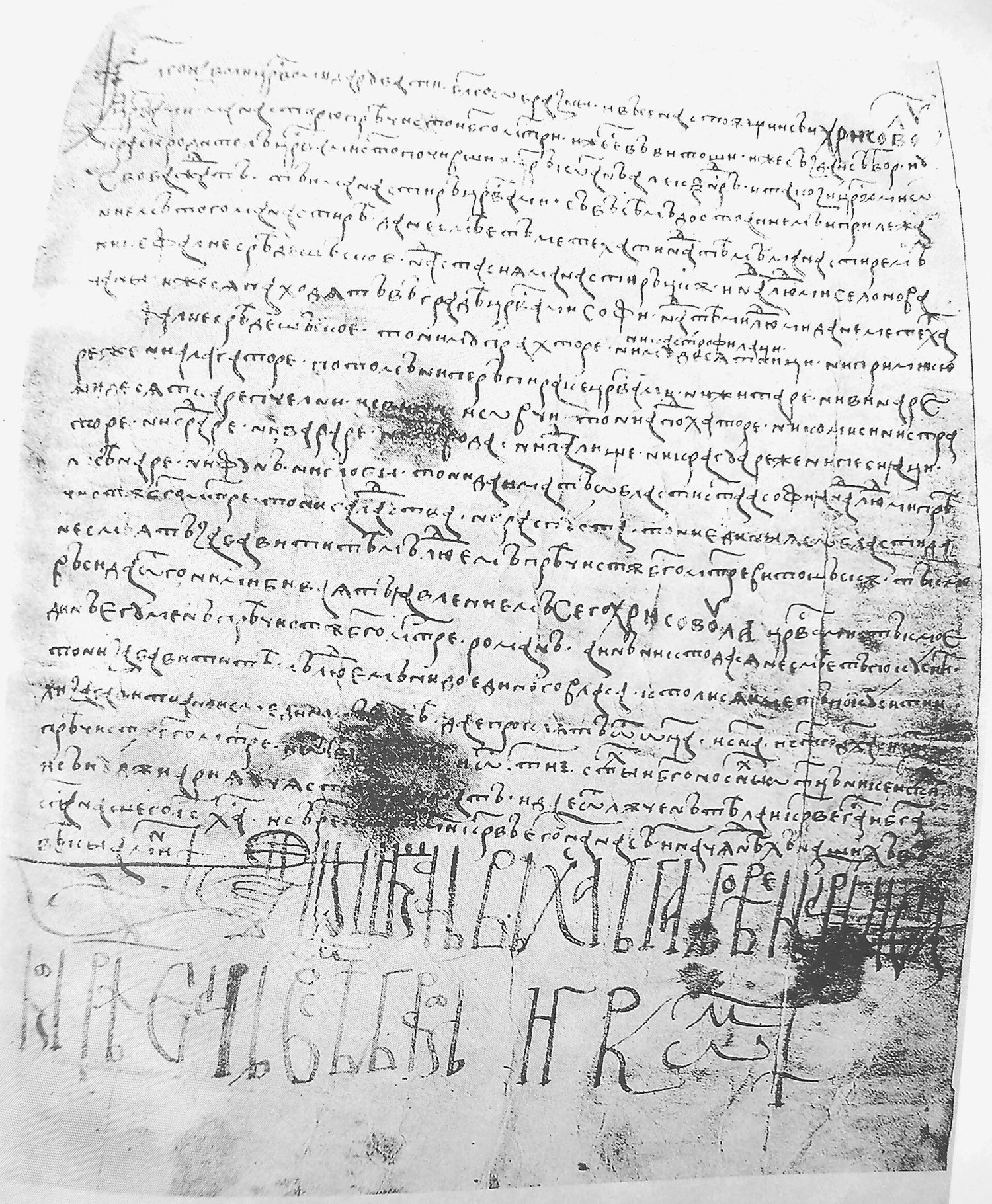
Vitosha (Dragalevtsi) Charter of Ivan Shishman

before 1380

A grant to the monastery of the Mother of God at Dragalevtsi on Vitosha.

The object

Vitosha (Dragalevtsi) Charter of Ivan Shishman — The charter
The charter

Why it matters

The charter speaks explicitly of a kefalia of Sredets, and the wording leaves no doubt that this is a local governor. That single mention is the main reason Sredets can be identified as the administrative centre of the southwestern lands in the last decades of Bulgarian independence.

It is a small thing to hang an argument on, and it is nearly all there is. The Bulgarian administrative map has to be reconstructed from scattered phrases in charters like this one, because no register or list survives.

Further information

The Dragalevtsi monastery was founded about 1345 as a stavropegic house — answerable to the patriarch rather than the local metropolitan — and the charter, issued no later than 1380, renews the immunity Ivan Alexander had given it. It survives in the library of the Zograf Monastery on Mount Athos, a link between the monasteries around Sofia and the Bulgarian houses of Athos; it is written on parchment in a cursive hand, the tsar's signature in cinnabar. Unlike the seven houses of the “Little Holy Mountain” around Sofia, Dragalevtsi was not destroyed at the Ottoman conquest — its site had no strategic value — and it was renewed in the later fifteenth century, its church repainted in 1475 with the help of the Sofia boyar Radoslav Mavar.

The whole document

Read the full charter

The grant and immunity

My empire was pleased to grant this seemly and ever-present chrysobull to the monastery of the Immaculate Mother of God which lies on Vitosha, which was founded, made and adorned by the parent of my empire, the tsar Ivan Alexander fallen asleep in holiness. And so, my empire frees this monastery, together with all its estates and holdings, so that none may interfere with it: neither the kefalia of Sredets in the monastery's holdings and over the people of the village of Novacheni, who are in the city of my empire, Sofia — over these people let none interfere, neither the kefalia of Sredets, nor his praktors, nor castellans, nor his tithe-men, nor primikyurs, nor alagators, nor further the perperakioi of my empire, nor grain-collectors, nor wine-collectors, nor tithe-collectors of bees, swine and sheep, nor apodohators, nor komises, nor strators, nor serdars, nor cooks, nor for cartage (podvod), nor lodging-due, nor falconers, nor houndsmen, nor hay-collectors, nor the murder-fine (fun), nor any fine; nor may St Sophia have authority over the people of the Immaculate Mother of God, nor galadstvo, nor the divorce-fine (razpust) — let no authority dare to trouble the people of the Immaculate Mother of God of Vitosha, but let all be driven off at the showing of this chrysobull of my empire.

Sanction and signature

Only the abbot of the Immaculate Mother of God, Roman, alone — and let no other dare attempt or trouble these people, not by a hair. And whoever attempts to harm them, even by a hair, let him be cursed by the Father and the Son and the Holy Spirit and by the Immaculate Mother of God and by the Twelve Apostles and the 318 holy God-bearing fathers of Nicaea, and be a companion of Judas and Arius, and be cut off from the body and blood of our Lord God and Saviour Jesus Christ, and be with those who said “His blood be upon us and upon our children,” for ever, amen. “Ivan Shishman, in Christ God faithful tsar and autocrat of all Bulgarians and Greeks.”

В. Начев, „Български царски грамоти“ (1996) · by permission

Places named

Show the places named (3)
the Dragalevtsi monastery
Today: the monastery of the Mother of God on Vitosha, above Sofia
Novacheni
a village near Sofia, given to the monastery
Sofia (Sredets)
Today: Sofia

Offices and terms

Show the offices and terms (20)
chrysobul (golden-sealed word)
A golden-sealed charter — the “zlatopechatno slovo,” the most solemn form of imperial act, its authority hung on a gold seal.
kefalia
The popular name for the provincial or town governor — the duke — a civil and military head. The Sredets (Sofia) kefalia is named in the Vitosha charter.
praktor
A tax-collector and fiscal official, often with judicial power, who could also farm the tax; praktors came into the villages with an armed escort.
kastrophylax
The commander of a local garrison, the keeper of a fortress.
tithe-collector (desetkar)
A fiscal official who took the tithe — a tenth — of produce: of pigs, sheep, bees (honey), wine, grain or hay, each by its own category.
primikyur
A court official; the great primikyur had charge of palace ceremony and protocol. Boyar Tsamblak, remembered in Boril's Synodikon, held the post.
alagator
The commander of a cavalry squadron or detachment; the officer in charge of the mounted service.
perperakios
A fiscal official, named after the perper coin.
apodohator
The collector of the apodohia, a due taken in kind, and a keeper of stores.
komis
A cavalry commander.
strator
The commander of an armed detachment.
serdar
A commander-in-chief; an old Turkic loanword.
falconer (kraguyar)
A falconer, obliged to breed or collect hunting falcons for the lord.
houndsman (psar / kuchkar)
Dependents obliged to breed and train the lord's hunting dogs, and to collect dogs from the population.
senar
A collector of the hay-tithe.
podvod
The duty to furnish draught animals and carts for state transport — one of the heaviest of the labour dues.
murder-fine (fun / vrazhda)
The fine paid for a murder; the Slavonic term is vrazhda.
razpust
The fine paid on a divorce.
metochion (metoh)
A dependent estate: a complex of lands, mills, gardens and houses belonging to a smaller church or monastery, which a grant could transfer to a great house.
immunity
The grant by which a lord or monastery — not the state — collects the dues, judges and binds the people of an estate; a charter's central privilege, barring the ruler's own officials from the land.

Description

Date
before 1380
Held at
Rila Monastery

Connections

Ivan Shishman